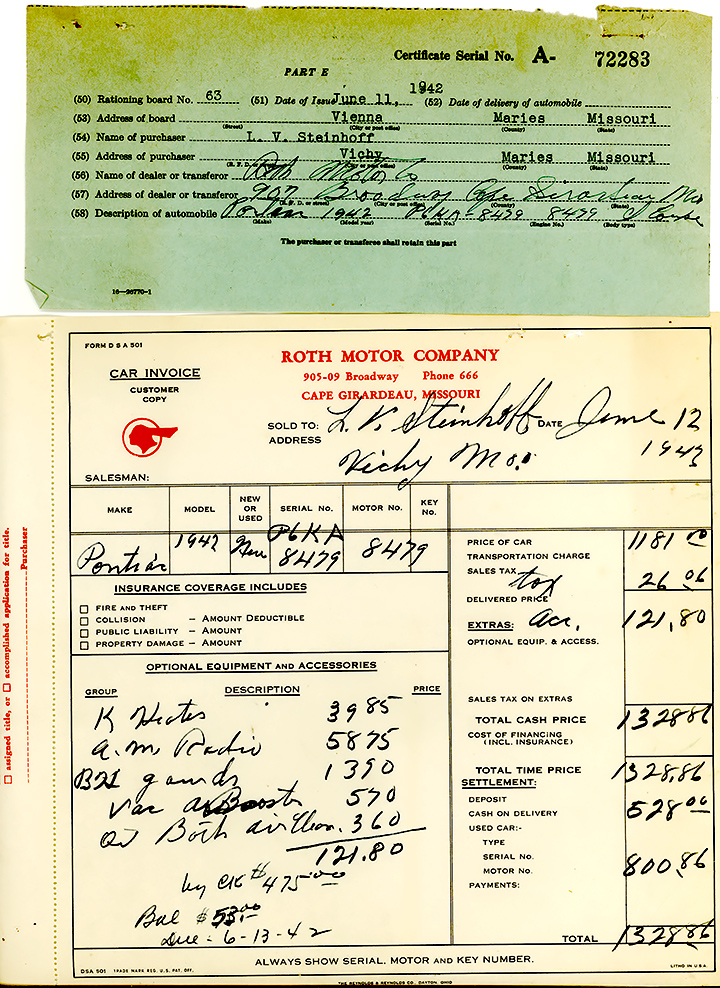
I almost let Dad’s April 17 birthday slip by. While poking around, I found where he had bought a 1942 Pontiac for $1,328.86.
What was particularly interesting to me was that he had to get permission from the rationing board to buy the vehicle. (World War II, remember?)
Because of his job, he had better access to gas, tires, etc., than most folks at the time. Mother’s parents ran a restaurant in Advance, so they, likewise, had access to sugar, meat and other rationed items that were sometimes in short supply.
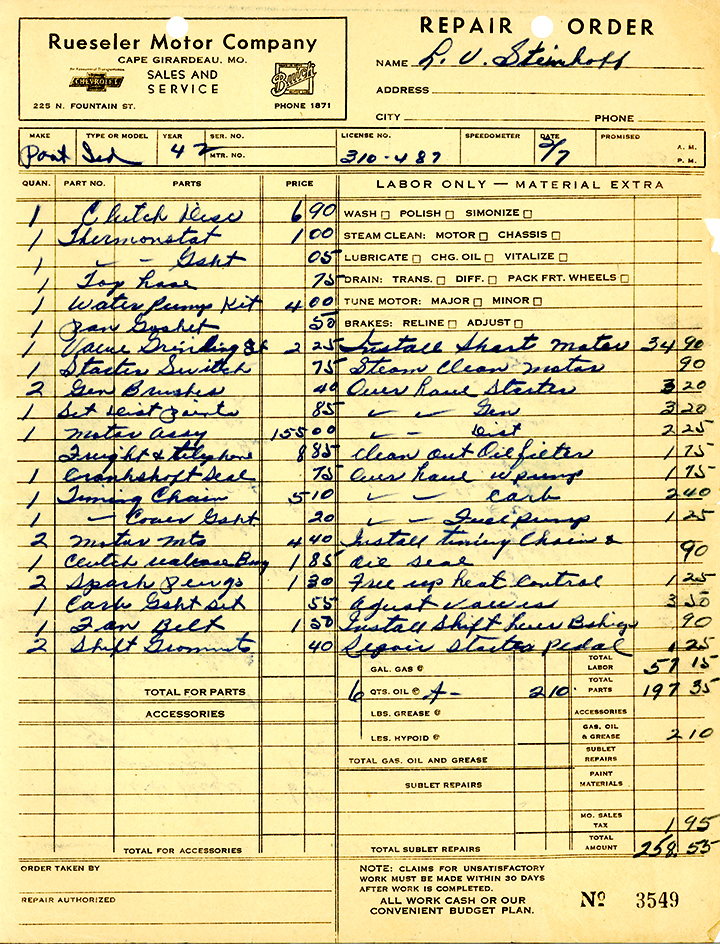
$258.55 for parts and labor
This was filed with the original purchase. I don’t know if this work was done as a condition of sale or if it was done later.
Dad was exempt from the draft
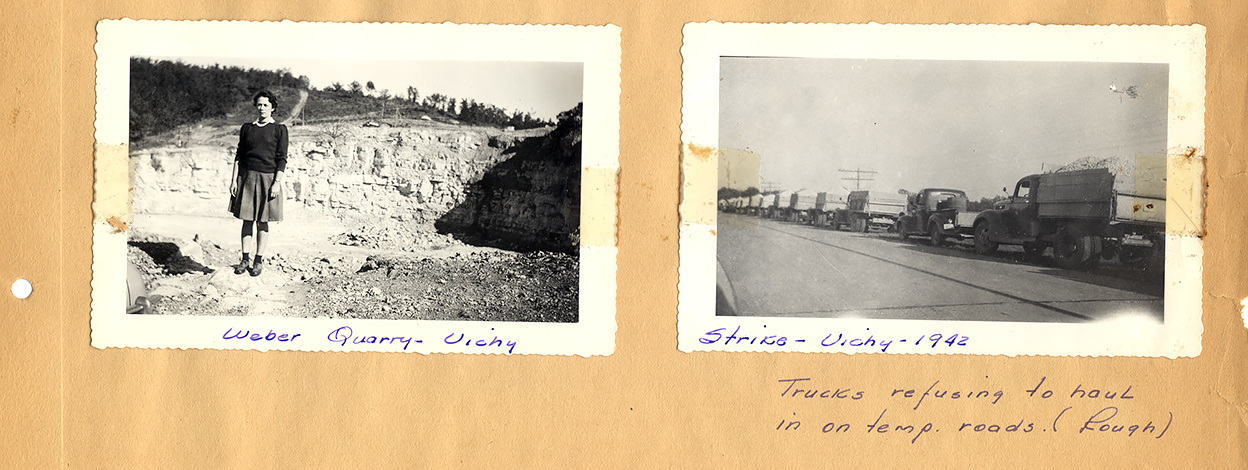
LV Steinhoff Vichy project 1942
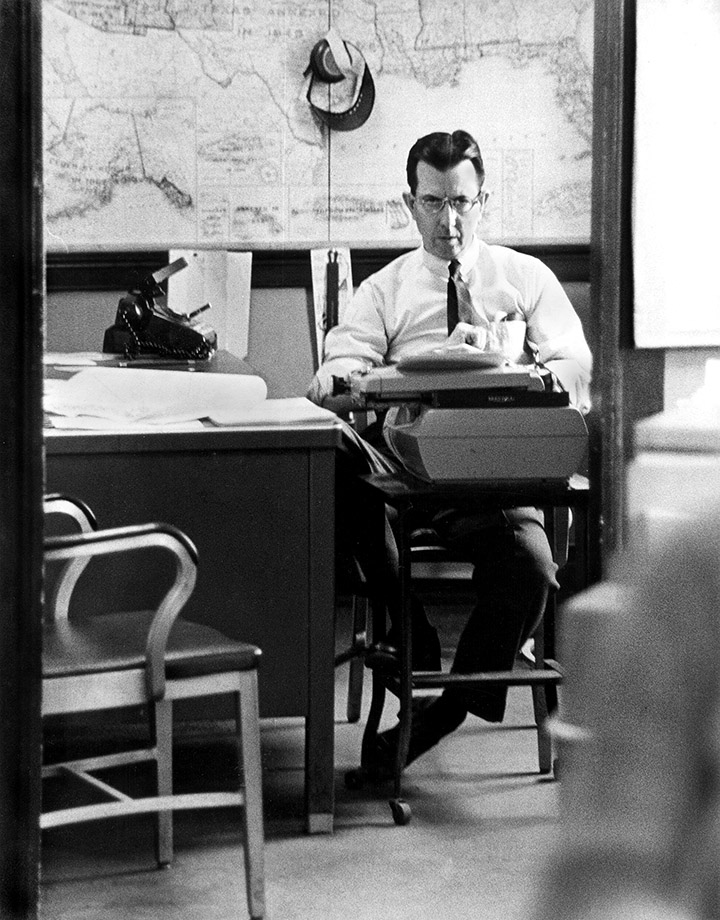
He spent the war years working for Markham & Brown building airfields and other war-related construction projects.
Mother went with him, which caused one memorable event.
A truck driver thought it would be funny to scare this strange woman by driving head-long toward her, not realizing that the woman was the boss’s wife.
Mother was not amused, nor was Dad. His “fun” cost him his job – and maybe his draft deferment.
When she was in the Lutheran Home, she regaled her grandkids with stories of all kinds of shenanigans, including the time when she swiped a dump truck because she wanted to go into town.
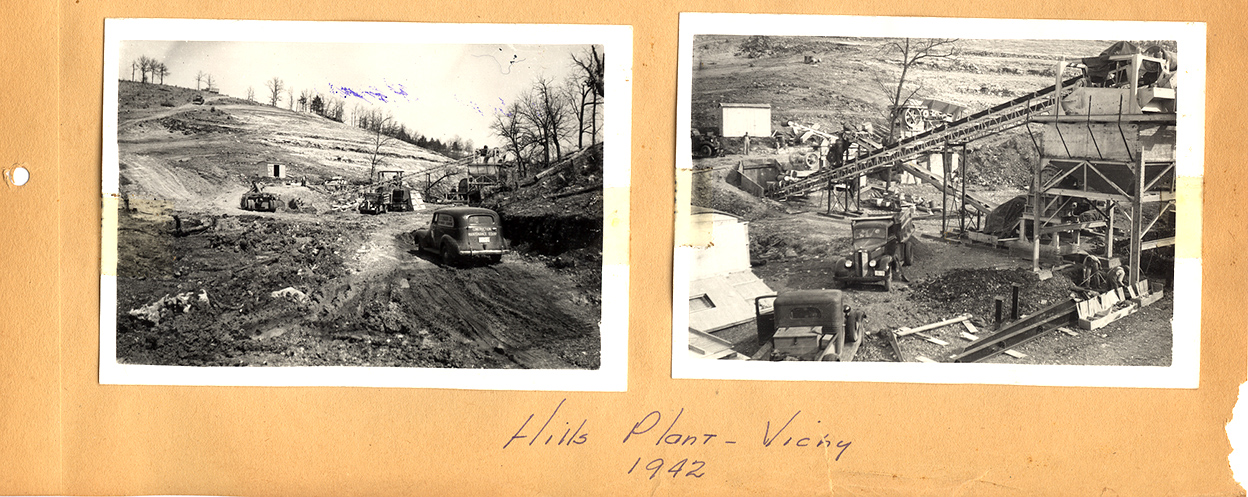
Hills Plant – Vichy
LV Steinhoff Vichy project 1942
It took lots of materials to build airfields and the like. One of Dad’s jobs was to keep the rock flowing from quarries like this one in Vichy, Mo.
I may have to drive around to see if any of his construction projects are still around.
I’ve written hundreds of obituaries over the years, most of them at The Southeast Missourian when I was fresh out of high school. I can’t improve on this note from Shari’s niece, Tara Cissell Marvin:
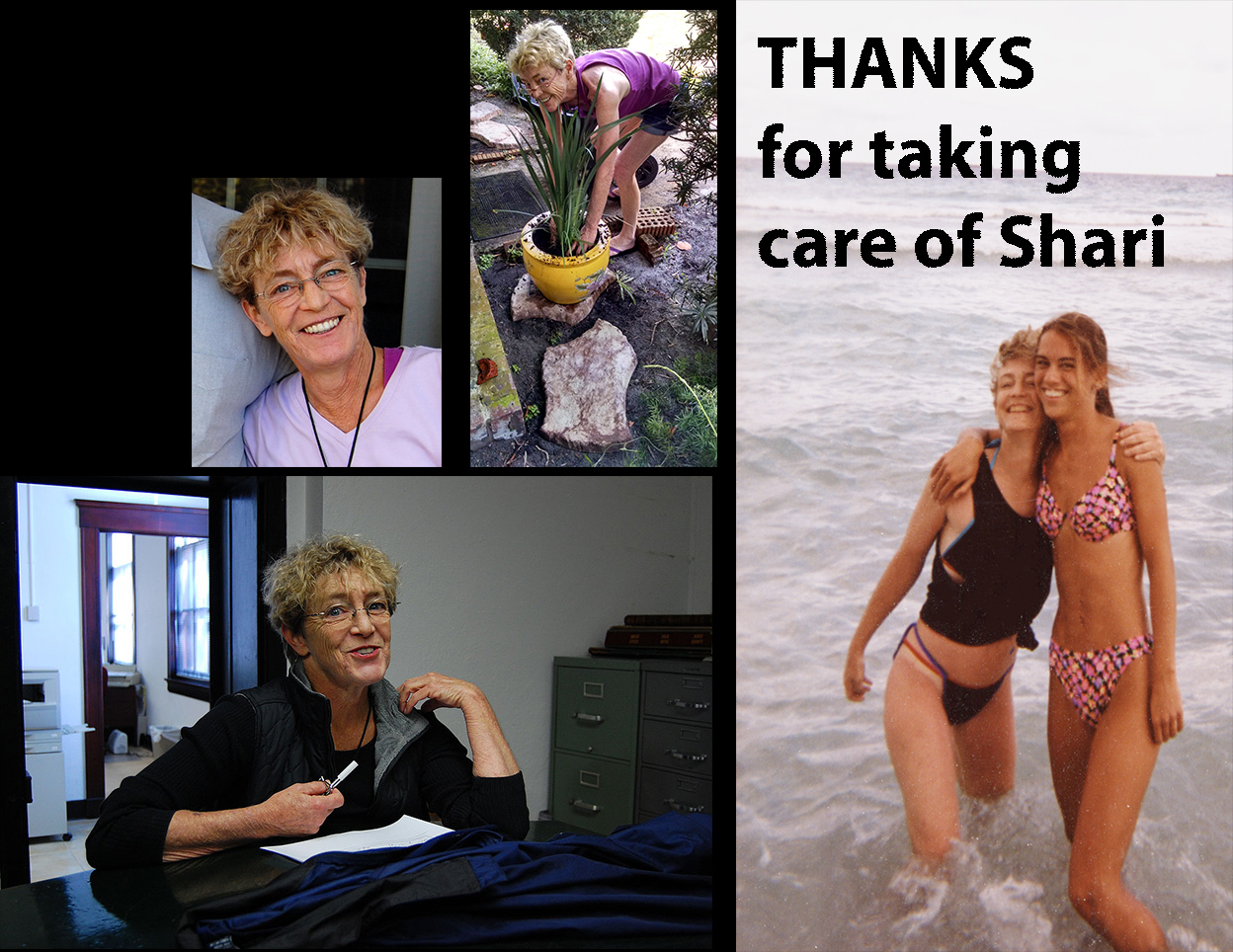
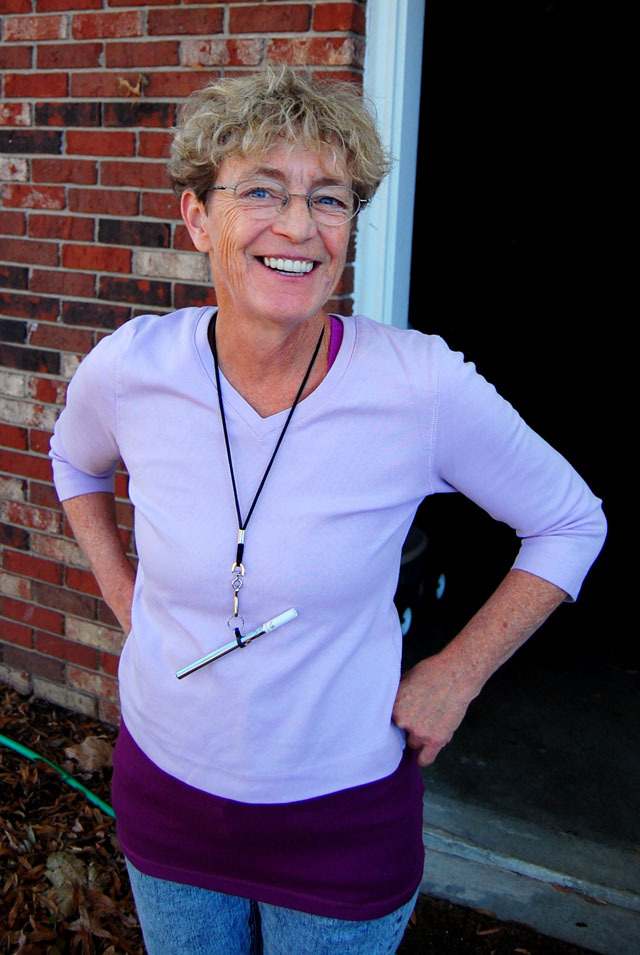
Shari Stiver, a fiercely independent and brilliantly overeducated soul, passed away on February 11th, at the age of 77. Shari possessed an insatiable curiosity, a sharp mind, and a green thumb that could coax life from even the most stubborn soil.
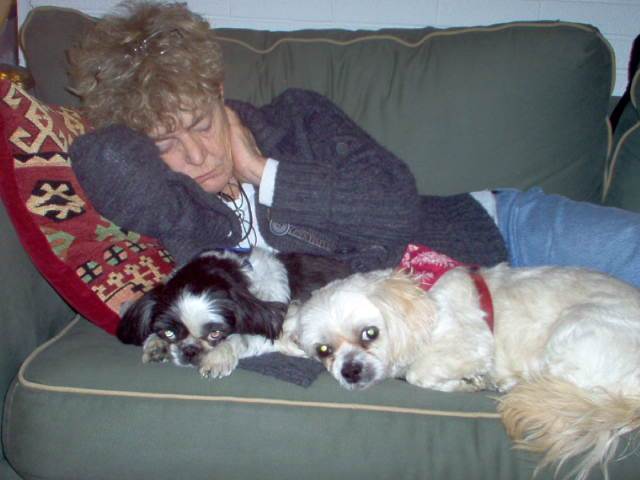
Known for a wit as dry as the prairie wind and a temperament best described as “selectively social,” Shari preferred the quiet company of cats, books, plants, and perhaps a handful of tolerable humans. Those who managed to earn a place in Shari’s world knew a person of deep thought, unwavering principles, and a begrudging but genuine loyalty.
Though not one for grand gestures or idle chit-chat, Shari found solace in the rhythm of the garden, the pursuit of knowledge, and the quiet company of her beloved cats. In true fashion, Shari leaves behind a meticulously cultivated garden, an extensive library, her furry friends, and a legacy of quiet resilience.
Sage advice from Editor John Blue
Southeast Missourian c 1965
As the “kid” in the newsroom, I got a lot of the routine assignments, particularly obits. In the days before the internet, email and even fax machines, almost all obits were taken over the phone. If someone held up the phone, grinned, and hollered, “It’s for you,” it had to be a call from our Charleston stringer. She was old enough to have been there for the signing of the Declaration of Independence, was deaf as a stump, and had badly-fitting false teeth that made her dictation full of clicks and garbles.
Editor John Blue must have noticed my frustration, so he called me aside and said, “The obituary is one of the most important stories you’ll ever write. It’s likely to be the last time the person’s name is in print. Every word will be analyzed and scrutinized by those who knew him or or for their entire life. It’s going to be mailed to friends and relatives all over the world, and it’ll be pressed between the pages of family Bibles.”
Unspoken was, “Don’t blow it off, and don’t screw it up.”
Mr. Blue also made it a point of emphasizing that our job was to report the news, not be a part of it. I’m going to bend his rule a bit to share some of my memories of the classmate who was my first girlfriend, first kiss and first disastrous (to me, at least) breakup.
A little history
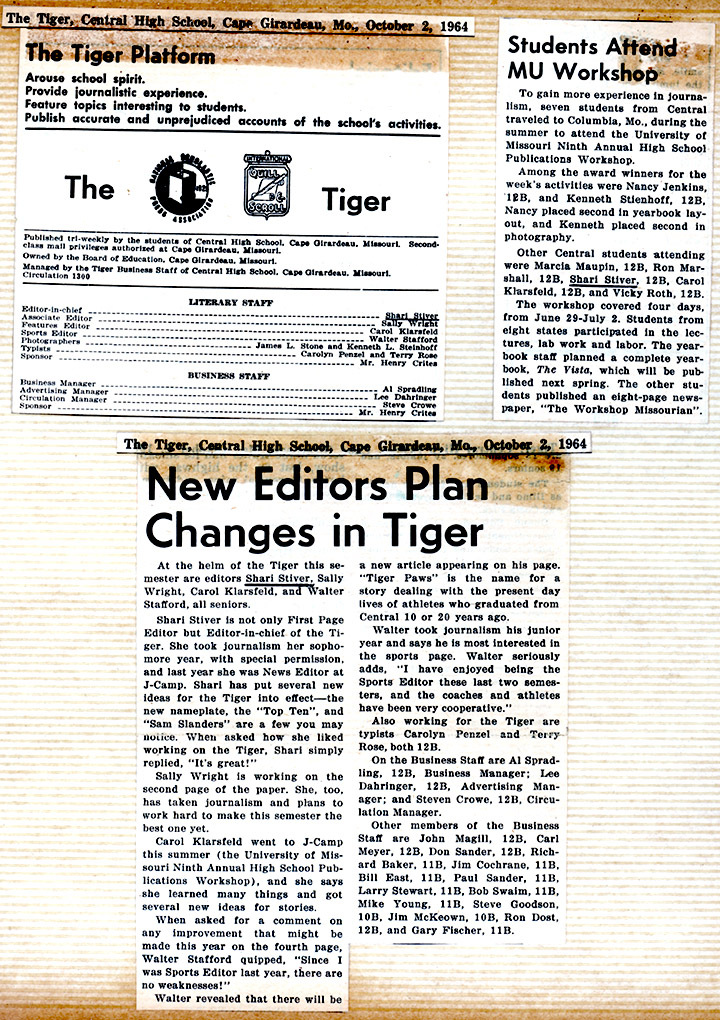
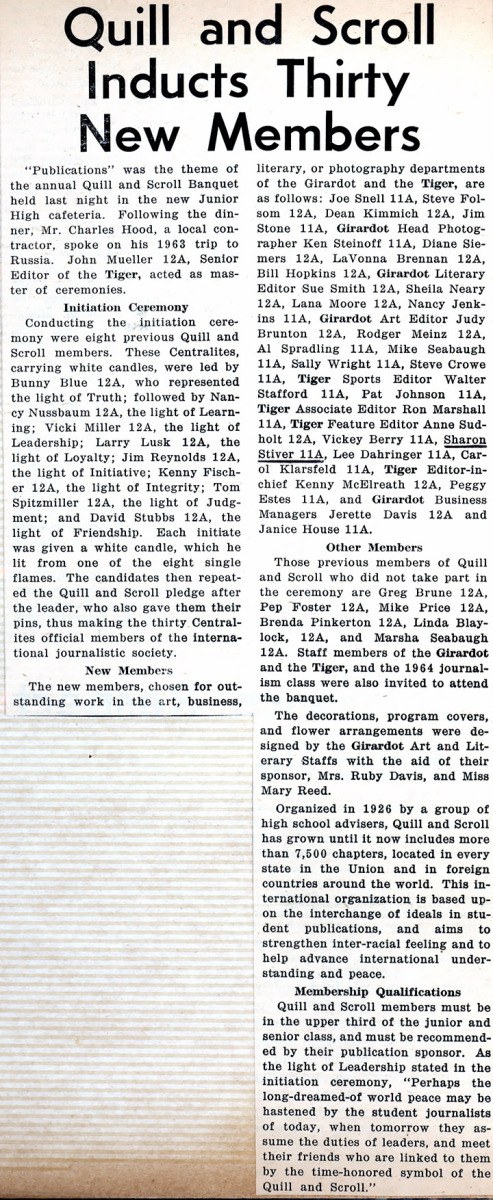
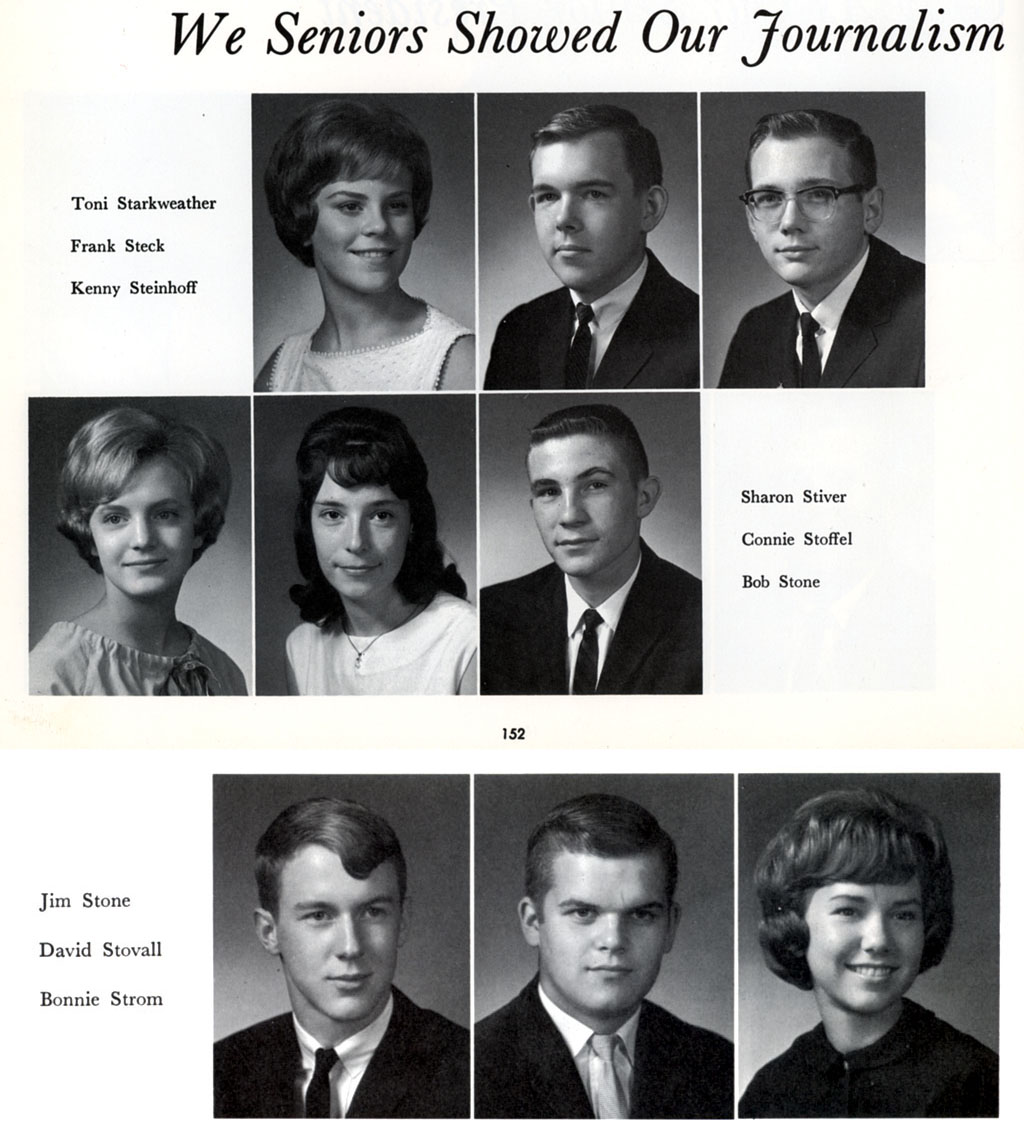
Sharon Lee Stiver was born April 4, 1948, in San Diego, Ca., the daughter of Capt. and Mrs. Charles Ellwood Stiver. Mr. Stiver was a navy aviator. Shari attended schools in Cape Girardeau, graduating 4th in the Central High School Class of 1965. She received her undergraduate degree from the University of Michigan, and her PhD from Washington University in St. Louis.
Shari was a child psychologist for 13 years working in the juvenile justice and substance abuse areas. After that, she became a contractor specializing in building restoration. (More about that later).
Shari and Dad tried to save me from Algebra
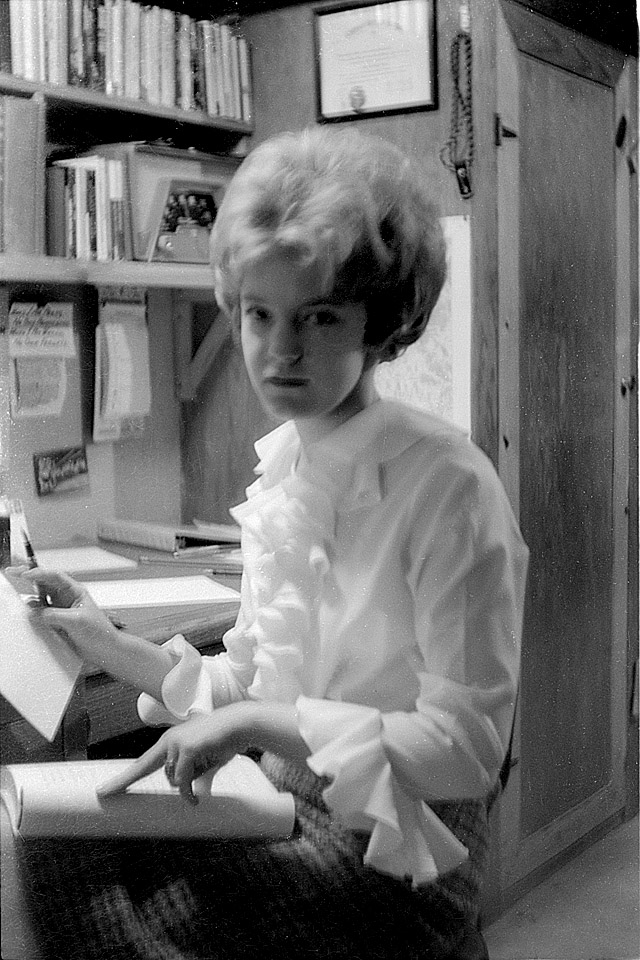
Shari Stiver in Steinhoff basement
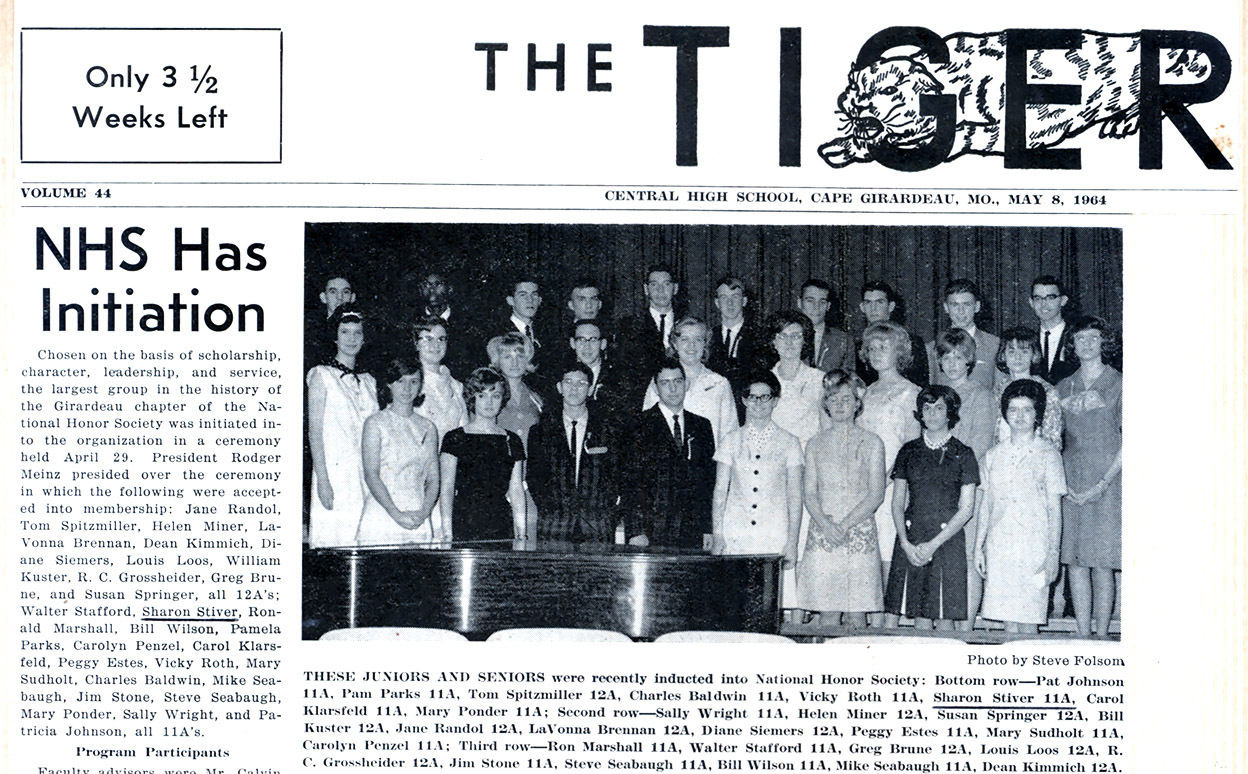
I was an OK enough student to make National Honor Society, but Shari ranked 4th in our class and was in the top 10%. I was one of the 90% that the top 10% stood atop.
Here she is in my basement office trying to explain that, yes, you CAN multiply letters. I sort of understood the concepts, I just wasn’t a big fan of homework.
When you spend K-8 in a Lutheran parochial school with the same two dozen kids, your social skills are somewhat challenged. I mean, the girls in your class might as well have been sisters.
High school was a brave and scary new world. I have some cringe-worthy notes from Shari’s friends trying to match us up. Even more embarrassing are letters she wrote to friends describing our early dating rituals.
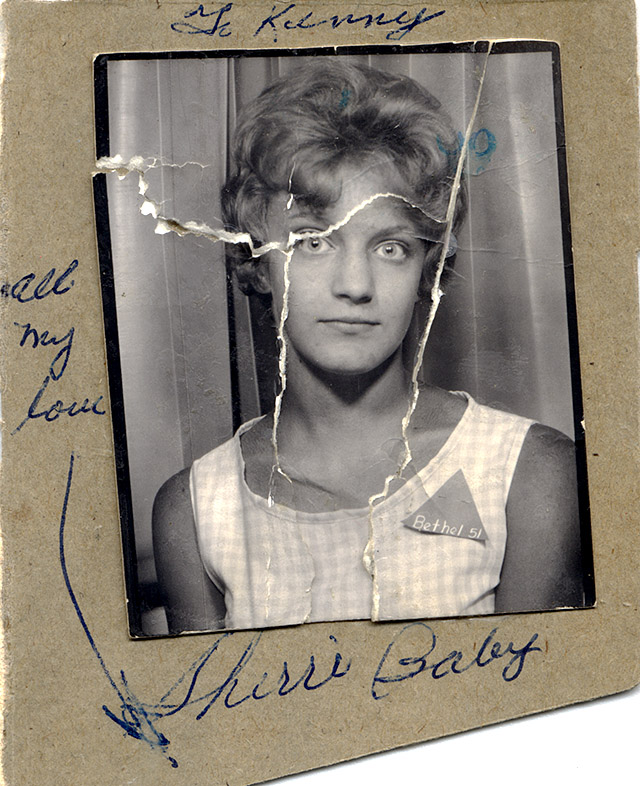
She and I could never figure out who sent this photo to me. It wasn’t her, because her name was spelled wrong. She’s wearing a Job’s Daughters Bethel 51 tag, so it must have been someone at camp with her.
We connected while working together doing political polling our freshman summer. I finally got up enough nerve to ask her to go to the Rialto for a movie, then she asked me to a dance.
I explained to her that I didn’t know how to dance, and demonstrated that, something that insured it never happened again.
One smart cookie
I was picking stuff up off the floor from “Shari’s room” so I could send my Roomba off in search of errant dust bunnies when I ran across a brown shopping bag that she had left under a chair. I remembered looking inside and seeing that it held a scrapbook with lots of newspaper clippings in it, but I didn’t spend any time on it.
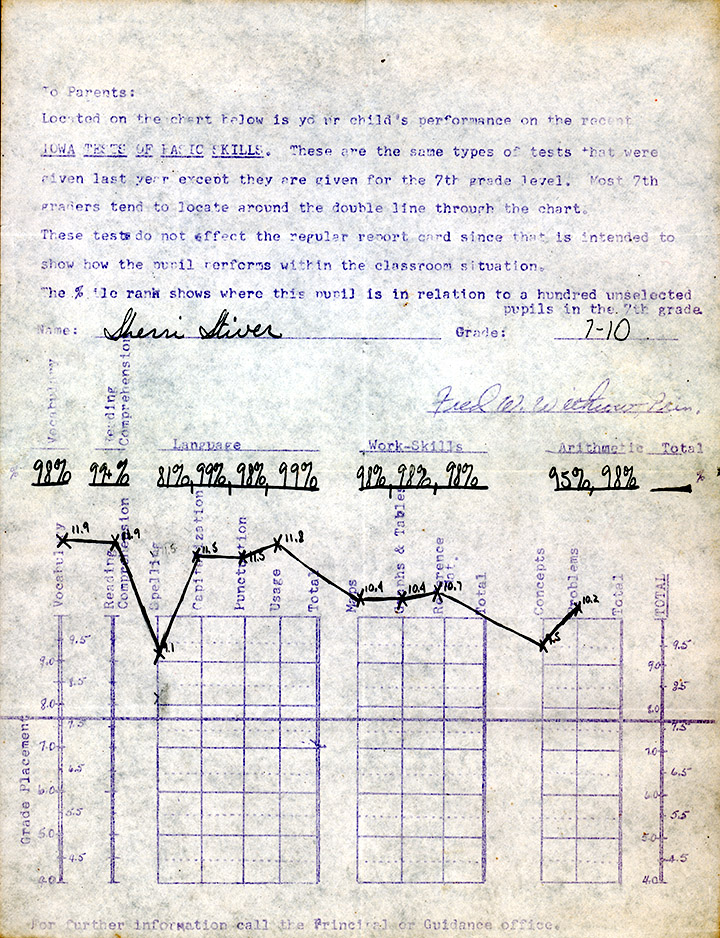
I finally gave it a good perusal and saw that it had the results of her 7th grade Iowa Test of Basic Skills. Not surprisingly, she was in the high 90 percentiles in almost every category.
Even her lowest category – spelling – was 81%. What I found interesting was that she scored a “mere” 95% in Arithmetic Concepts. Maybe that’s why my algebra scores were mediocre since I counted on her to tutor me.
Detailed answer and precise handwriting
I’m not exactly sure what she was hoping to discover, but I like her summary: (“The answer is not completely exact. It’s about as far off as the inaccuracy in measuring the radius (the cow’s mouth will be more than 75′ from the building even if his neck isn’t!”)
The only nit I will pick is her reference to “his neck.” We had a pasture behind the house where the Hale cows grazed. Cows were females, and bulls were males, so she appears to have made a gender error in her qualifier.
She scored lots of ink
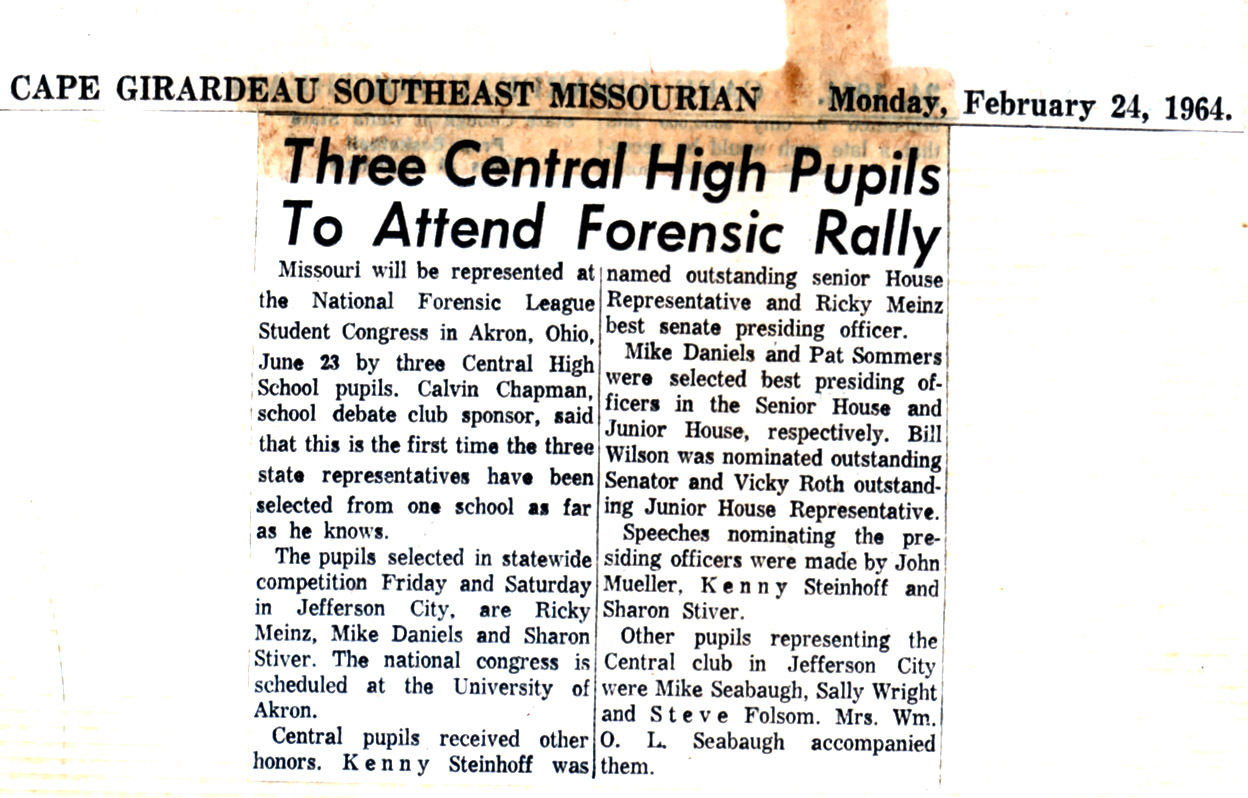
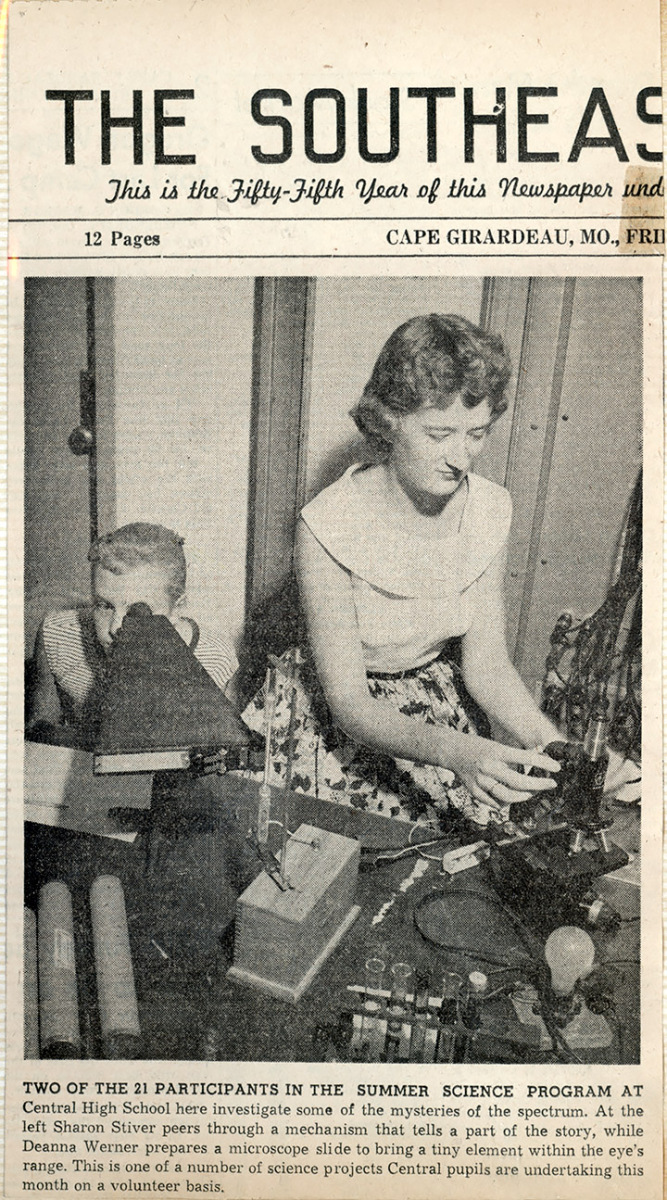
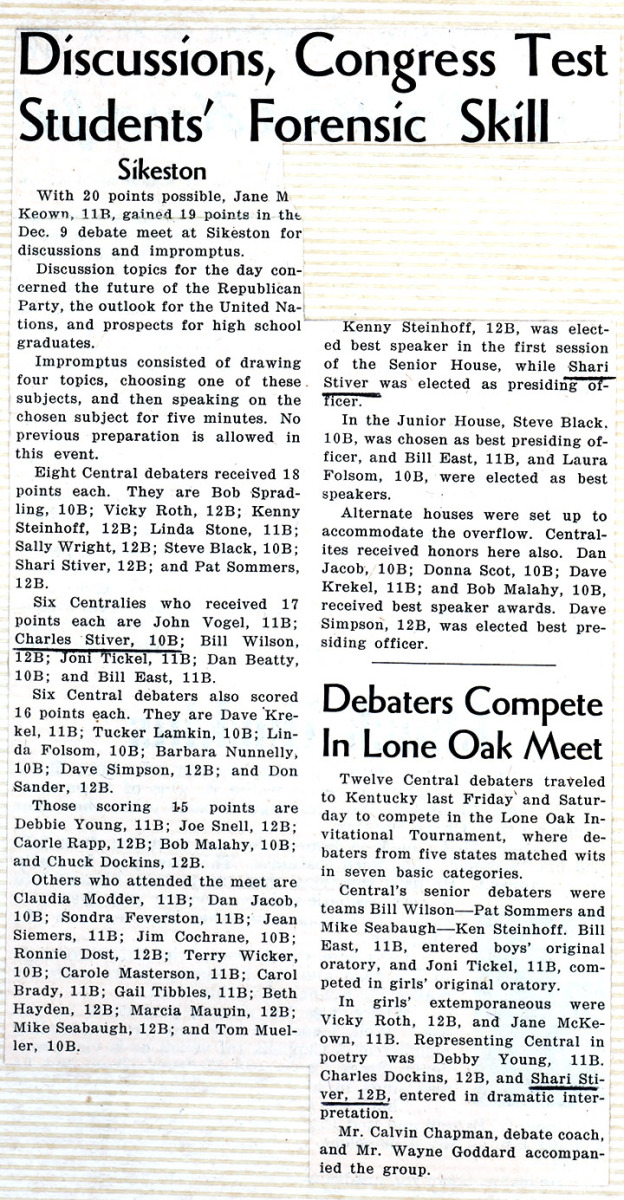
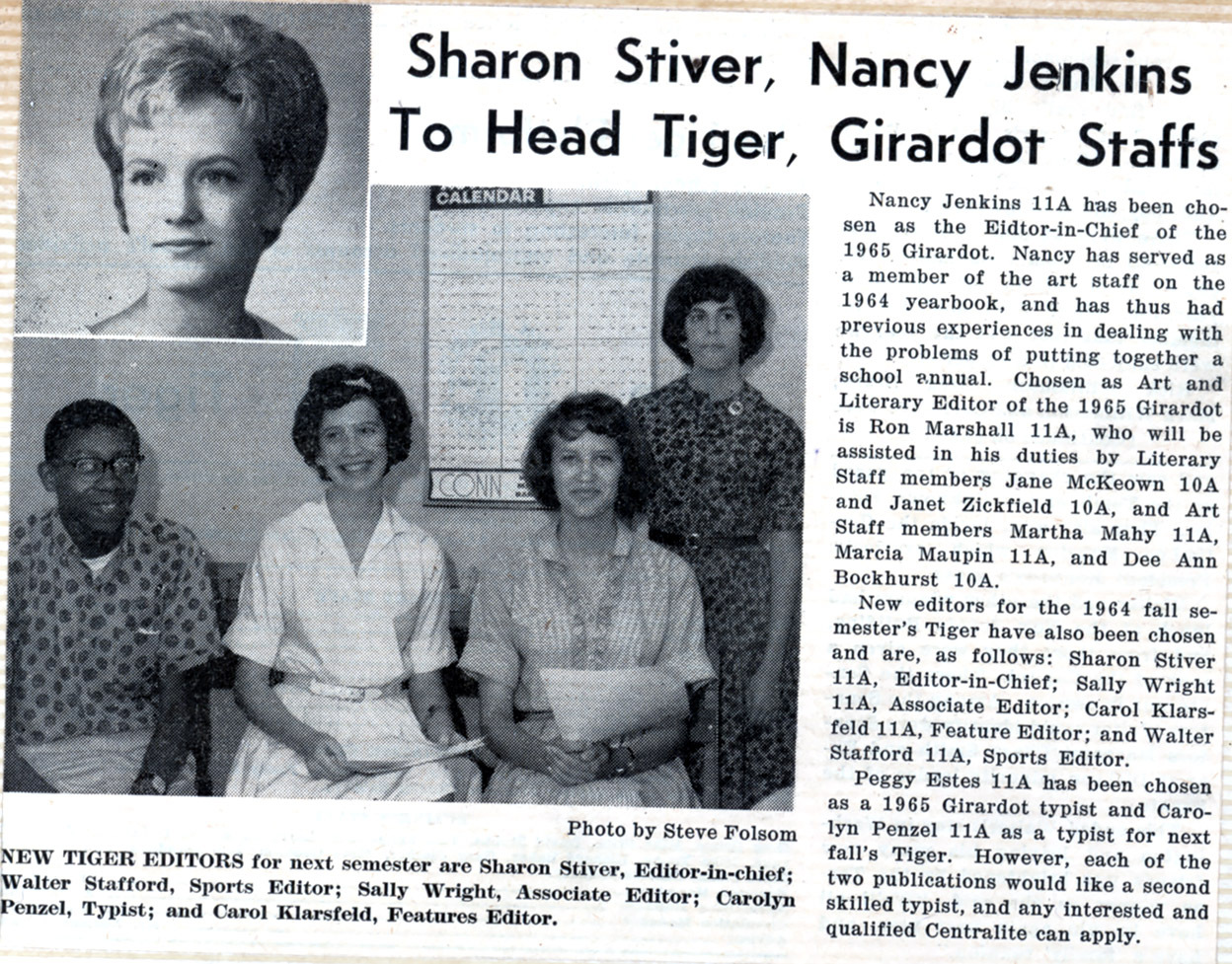
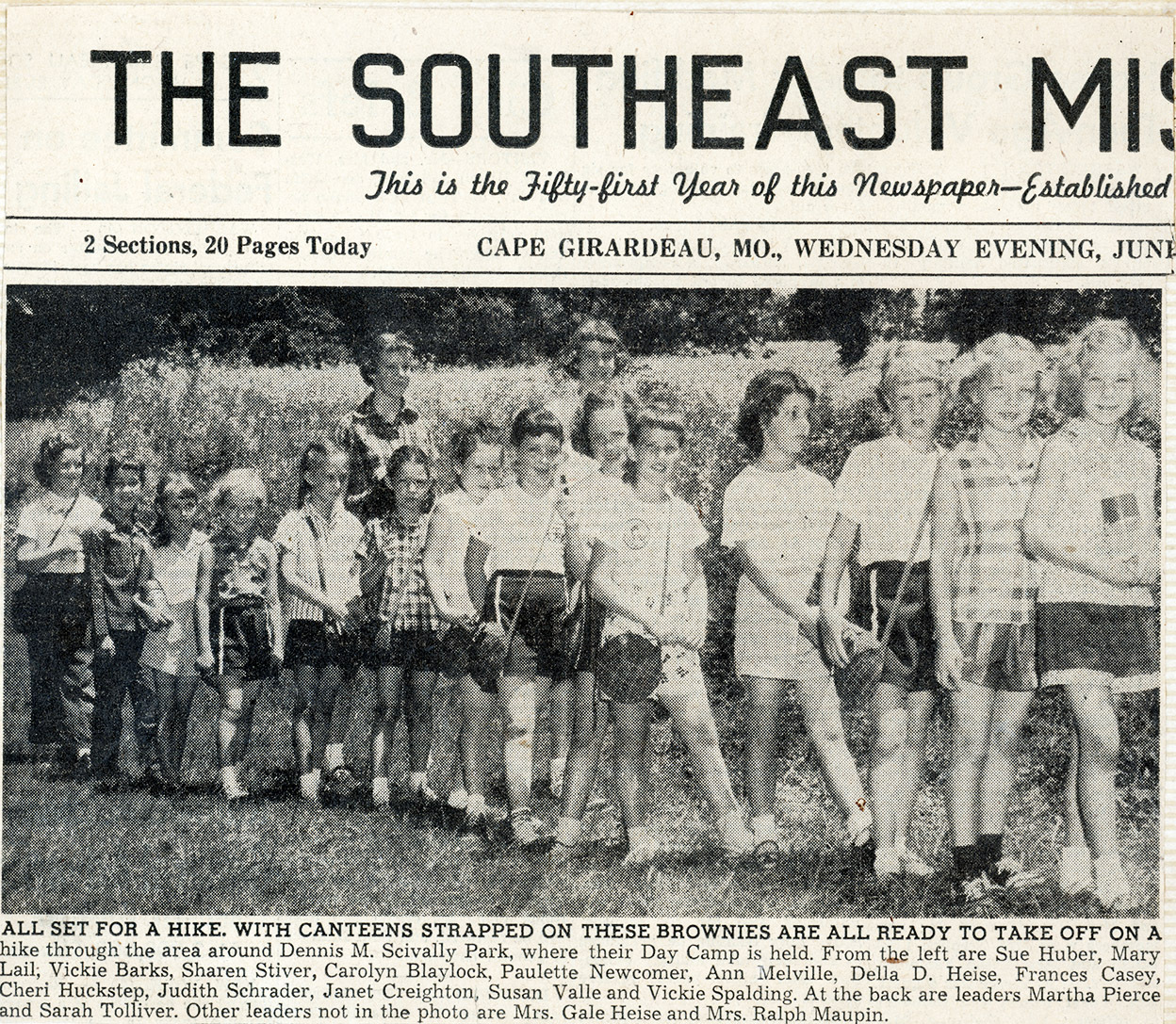
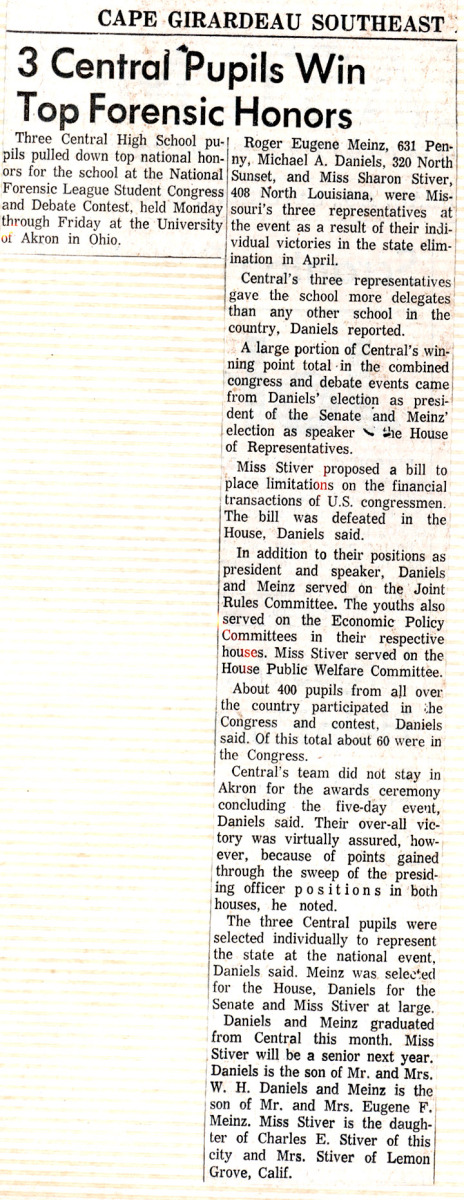
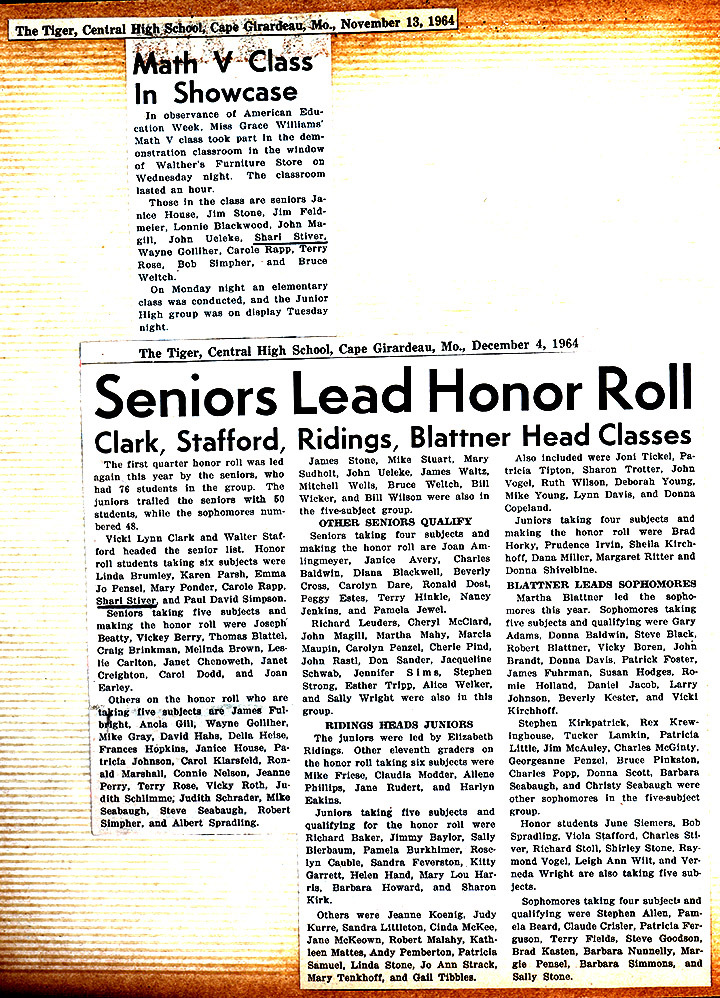
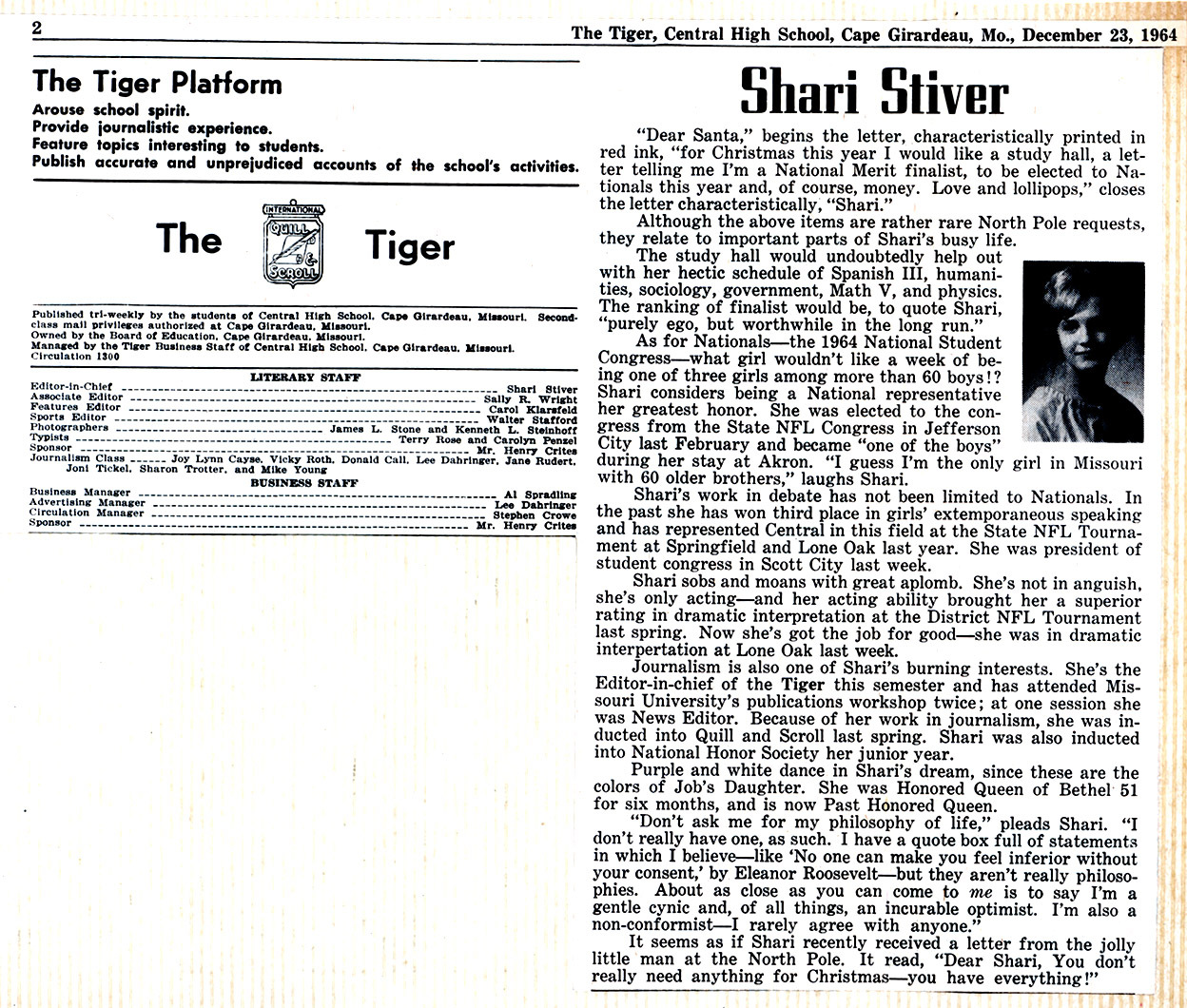
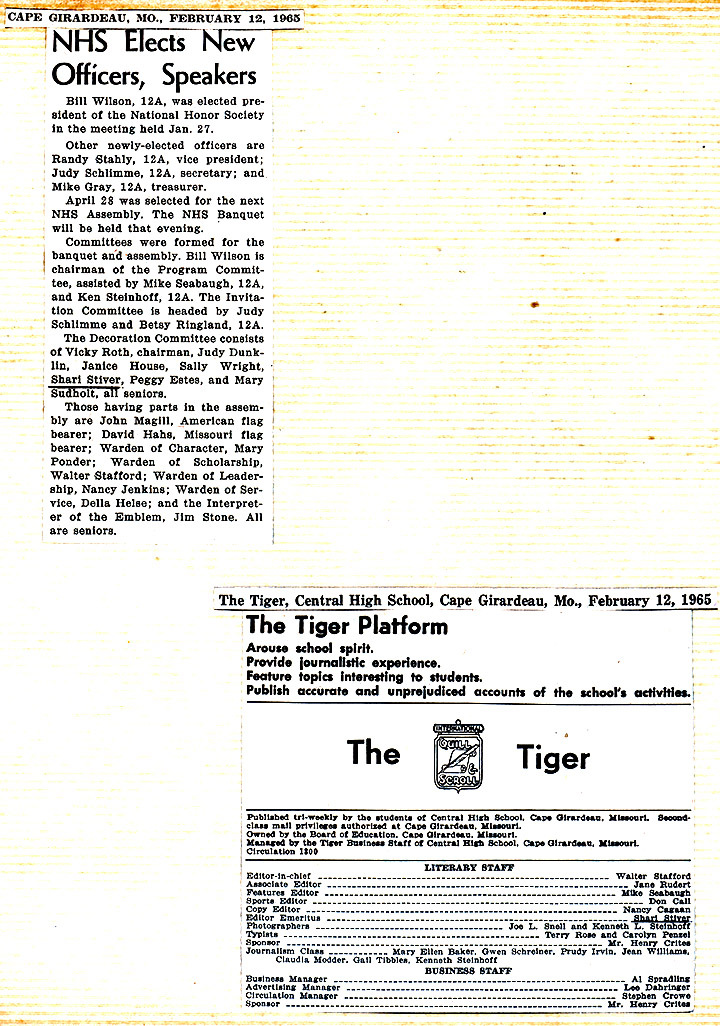
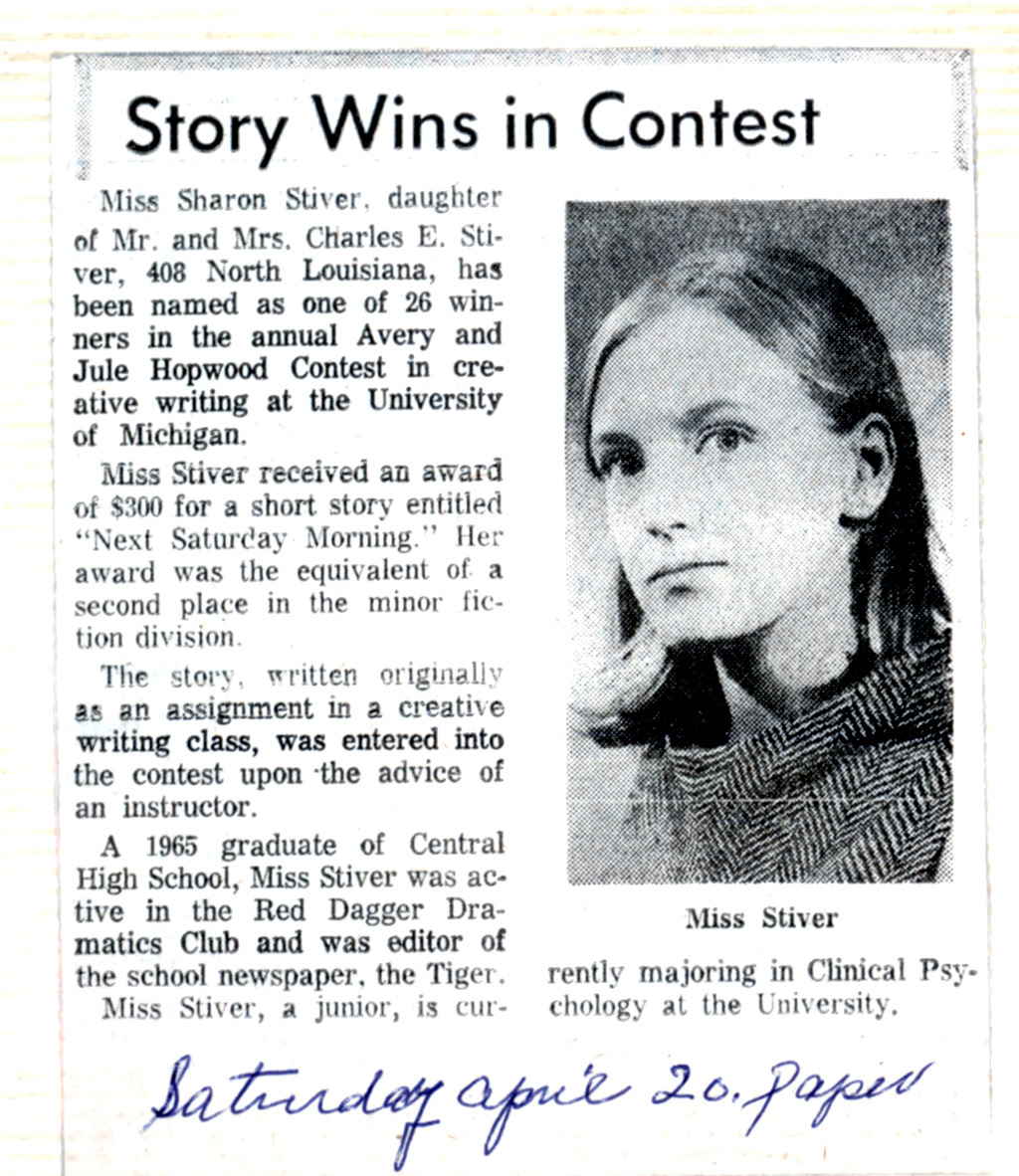
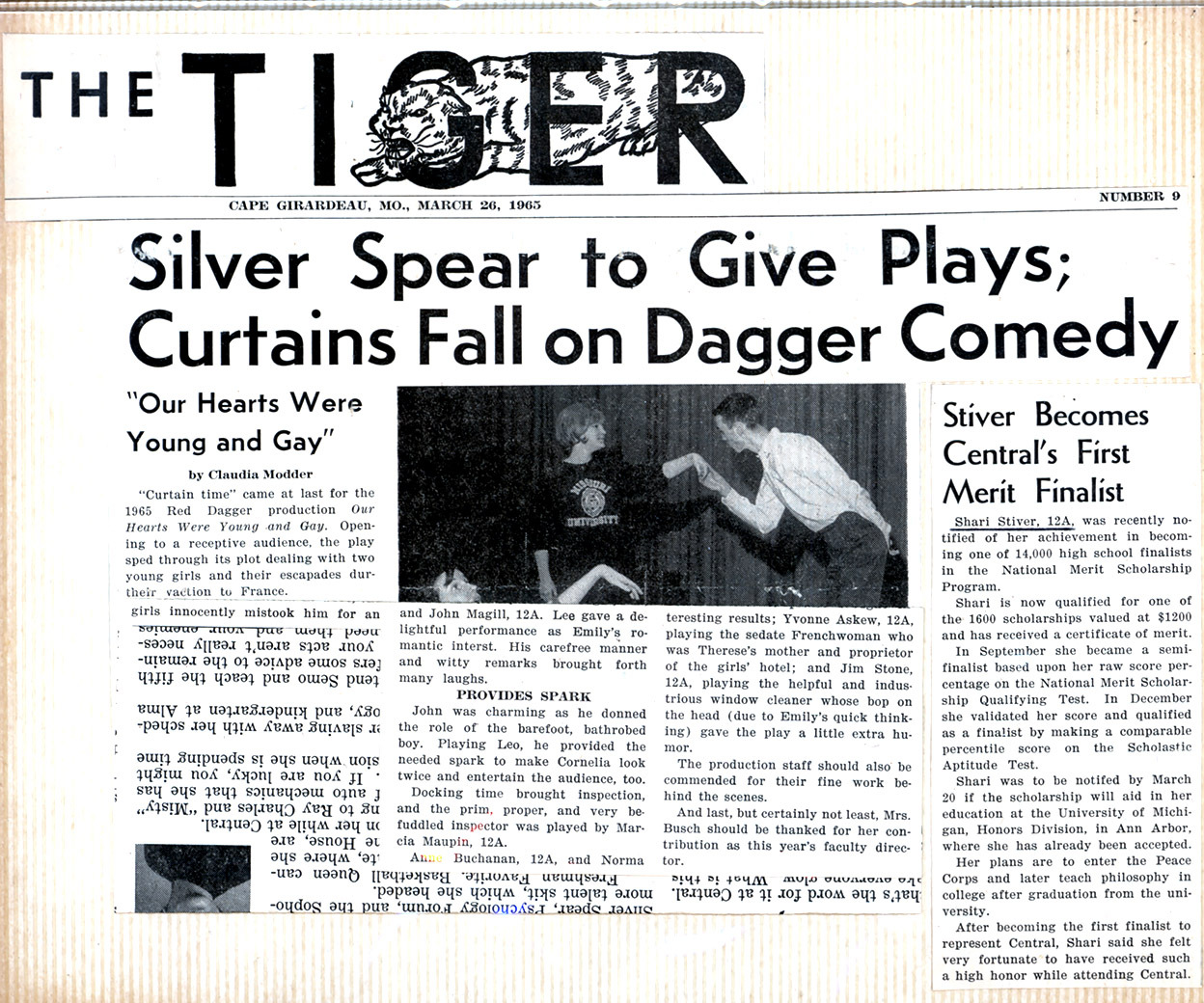
Here’s a gallery of some of the news stories that were in the scrapbook. Most came from The Southeast Missourian or the Tiger, the high school paper.
Click on any image to make it larger, then use the arrow keys to scroll through the gallery.
It ain’t gonna happen
When I asked Shari’s friends and relatives to help me understand who she was, I paraphrased Winston Churchill’s description of Russia, “a riddle wrapped in a mystery inside an enigma.”
Several said, “You should have known her better than anyone. You go back so far.”
I explained that we were in a common orbit of debate and classes our freshman year, but only dated from our freshman summer to New Year’s Eve of that year, then didn’t speak until Jim Stone and I reconnected with her in 2010.
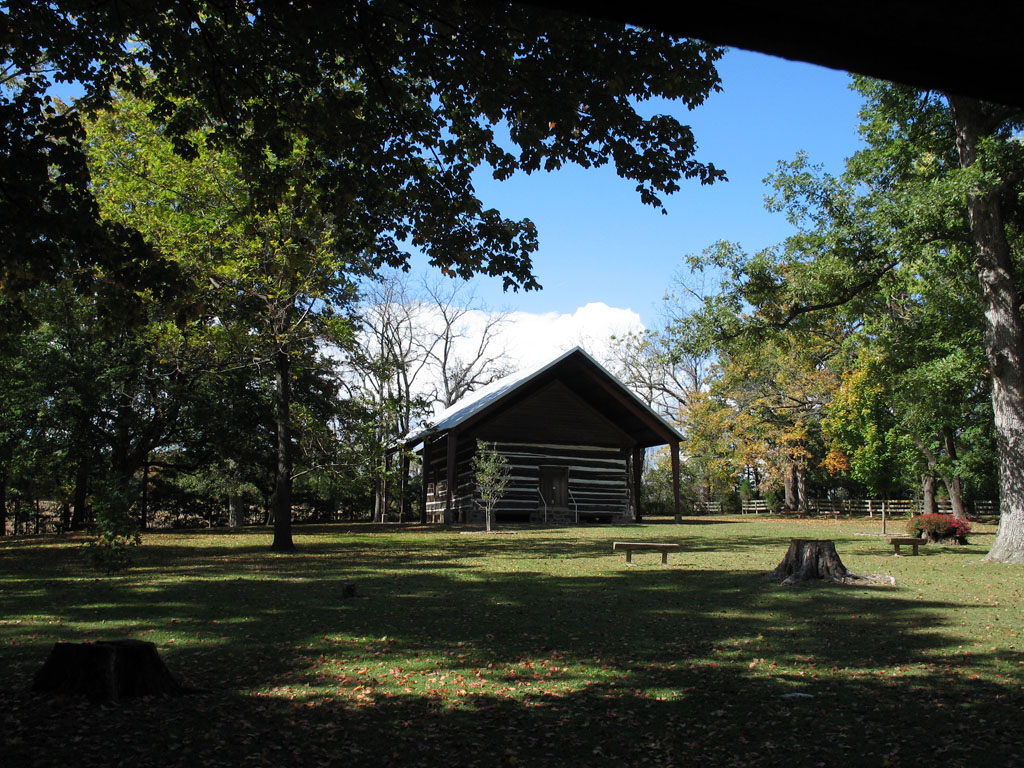
We DID have one strange date after our breakup. I asked if she’d like to ride out to Old McKendree Chapel on a rented bicycle built for two for a picnic. How I came up with that idea, I don’t know. I had logged lots of bike miles on my hilly paper route, but I don’t recall her ever mention two-wheel experience.
I don’t remember any details of our ride. I know it had to have involved hills and several stretches of gravel road.
We made it to the chapel grounds successfully and spread out our picnic lunch. We hadn’t been there long when the church caretaker ambled up and said, disapprovingly, “This is sacred church ground, any public display of affections would be inappropriate.”
Shari looked me in the eye, then turned to the caretaker and said, deliberately, “Don’t worry, that ain’t gonna happen.”
That brings to mind a special edition The Palm Beach Post did on Cuban and Haitian refugees: “Crests of Hope, Troughs of Despair.”
Shari and drama
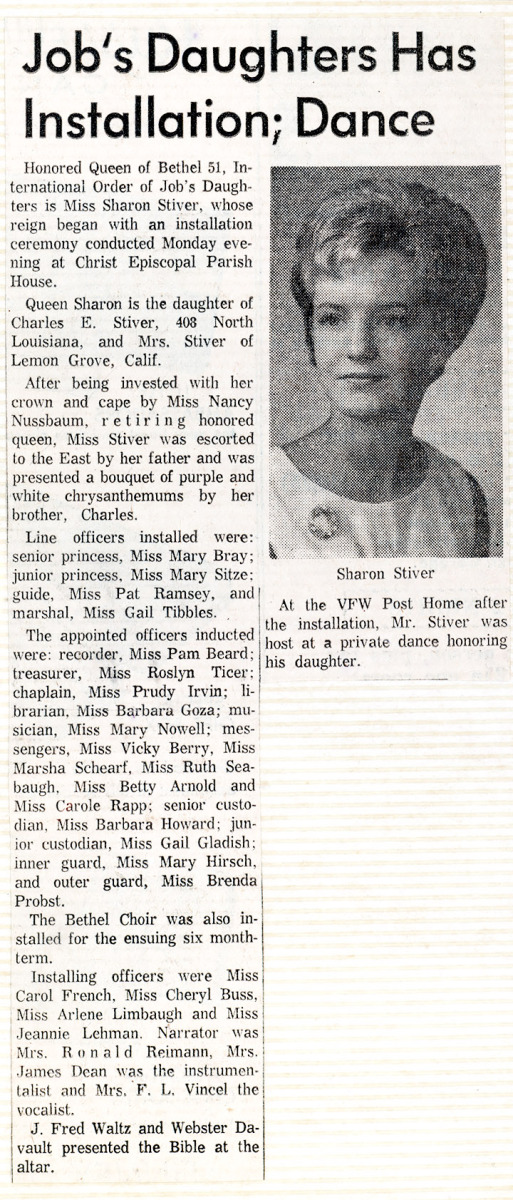
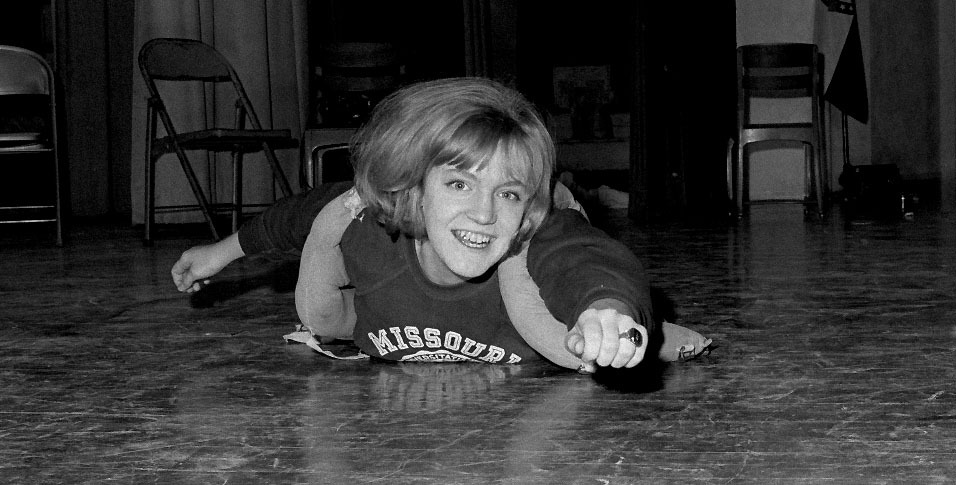
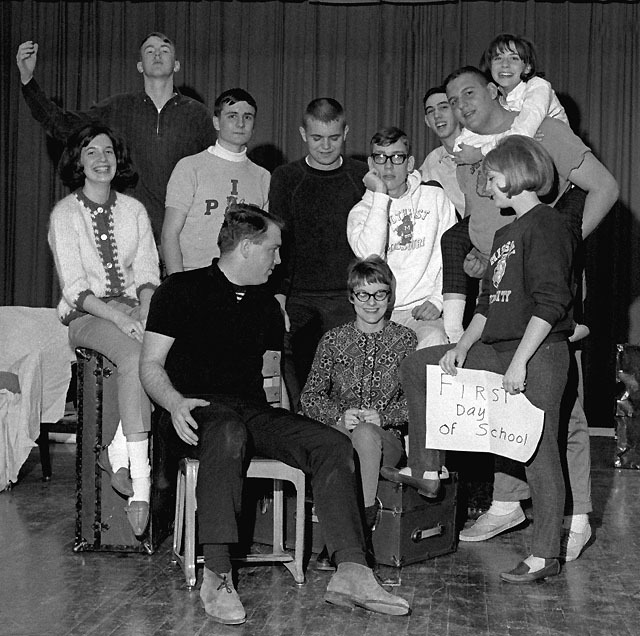
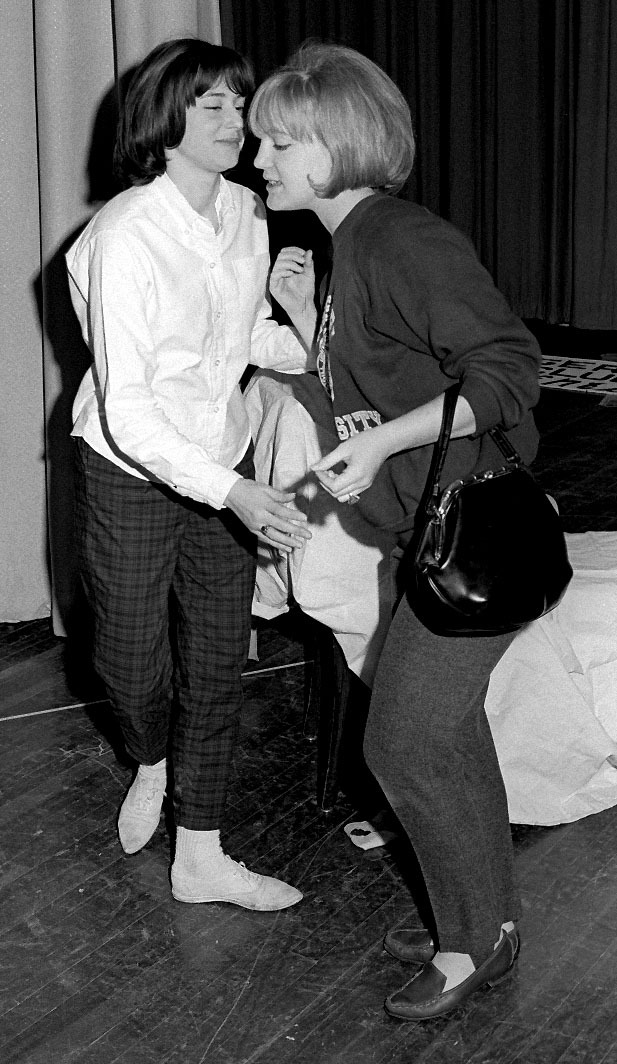
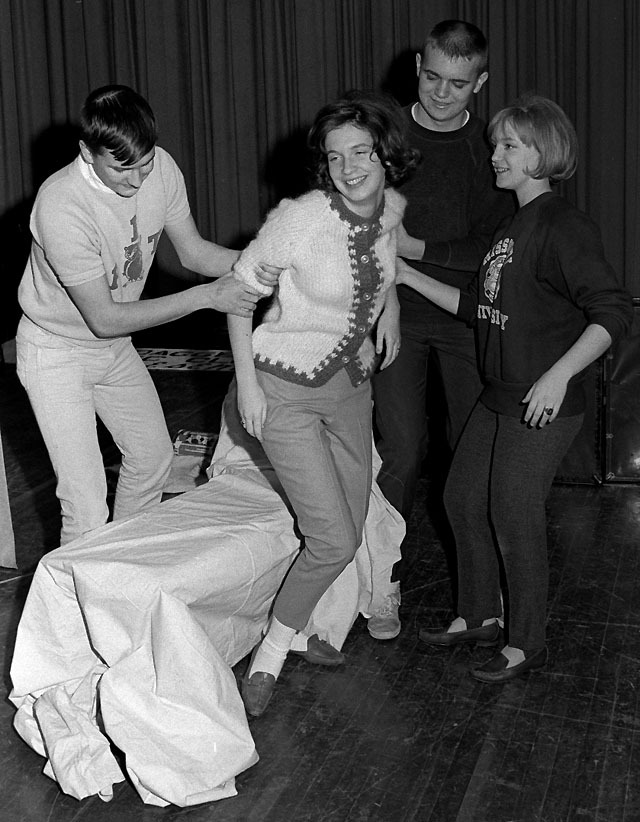
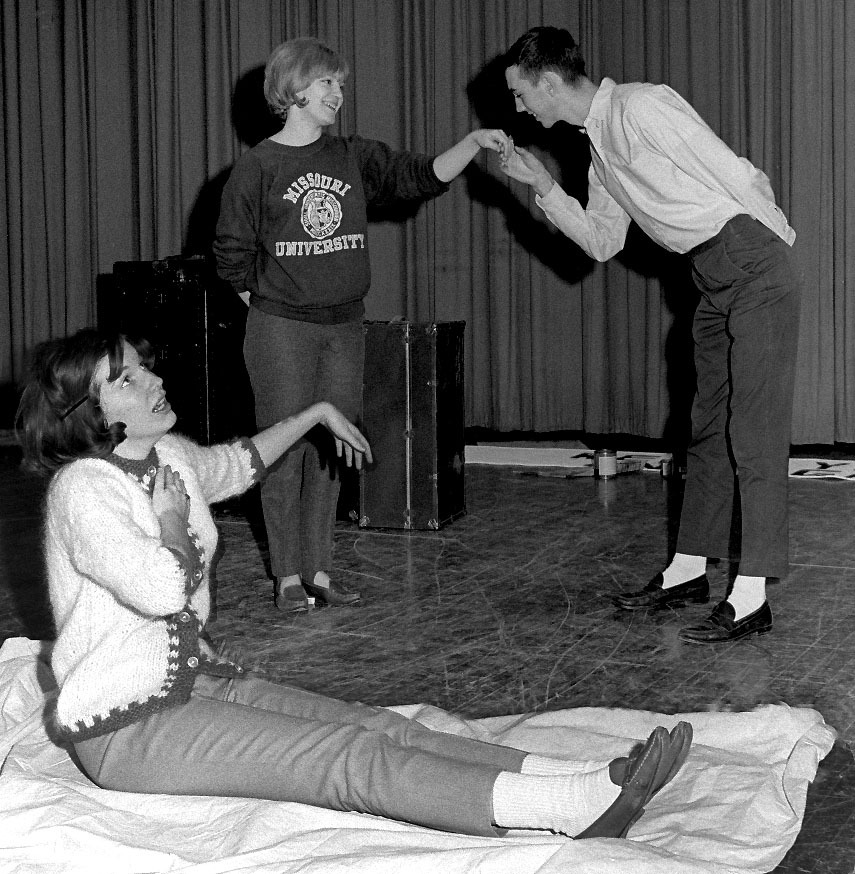
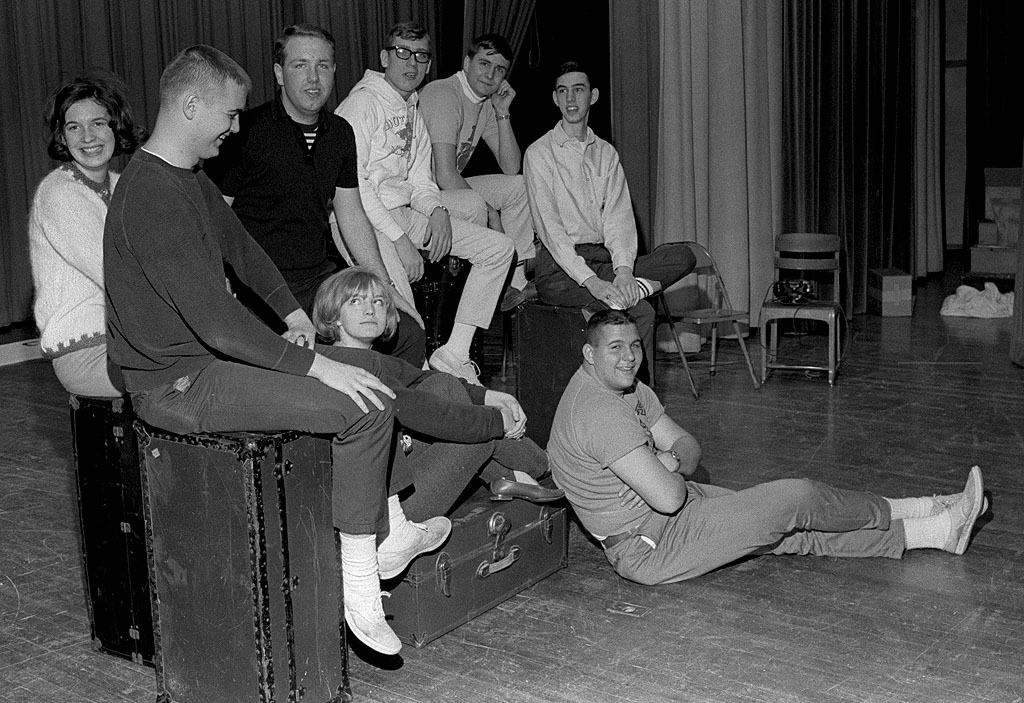
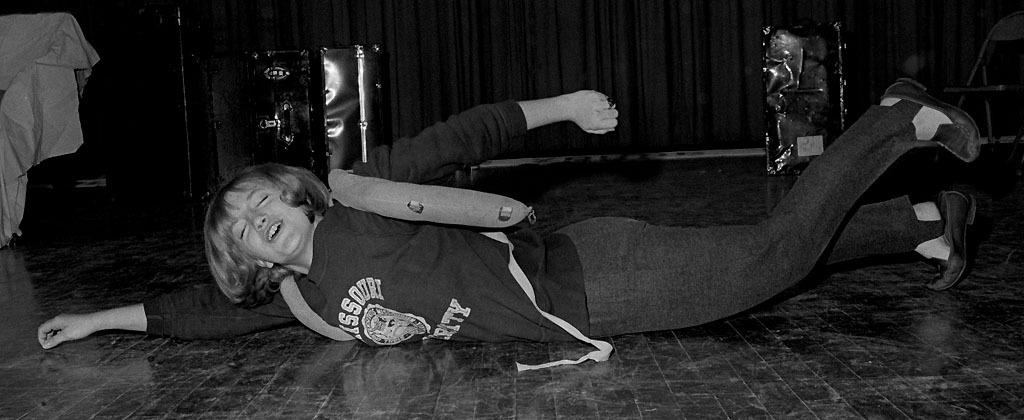
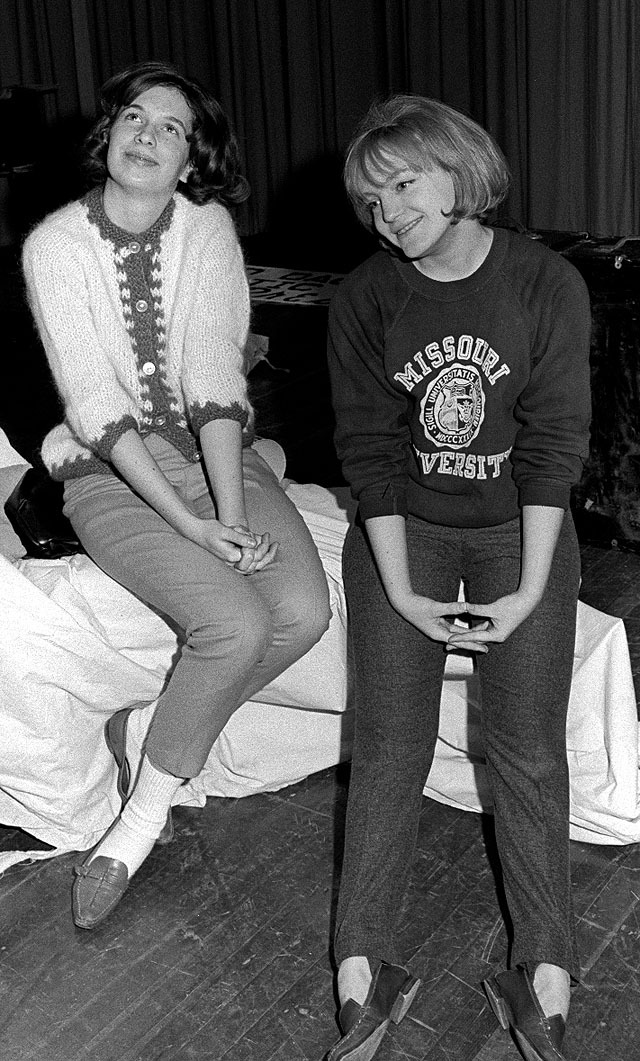
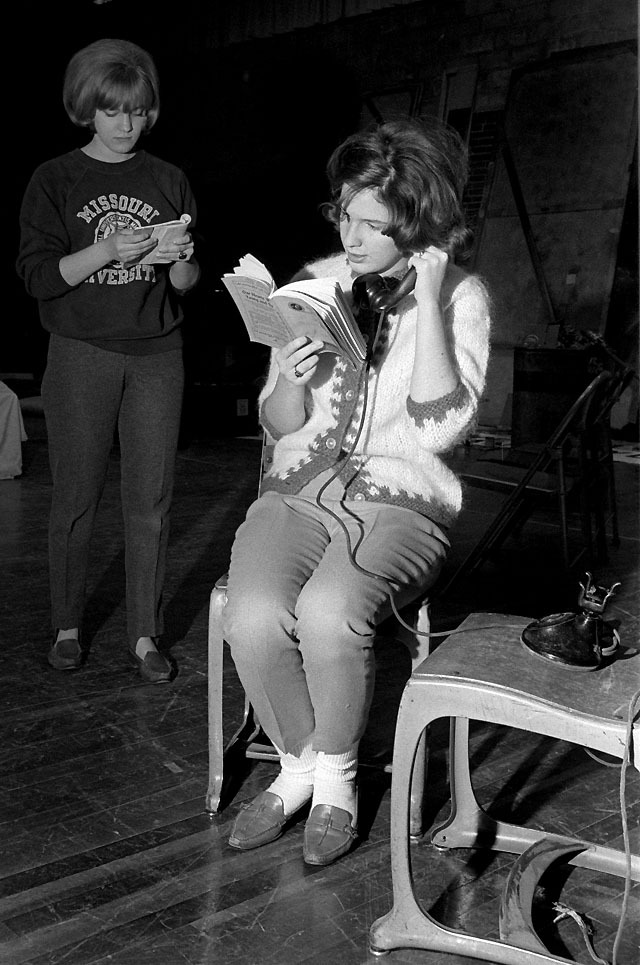
Shari was active in Central’s Red Dagger and Silver Spear. Here is a gallery of her in Our Hearts were Young and Gay. You can see the whole cast in this blog post.
Memories from Mary Jo Stiver
Mary Jo and Woody Stiver
Mary Jo was Shari’s brother Skip’s ex, and Charles E. Stiver III (Woody) was her nephew. This photo was taken at Woody’s high school graduation.
Mary Jo: It’s occurred to me that in the 35 years I’ve known her, I only spent little snippets of time with her over holidays and short visits. I tried to entice her on some travels with me, but she was mostly a “homebody” person.
When I would go to visit her at her home, she would make me a tea and, of course, she would always have her Starbucks handy — her favorite! We would tour around her home to see her latest renovations and acquisitions – and visit with her children, the kitty cats. And of course, she would regale me with stories of her and Skip’s childhood — and lots of STIVER family history.
My dear sister-in-law will be sorely missed. To my children, and all her nieces and nephews, she was “Tanta” – the “fun” aunt! She was fiercely independent, kooky at times – and always interesting, controversial or not. One of the most intelligent women I ever met. As you know, she loved gardening and antiques, thanks to her beloved grandmother, Meme (pronounced Mimi.) – and her aunts, Ouida and Great-grandmother Bookie. I loved all the stories!
I wasn’t around for her years as a psychologist – however, I saw the beautiful work she did as a historic renovation specialist. That was her passion.
She and I loved each other from the first time we met – Did you know we shared the same birthday? That made us feel like real sisters! We always called each other, “sis.” I wish we lived closer to have had more time together. I’ll miss her terribly!
Barb Goza Chemers
I met Shari in high school, as a new member of Jobs Daughters when she was the Honored Queen. She had risen to the top of that organization as she did with so many of the organizations she joined. Her energy, intellect, creativity, practical problem-solving, and straight-forward communication were of use in all her endeavors – from school to psychological treatment of troubled adolescents to reconstruction of troubled houses.
These propensities also made Shari a stand-out friend for me. She introduced me to ways of thinking and organizing that I hadn’t before seen in operation. Her powers of observation, memory for what she observed, and willingness to share her observations facilitated my developing adulthood. As adults, we’d go for long periods of time without seeing each other, and upon reconnection, simply pick up the thread of the conversation. So now, although I miss Shari’s presence on this earth, I am still able to have lively conversations with her in my mind. And I am able to see many of Shari’s faces.
• The Jobs Daughters Honored Queen beatifically glowing as young women marched in white satin Greek goddess robes
• The high school senior mischievously smiling as we surreptitiously skinny dipped in a Cape Girardeau pool at dawn
[Editor’s note: despite many accounts of teenage skinny dipping recorded on my blog, I was never invited to dip my skinny with any of the miscreants.]
• The graduate student chewing her pencil while puzzling where to place the next index card on the wall of cards organizing concepts of her dissertation
• The frustrated pout of the patient, so distressed that treatment for her cancer had so many negative side effects
• The satisfied grin of the gardener, proudly standing among her crops
All these faces, and more. Shari graced us with much to learn from and much to remember.
Ronna Orentas
When Shari was in the hospital, I asked who she would like contacted. She said, “hairdresser.” I don’t have a photo of Ronna, but I found a clipping from a magazine that was probably a hairdo Shari wanted to copy.
Ronna: I remember her when we met at the Lindell Club, always in painters’ white pants. Had no clue she was a Dr hahaha. Spent many hours talking and getting to know each other over the almost 40 yrs of sobriety. She was independent, stubborn, extremely intelligent and talented and I loved her for who she was!!! We got sober together and grew old together and I’ll miss her!!!!
Jim Stone
Jim: She was a unique personality indeed. Although we reconnected a bit recently, most memories are from high school days. Shari was a very smart player in our lives and those of many others over the years. She left her mark wherever she was and on whatever she did. I already miss her.
I bought tickets for a James McMurtry concert in St. Louis. I invited Brother Mark and Robin, Shari and Mother to come along. Mother bailed, so Shari asked if she could sub in BFF Linda. Here’s Linda when we went out for a bite to eat.
Linda had been Shari’s roommate in college, business partner and was named the executor of her estate.
Linda: Her grandmother instilled in her a reverence for family, and, consequently, it’s about the family not not necessarily the individuals. It’s the concept of family.
When I stopped seeing her, I missed her a lot. We did all that estate selling, we did projects – she was my “I’m working on this and I can’t make it work call.”
She was that DIY person, and I still miss it.
Well, it’s going to take a long time to unravel who she was. or whether we’ll ever be able to. And she was somebody different for each of us. Yeah. You know, she was somebody different at different times of my life for me. You know?
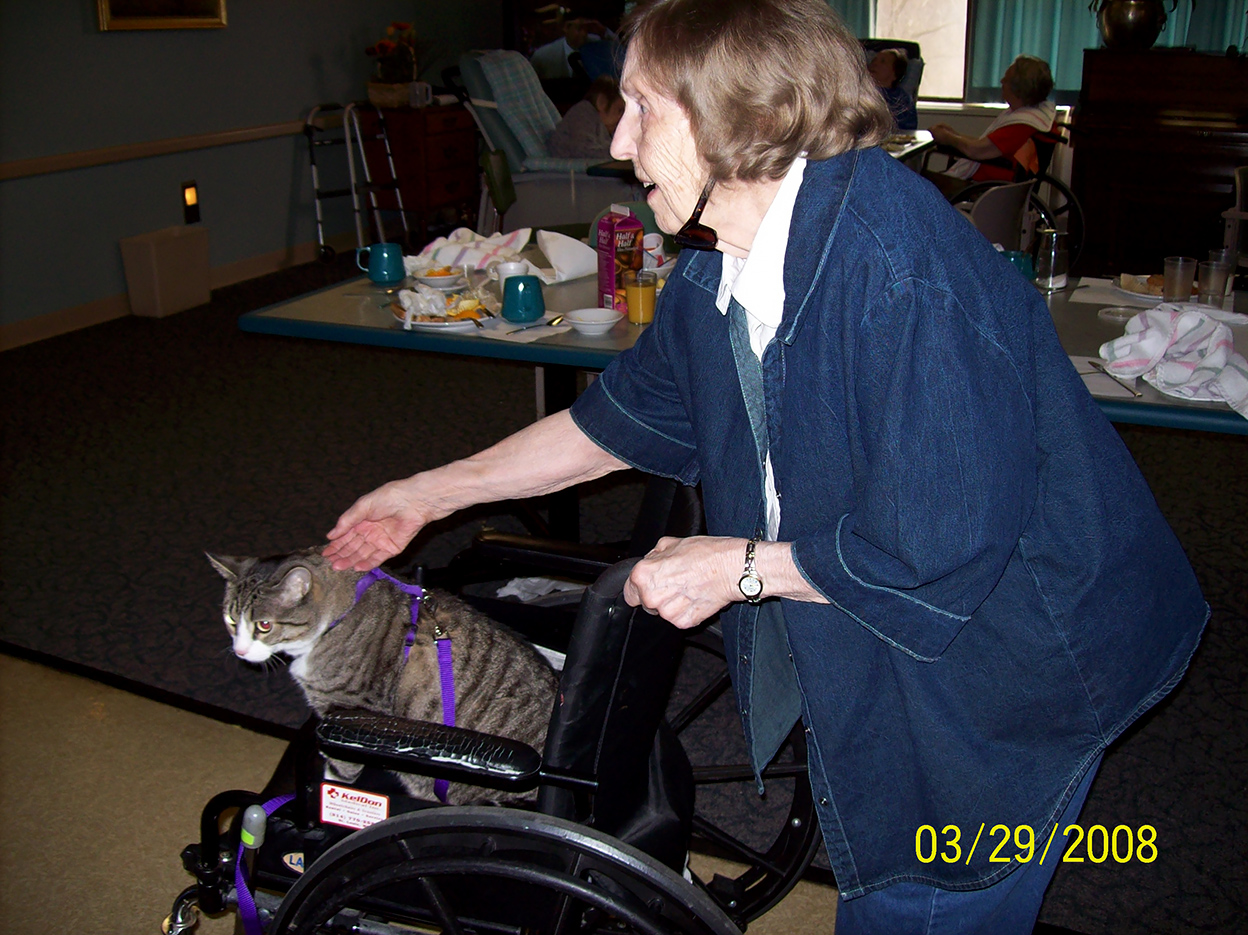
My mother adored Shari. Well, I don’t know if she adored her. But Shari was very kind to her. Shari would take Weezer (her cat) to the nursing home. And Weezer would sit on my mother’s lap, and Shari would push her around in her wheelchair. And everybody in the place was just like, “Oh.”
Sally Wright Owen
Presidential candidate Barry Goldwater campaigns in Cairo, Ill., 10/02/1964
‘We had our own press passes and sat in the very front of the press box, and they even fed us,’ said Sally Wright, 12B.
“‘And we saw every detail,’ added Shari Stiver, 12B.”
Sally: Shari often found refuge at her grandmother Mimi’s house, conveniently located next door. This was the scene of the Razor Gone Rogue debacle.
Must have been either freshman or sophomore year of high school. We decided to shave our legs before some sort of school function. There is a technique for shaving your legs. We did not consider that. What could go wrong?
Let me count the ways. Many nicks and bloody notches later we realized that you DO NOT shave legs without soap or shaving cream. Our injuries were beyond little scraps of toilet paper plastered on the offending areas. This was an all-out Band-Aid (full box) emergency. Lesson learned: It’s ugly being beautiful.
.
Thawing out in Florida
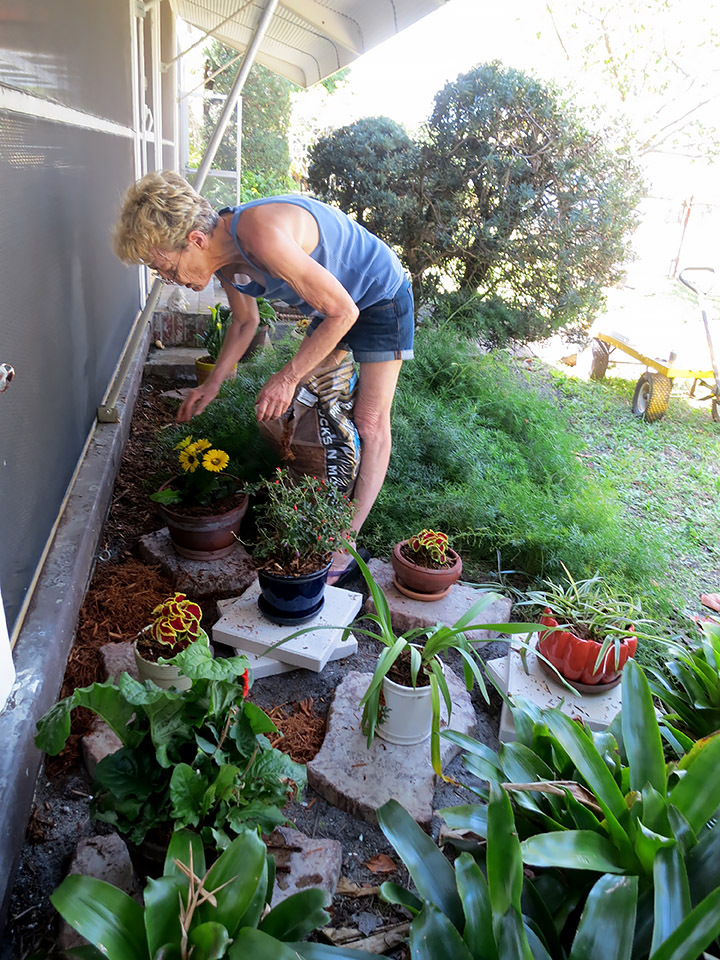
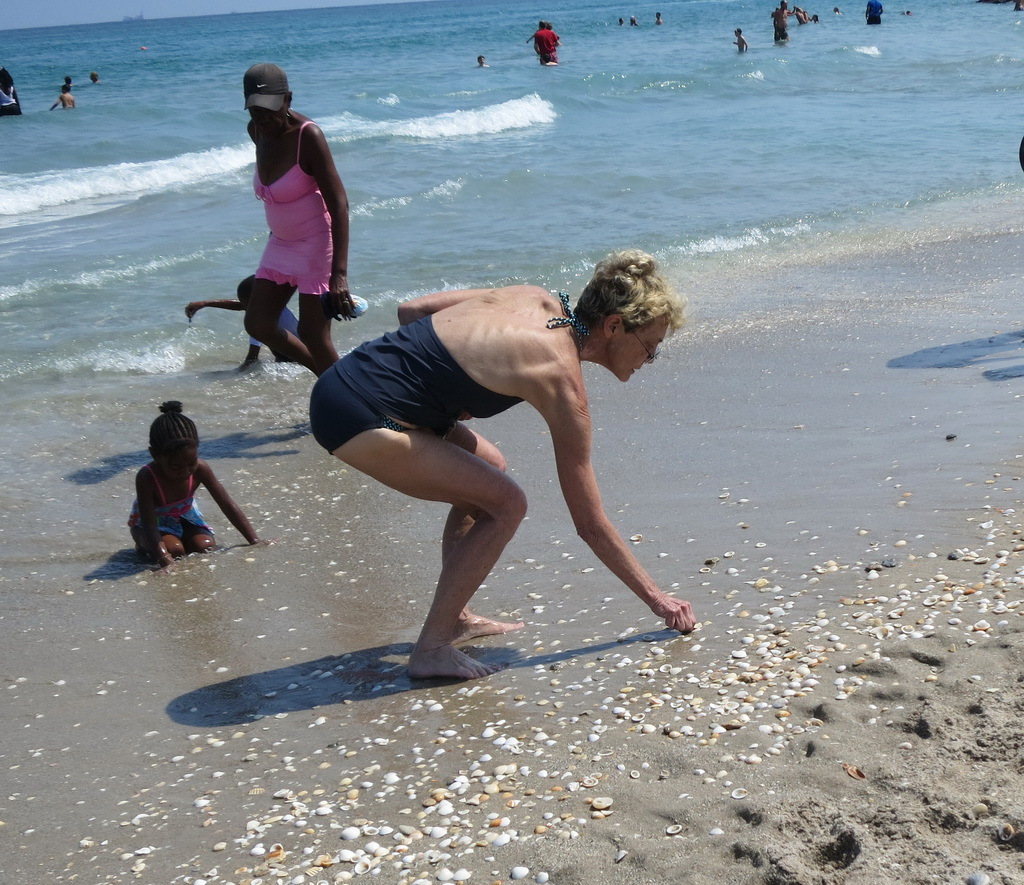
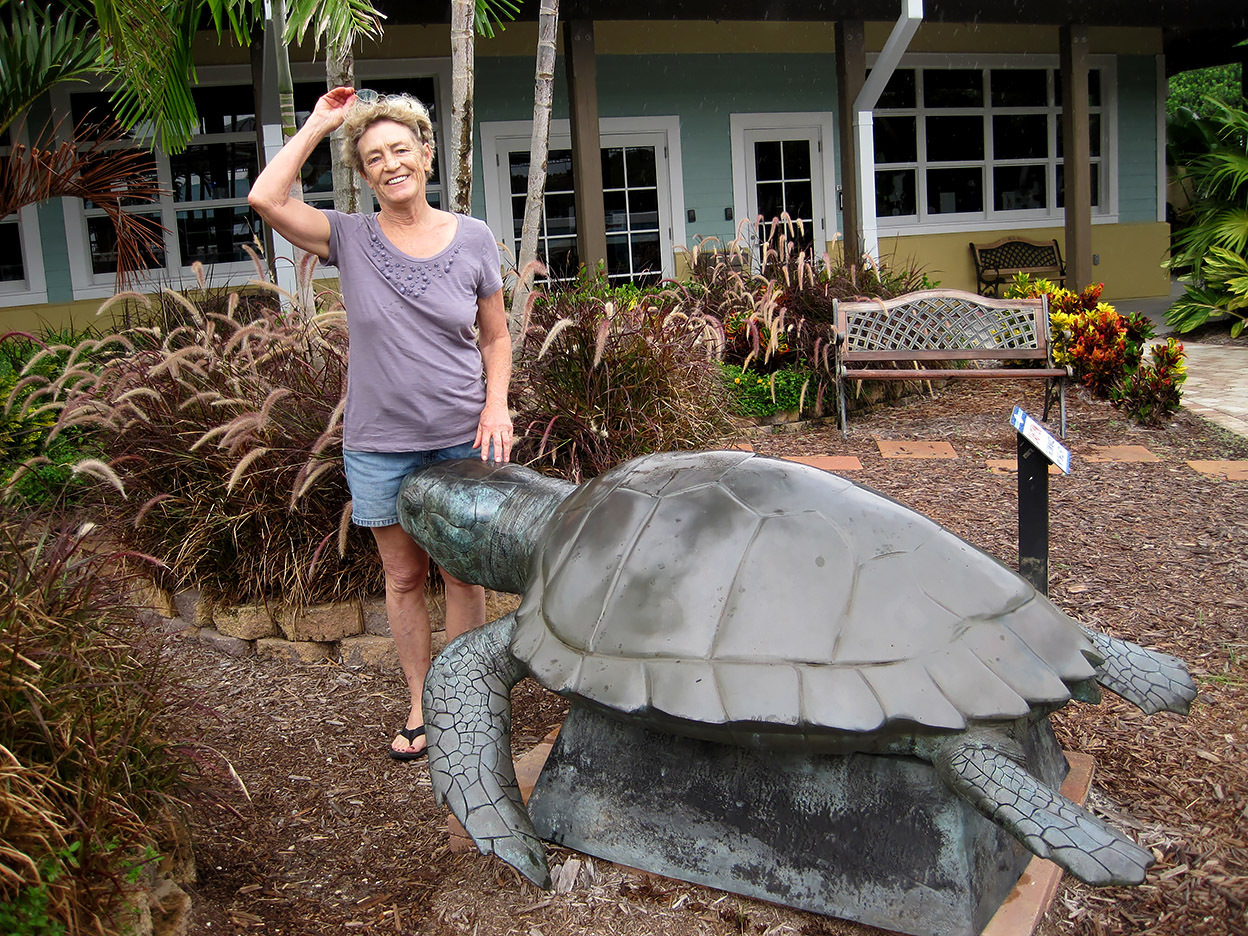
When the frost was on the pumpkins back in the Midwest, Shari was eager to visit Wife Lila in Florida so she could thaw out, swim, go to the beach, play with flowers and see the sights.
She’d fly down, then I’d give her a ride back to Missouri.
Here’s a gallery of her frolics.
De facto Niece Catlin
Caitlin McCann – Shari Stiver’s de facto niece 3-10-2025
Shari’s laptop was a treasure trove of photos of Catlin McCann, many of which were of a young woman she describes in legal documents as her “emotional/de facto niece.” I met her when she came to St. Louis a few weeks ago. I can understand why Shari loved her so much – she was smart, funny, and had strong emotional attachments to her de facto aunt.
I told her that Shari’s laptop tracked her through her pre-teen, braces and acne years, though high school and college and points in between.
Here are some highlights of what she recalled.
Caitlin: I’ve known Shari since I would have been five or six. It’s been a long time. You know, she bought me my first tool set, the first of which was non-operable.
It was for kids, but because Mom and Shari were doing repairs around the house and I wanted to help, she got me a fake tool set so that I could help, but not actually mess anything.
Costumes
She made me Halloween costumes for several years. There’s a bunch of pictures of those which I remember thinking was great fun. I remember laying. on the floor and the draft paper and her just urging me to sit still if I really wanted this to work.
One Halloween I got it into my head that I wanted – for whatever reason- to be a hot pink angel. I don’t know what I thought I meant by that, but it was very pink, and Shari said, “Okay, kiddo,” and made the dress and the wings and the whole thing.
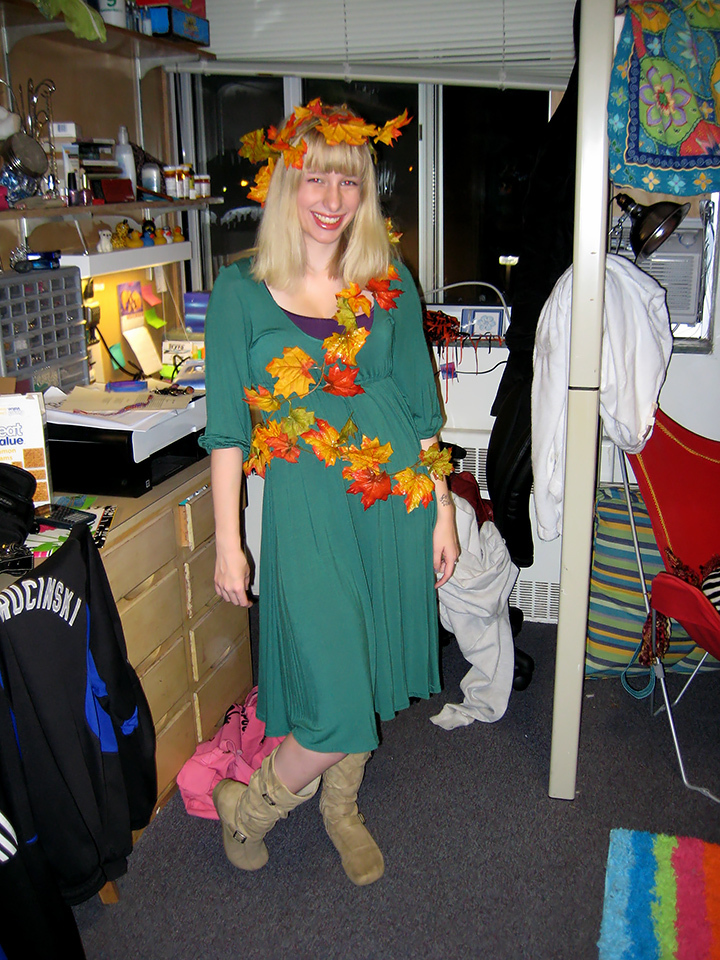
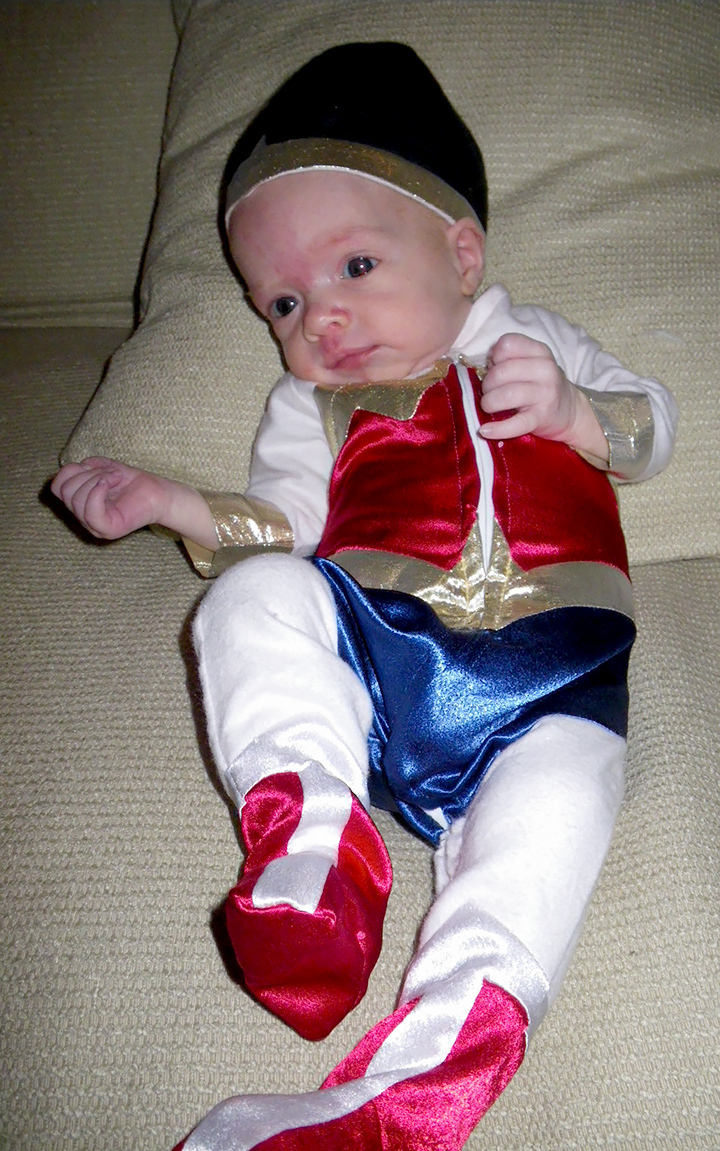
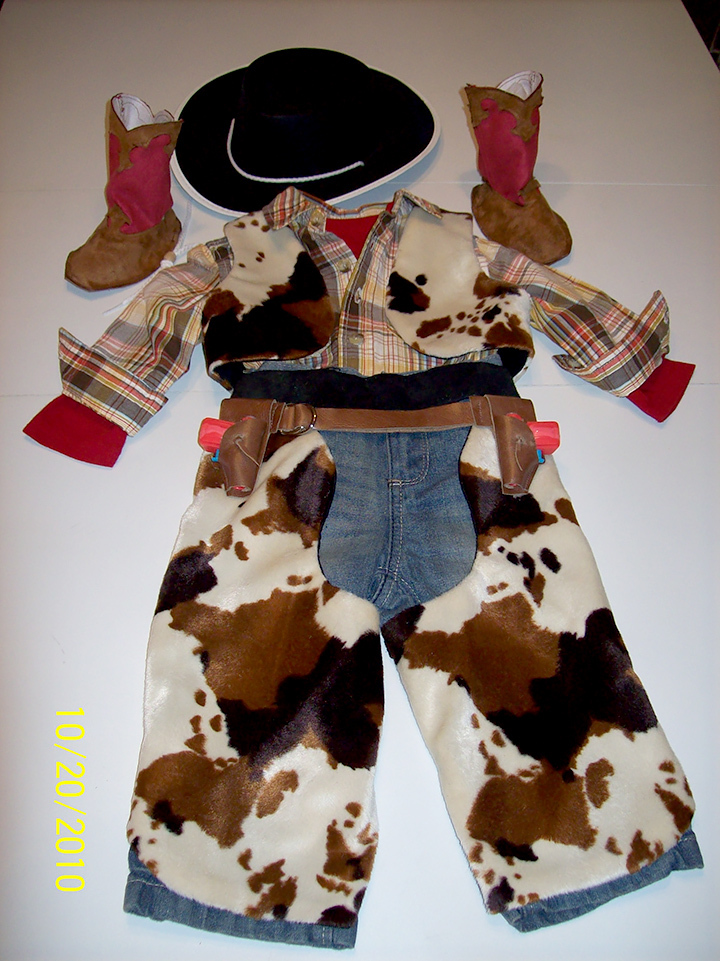
[Caitlin wasn’t the only one she made costumes for. Here are some examples.]
Shari made dorm room look like adults lived there
When I went off to college she had me measure my first dorm room, and then she sent me an AutoCAD floor plan.
She spray painted cement blocks and two by fours, and made like a little entertainment system. My roommate and I lived there all four four years and just loved her. I’m telling you our our apartment is the only one that looked like adults lived in it. Everybody else was chaos. We made a home and it was because Shari organized everything.
Birthdays aren’t real
When I was really young, she told me, “You know, that my birthdays weren’t real, and that they didn’t all need to be celebrated, so please stop asking what her birthday was and what age she was, so I remember figuring it out once and actually like calling her and doing something nice for her her 60th, and she told me, ‘ I love you, don’t ever do this again.'”
Cornerstone of my life
She’s just been basically a cornerstone of my life. She was my safe space for whatever I was going on with in the world or figuring stuff out and she she was always really good about telling me that that was normal and it didn’t make me weird to be going through whatever I was going through at the time.
I’m gonna miss the random text messages and the care packages because she was one of the first people in my life who made it really clear that it was okay that we were in constant contact.
For a long time I didn’t know that was normal, that that was okay and she made that not just okay, but healthy, because I never doubted that she cared and I don’t think she ever doubted that I cared.
She had she had opinions and I didn’t always agree with her opinions, but I think we had a a good system of just letting each other air those opinions and if we didn’t agree that was fine She was very patient with me,
She let me yammer on about boys when I was a teenager. She didn’t like most of them, and she was right in the long run. But she let me talk it all out
You need to collect something
She sat me down when I was about 8 or 9 years old and she said, “Look, kid, you’re getting real hard to shop for. I need you to pick something to collect so that I can know where I’m going with you.”
Initially, we tried cats and that didn’t quite stick in the same way it did with hers. We ended up with rubber ducks, which is why there are two rubber ducks in the bathroom.
Katie Bug and Greasshopper
She approved of my husband. She loved him. She really did.
I was really nervous to introduce them because I thought, “Oh, God, if Shari doesn’t like him, I’m f’ked. Kiss of death. Yeah. Well, and because her opinion meant so much to me, but no, she really took to him.”
When I was a little one, she called me Katie Bug, and so she has given me a lot of things with little ladybugs over the years
I knew he had arrived, because she texted me after we’d had lunch and grilled him. She texted me after and said, “I think I like him. I think you can keep him. I’m going to call him Grasshopper.”
And so, anytime she would call or check in with me, it was, “How are you and Grasshopper?” I mean, it was just… I love it. And I just, I know, I always loved it. I just thought, what better stamp of approval from her?
David Hoyt Servis – Sharon Lee Stiver
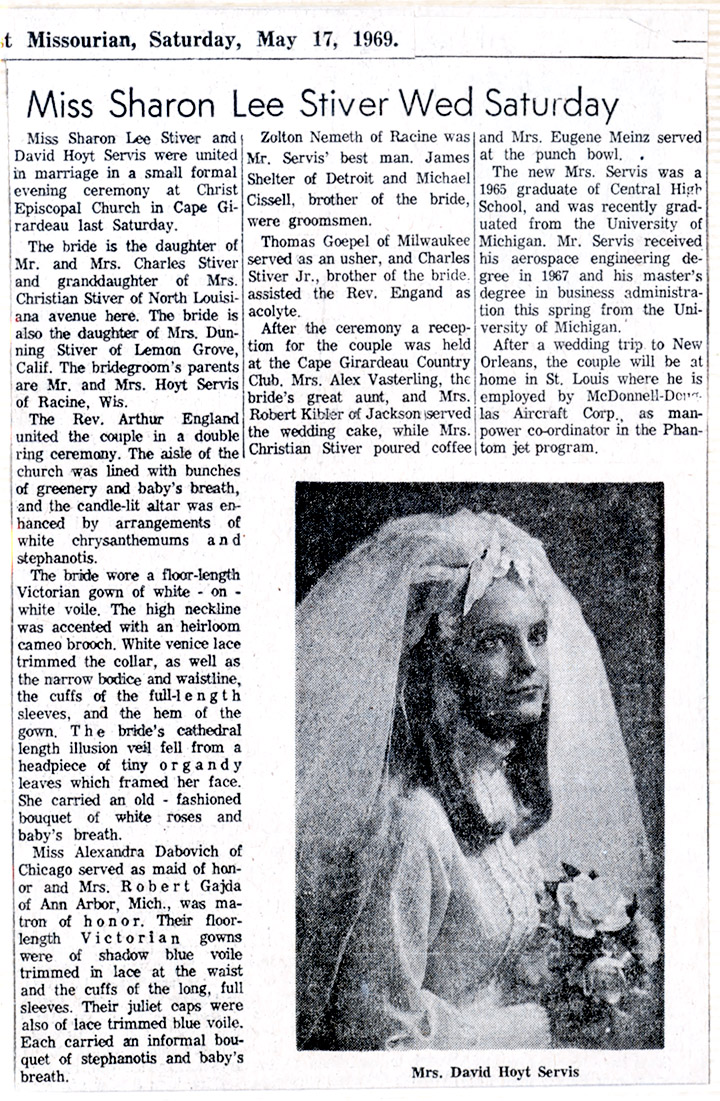
Shari’s scrapbook held a number of surprises, including The Missourian account of her wedding to David Hoyt Servis in 1969.
LaFern, Shari’s mother, offered this account of the wedding. I offer it up only because it becomes germane with some other things found in the scrapbook.
LaFern: The day before the wedding we were in the laundry room. Her bridesmaids were already here, and I was doing laundry, and she was sitting there by the washing machine. I was getting the clothes out of the dryer. And she casually made the remark, “You know, I don’t think I would be getting married if I weren’t. afraid to be alone.”
And I said, “What?”
And she says, “No kidding, mom, I don’t think I would be getting married if I wasn’t scared to death to be alone.”
Records show that Shari and David married on June 10, 1969 and divorced June 26, 1971.
Afraid of being alone
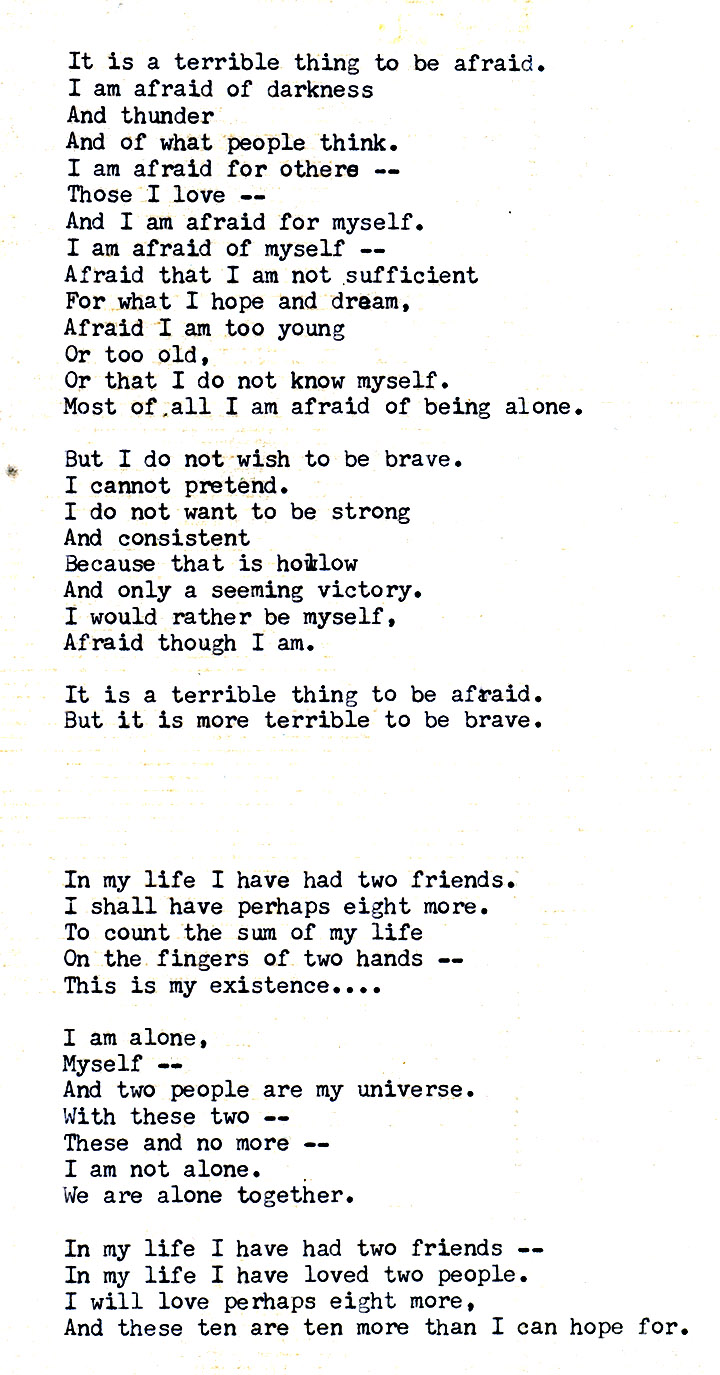
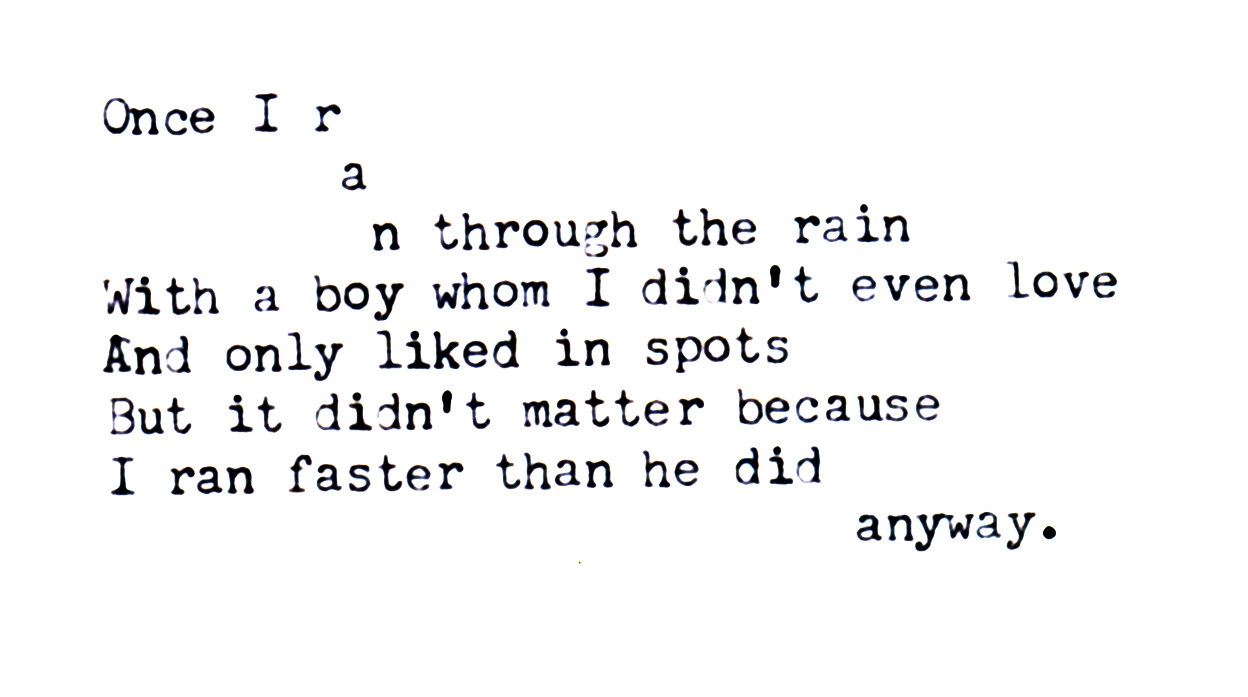
I wouldn’t have included this account had I not run into some poems Shari wrote that echoed that fear of being alone.
Rodger (Rick) Meinz
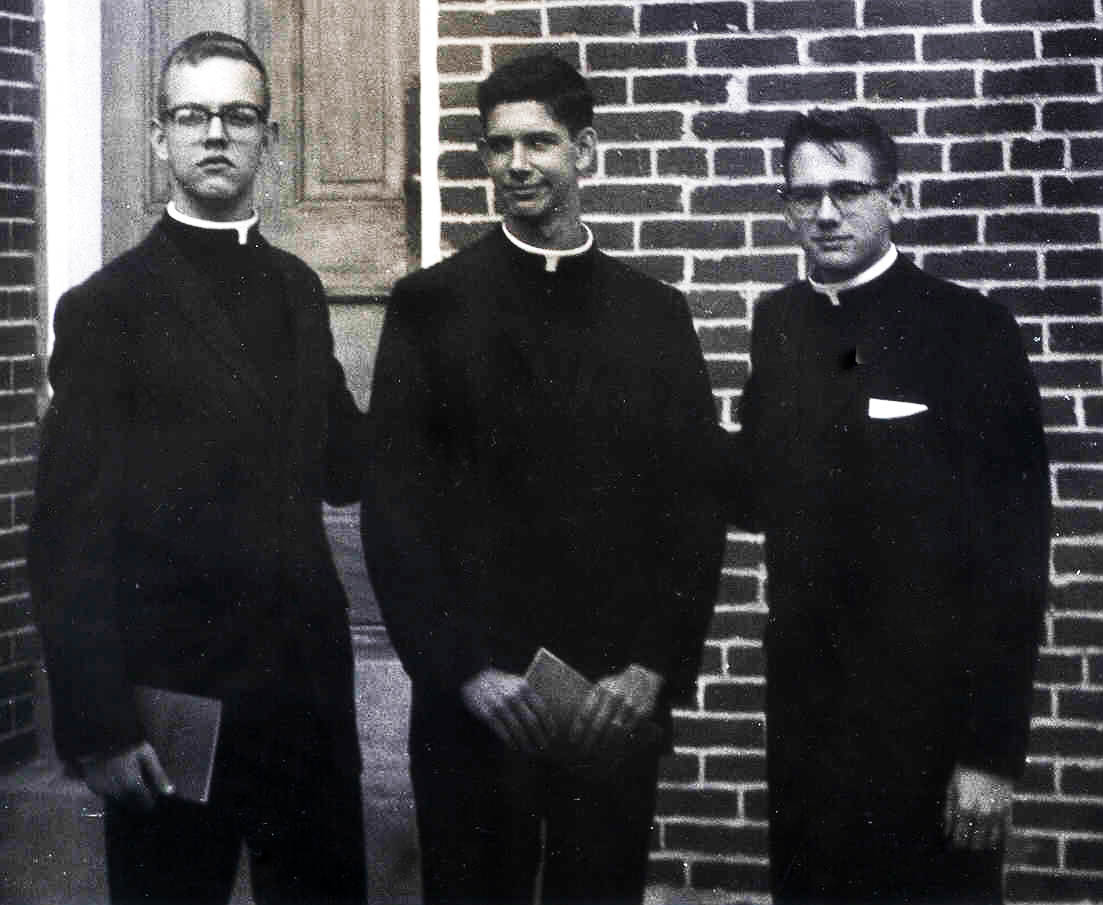
This photo of John Mueller, Rick Meinz and me dressed up for a Trinity Lutheran Church pageant of some kind demonstrates that it doesn’t take six degrees of separation to link up people in Cape Girardeau.
All three of us dated Shari, and Rick ended up marrying her.
Rick (I’ll call him that because that’s how I remember him from high school) days, had some interesting perspectives on our mutual girlfriend. He was drafted and joined the navy ” to avoid jungle duty in Vietnam,” but chafed at military life. He left with an honorable discharge, but both he and the navy were happy to see each other go.
I’d like to get married
Rick: Shari said, “You’re getting out of the navy, so why don’t you come stay with me?”
Four or so months later, she said, “I’d like to get married.”
“Whoa! You REALLY want to get married? WHY do you want to get married?”
“Well, for the experience of it. I’m in women’s studies, and I want the experience of it. And, I want to get my name back.”
So, they went before a liberal judge in Houston who was willing to let Sharon go back to Stiver, and, at the same time, change her middle name from Lee to Brooks, in honor of the Brooks side of her family.
Records show that Rick and Shari were married May 3, 1972 and split in June 26, 1974, although he said they had been separated long before that.
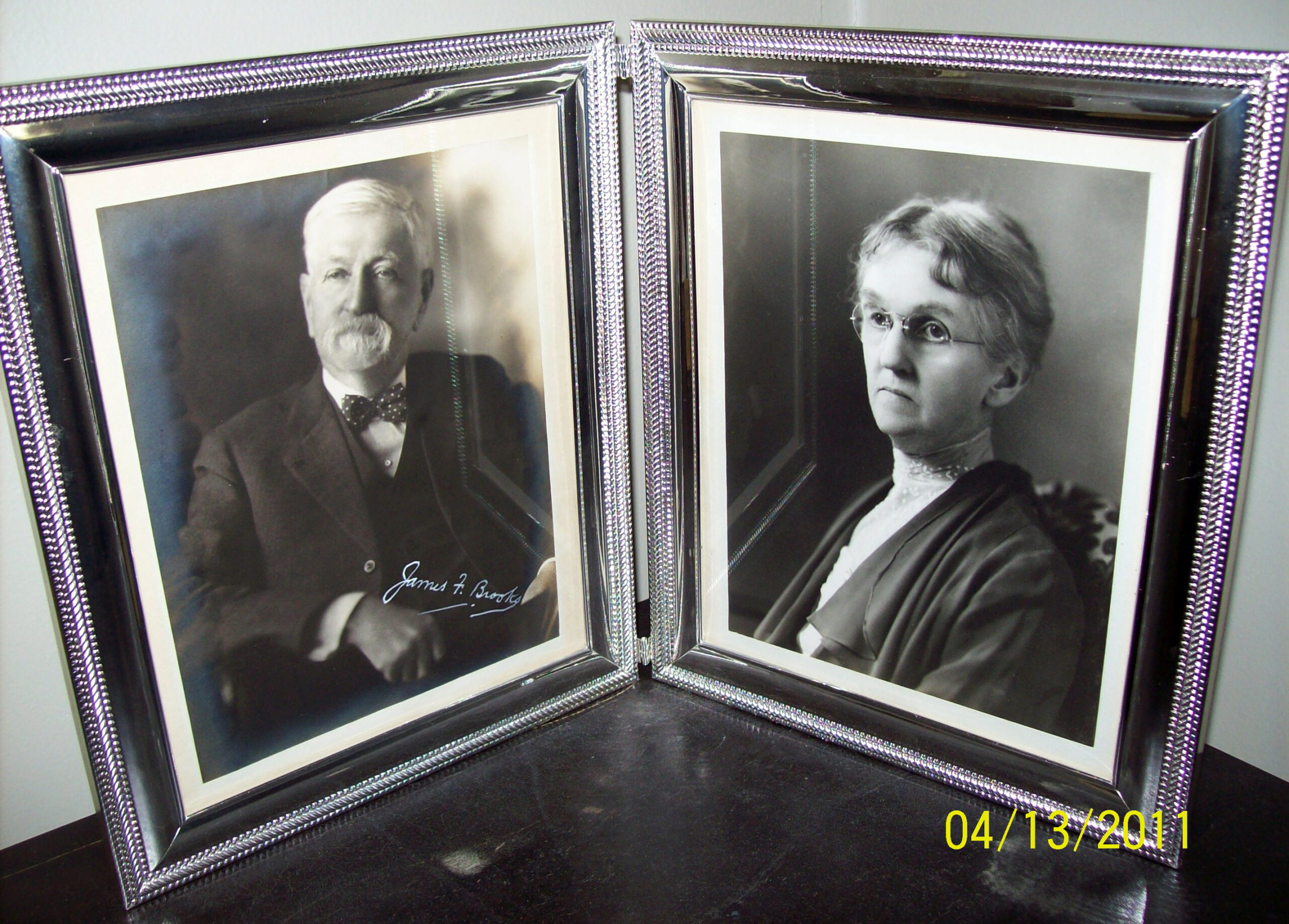
The Brooks -Shari connection
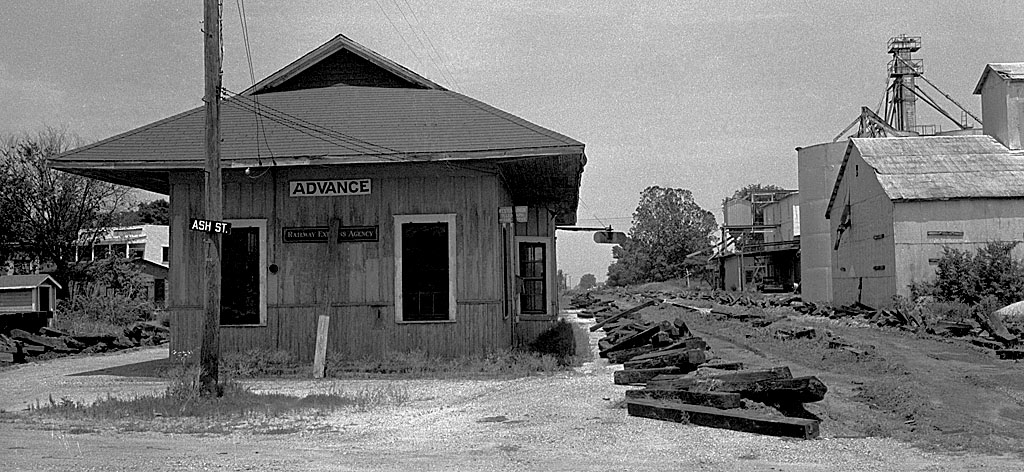
I knew a little about Major James Francis Brooks from when he was told by Louis Houck to “advance” down to where he could buy property for $10 per acre instead of $35 for a railroad depot. That “advance” was how Mother’s hometown – Advance – got its name.
Where did the first call terminate?
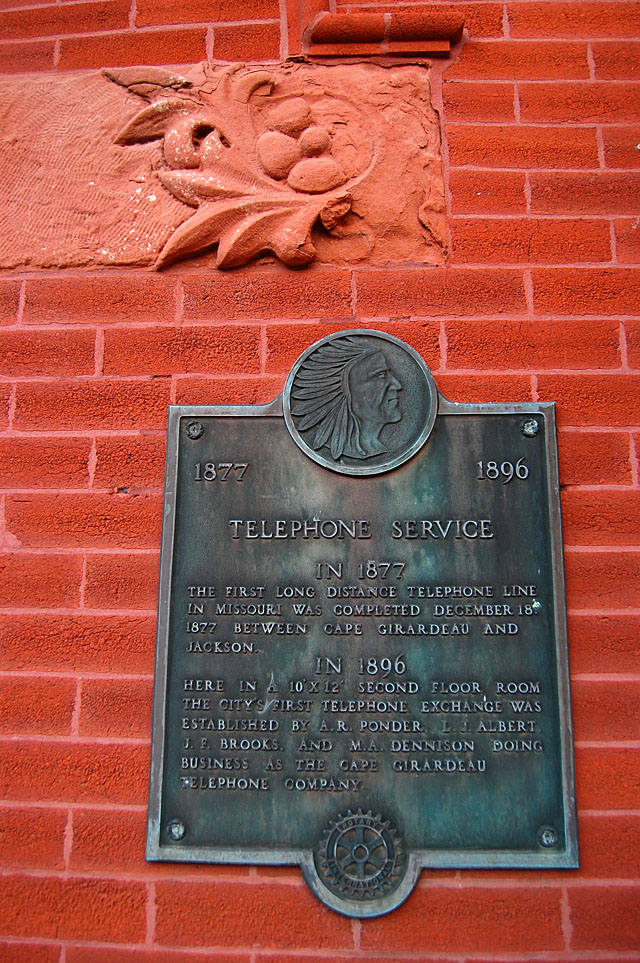
We were walking around on Main Street when she said she’d like to take a look at a plaque on the building at the corner of Main and Themis.
The Rotary Club plaque read, “Telephone Service. In 1877 the first long distance telephone line in Missouri was completed December 18, 1877, between Cape Girardeau and Jackson. In 1896 here in a 10′ x 12′ second floor room the city’s first telephone exchange was established by A.R. Ponder, L.J. Albert, J.F. Brooks and M.A. Dennison doing business as the Cape Girardeau Telephone Company.”
It rang in my great-grandfather’s kitchen
“The call may have originated in Cape,” she said, “but do you have any idea where it terminated in Jackson?”
Somehow or another, knowing Shari, I was pretty sure I was going to find out.
“The first call rang in my great-grandfather’s kitchen,” she elaborated. “He was the J.F. Brooks mentioned on the plaque. He was the engineer who laid out the railroad for Louis Houck. Houck wanted to be able to get hold of him, so he had him pull a phone line between Cape and Jackson.”
Maj. Brooks and Bookie
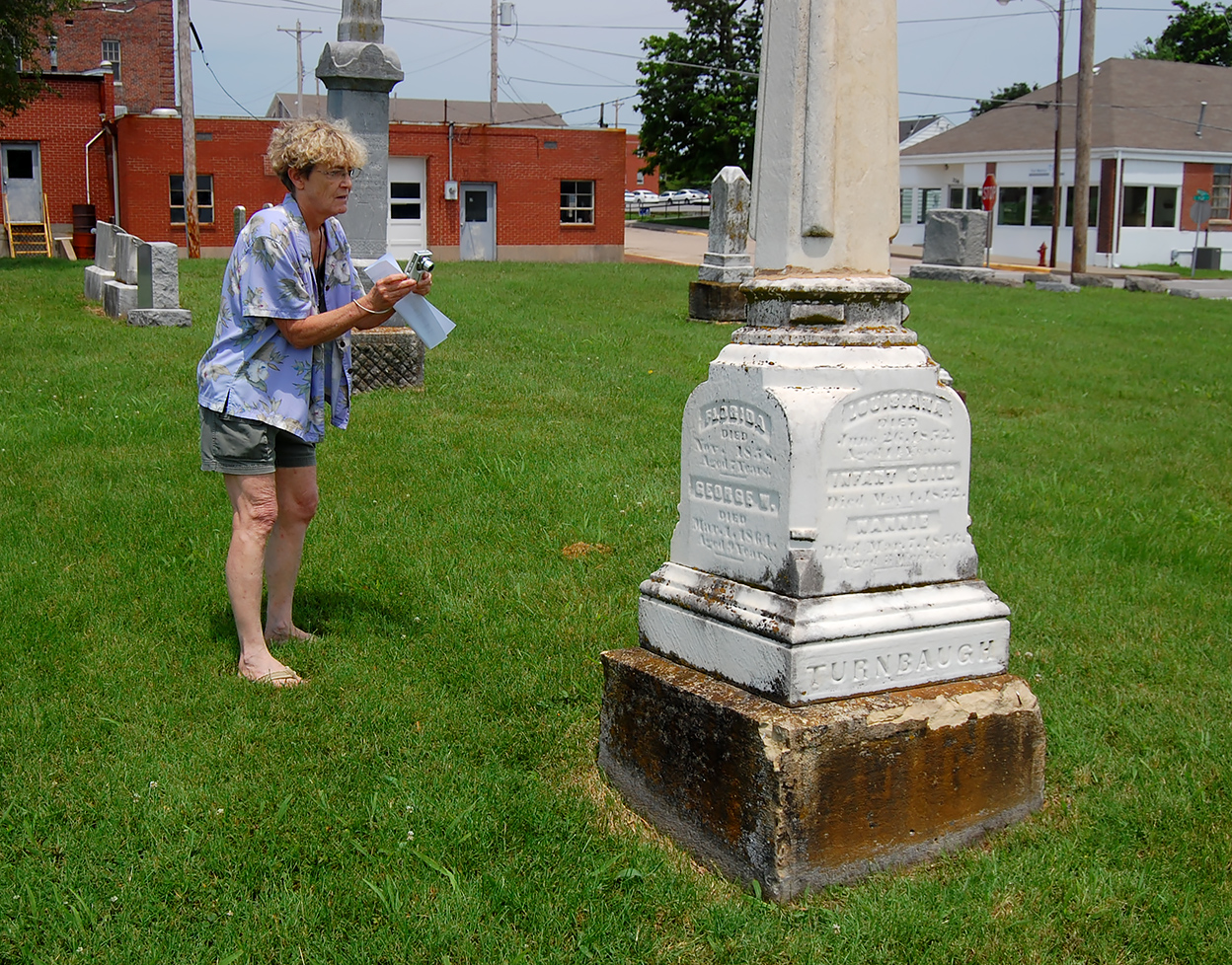
Shari added that her great-grandmother, “Bookie” (Florence Adele Turnbaugh Brooks) played telephone operator after the initial excitement of the first couple of calls died down. Maj. Brooks got his engineering degree at Vineyard College in Kansas City after he rode his spotted pony west with a wagon train to get there.
The Turnbaughs were Southerners who owned slaves, which Shari suspects caused some heated discussions over a bottle of whiskey on the front porch of the Turnbaugh house in Jackson.
Looking for Turnbaugh grave markers
Shari Stiver w Turnbaugh marker Jackson MO Cemetery
Shari wanted to find her Turnbaugh relatives while I was looking for other grave markers in the Jackson Cemetery.
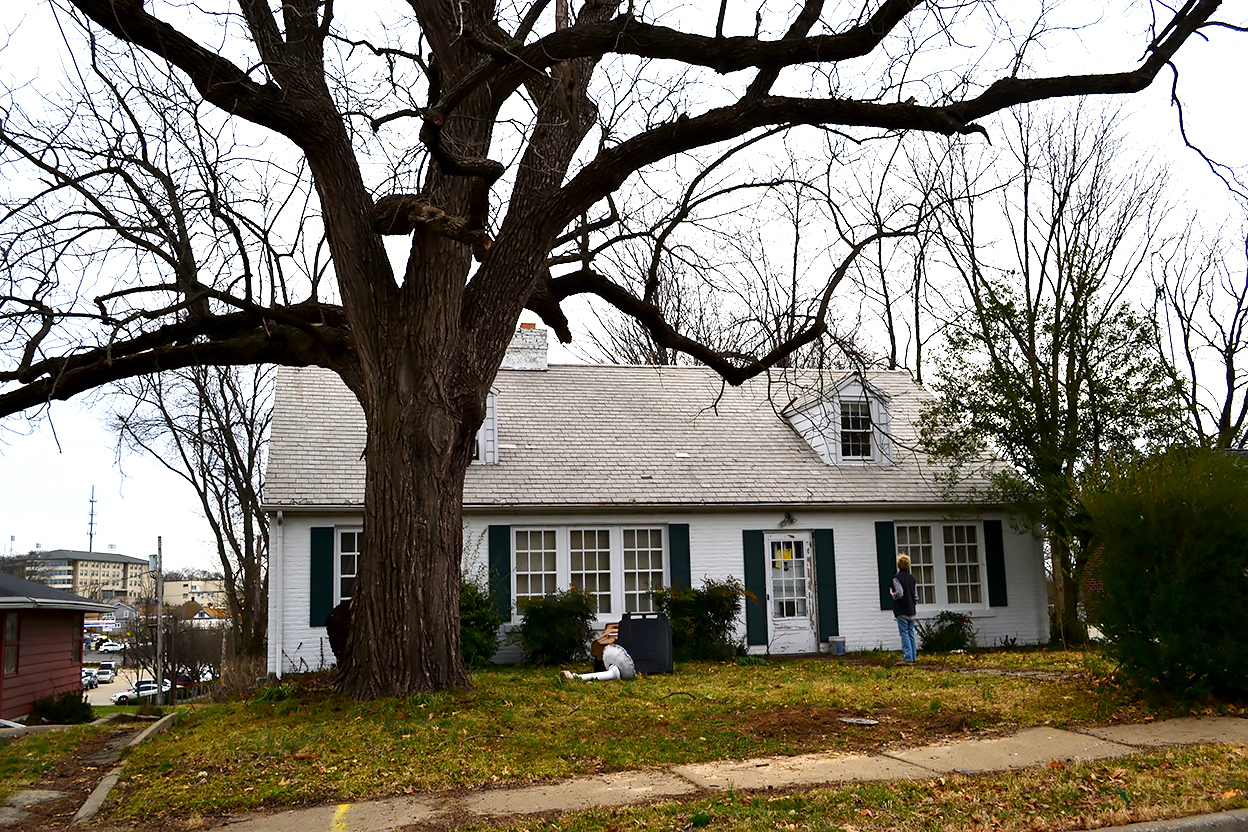
Gladys (Mimi) Stiver
Shari Stiver at 406 Louisiana 02-12-2012
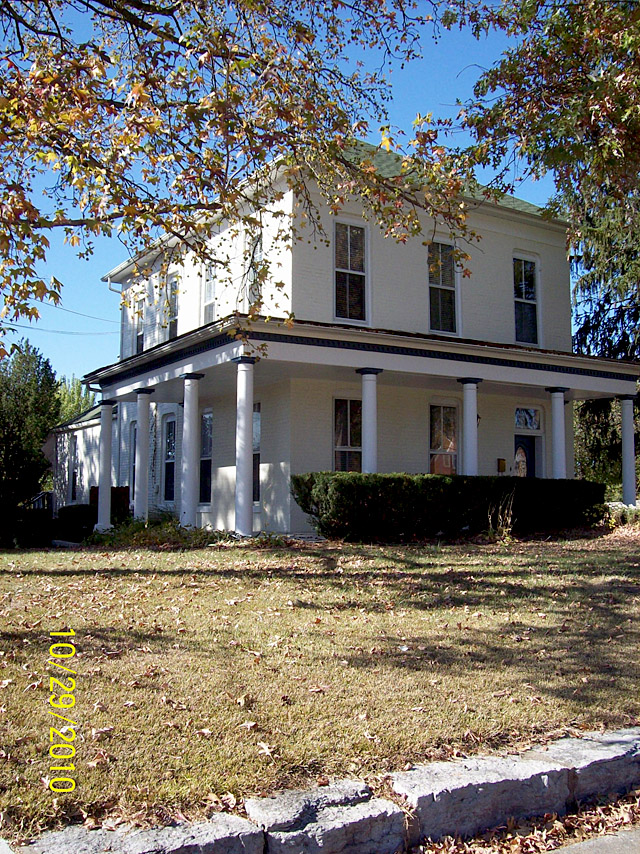
Shari and I probably spent as much time at her grandmother’s house at 406 Louisiana as anywhere. Since I was only 15 and didn’t have a driver’s license, my dad or her dad had to chauffeur us to and from date locations. We sat a respectable distance apart on those jaunts.
Mimi, as Shari called her, gave us some safe space on her back porch. She recognized that I was essentially harmless / clueless, so she would leave us alone and make sure clomped loudly if she was going to invade our spot.
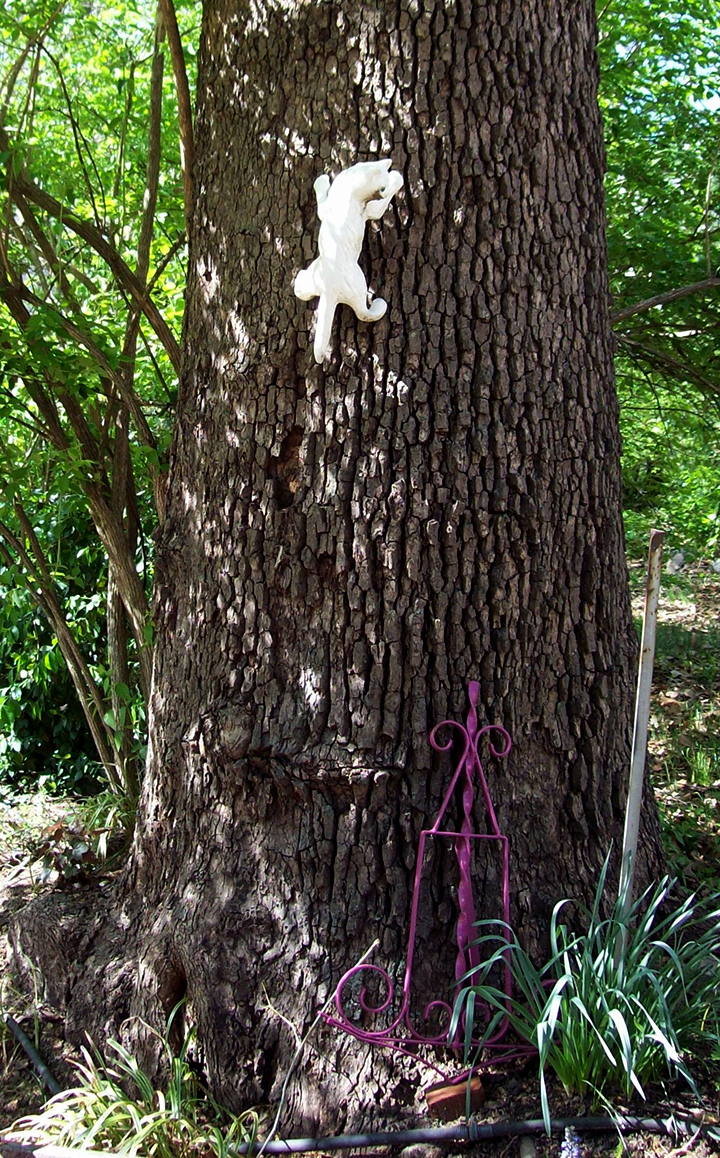
I remember the white cats
I was always fascinated by two white china cats hanging from the shutters around the front door. When I visited the house years later, I was disappointed that the cats had vanished.
I was pleased to see that at least one of them had followed Shari to her back yard in Webster Groves.
I admired and respected Mrs. Stiver
She was a mover and shaker in the local Republican party, and I was a young Barry Goldwater aficionado, so we had some mutual interests. What impressed me was that, despite my age, she was never dismissive or condescending She was one of the first adults who didn’t treat me like a kid.
LaFern: Shari more or less worshipped her grandmother. Oh, yes, oh yes, she did, yeah. Because to Mimi, Shari never did anything wrong. She didn’t. She idolized that child. She really did. She just adored her. And it wasn’t false in any manner of means. It was just Mimi. Mimi had the ability to love and to love greatly. And Shari just soaked it in. She loved it very much.
I don’t know, I don’t know what her beginnings were like but I know that she really, really appreciated her grandmother’s love.
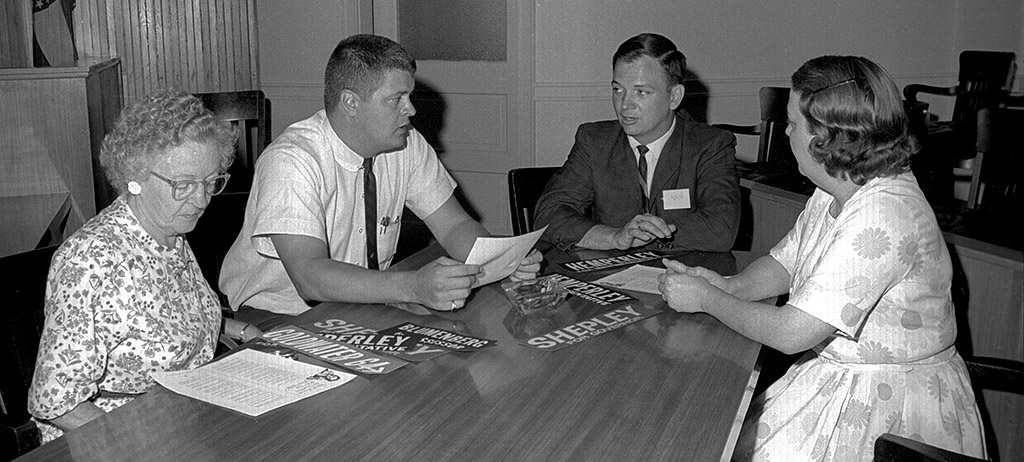
Gladys Stiver on Primary Election night
Gladys Stiver, Gary Rust and others at Jackson courthouse c Aug. 1964
Gary Rust, at the end of the table, recruited me to work at The Jackson Pioneer before he became a newspaper publishing magnate. Mrs. Stiver is on the left as the election results started coming into the courthouse.
Here’s what election night was like in the days before computers and the internet.
Shari will be united with her grandmother
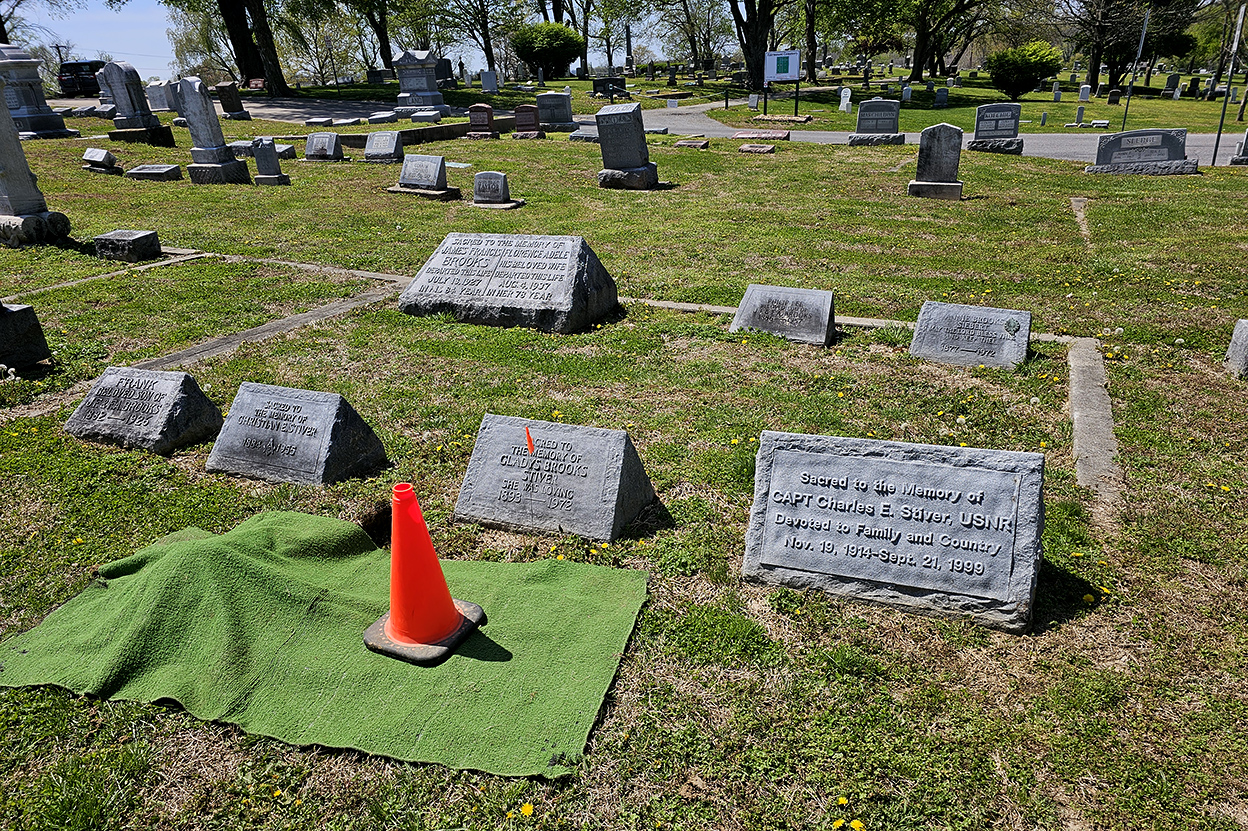
Brooke-Stiver plots 04-12-2025
Shari’s ashes will share her grandmother’s plot in the New Lorimier Cemetery’s Section 1, Lot 23, Grave 5., next to her dad’s grave.
Mom – LaFern Stiver
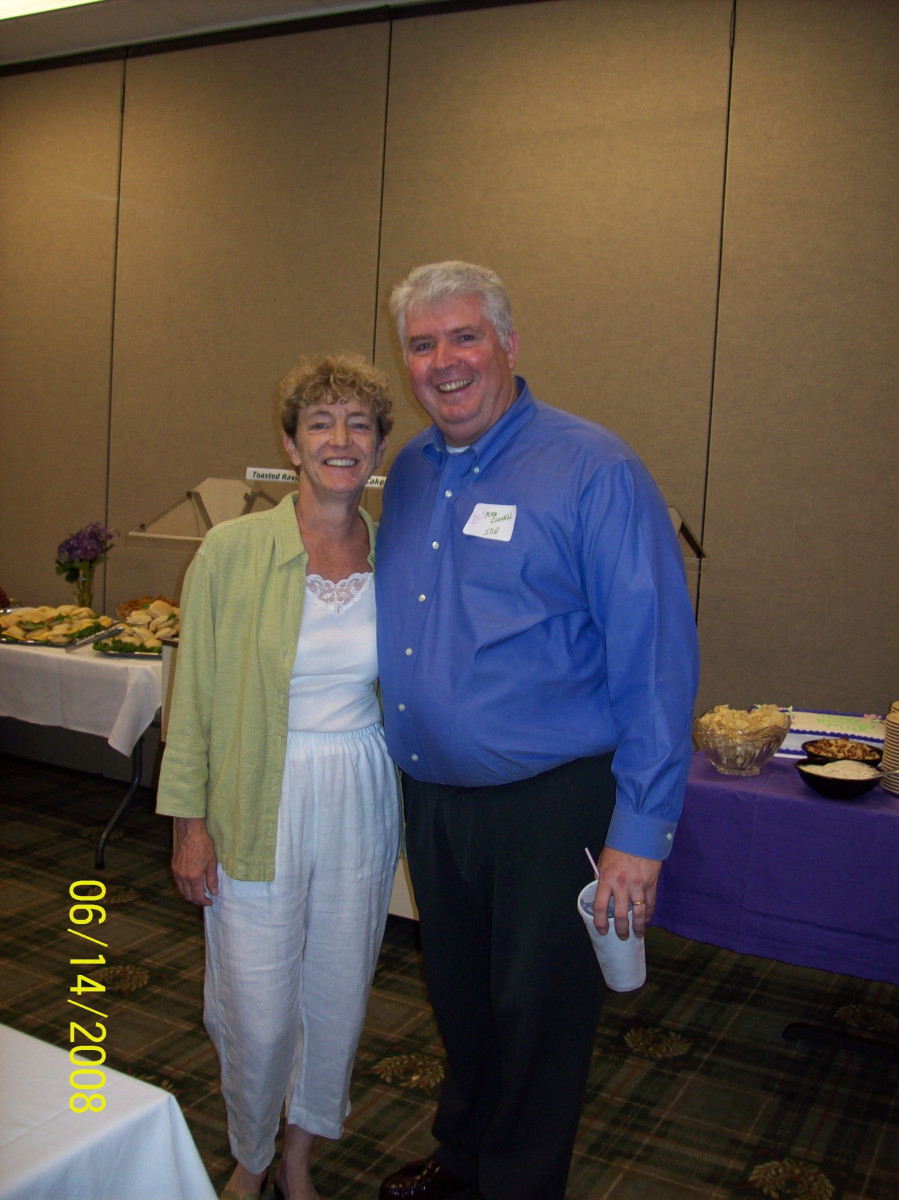
LaFern Stiver – Mike Cissell – Shari
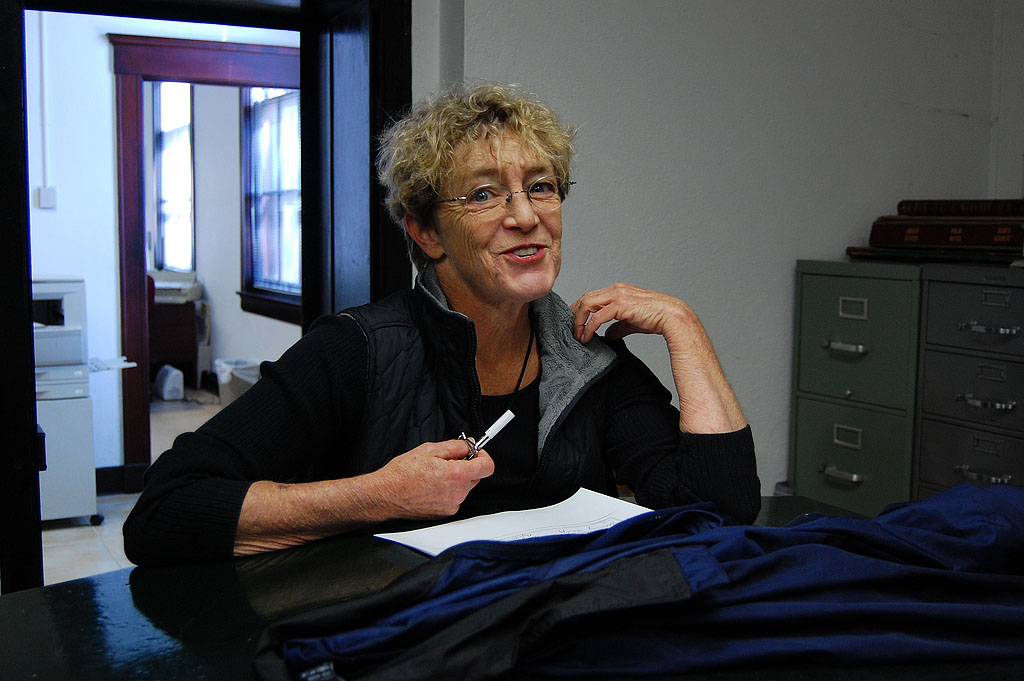
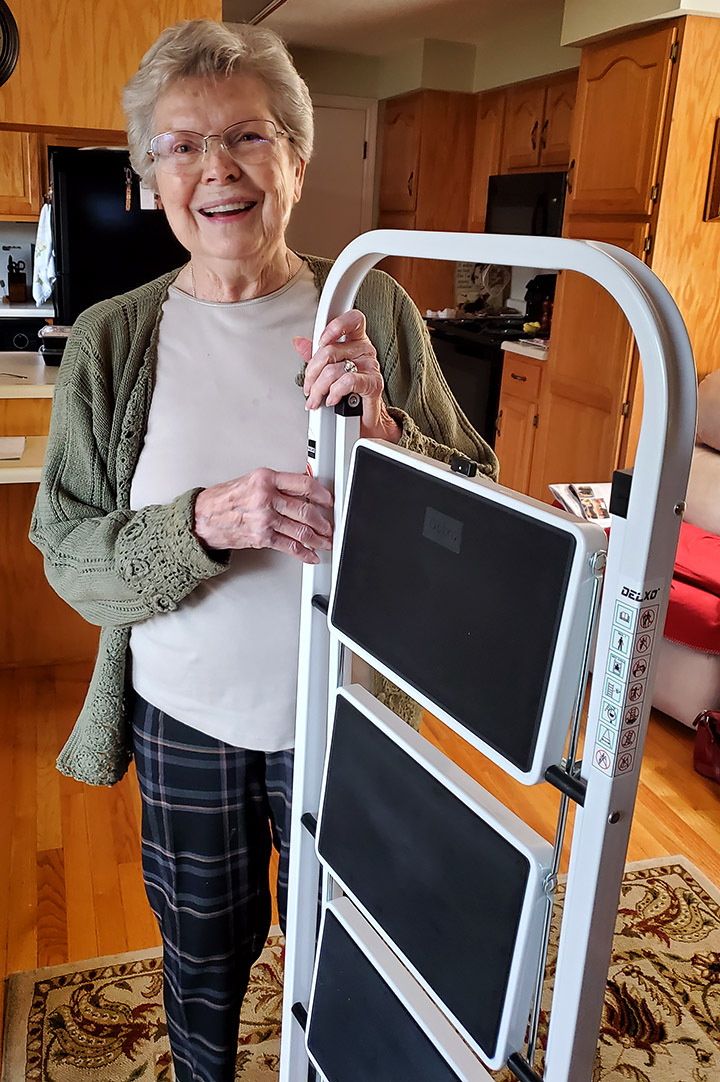
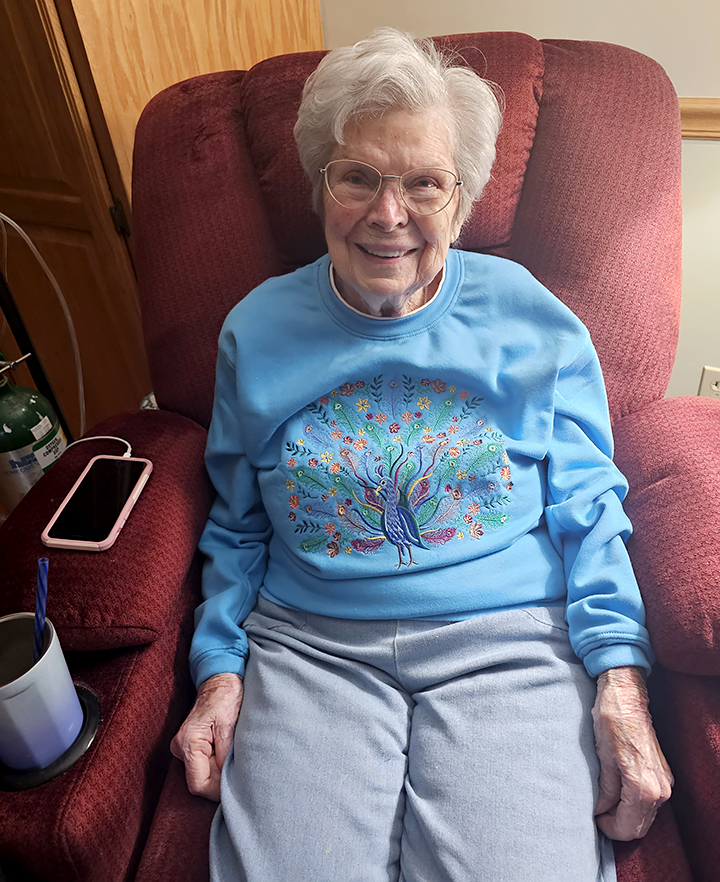
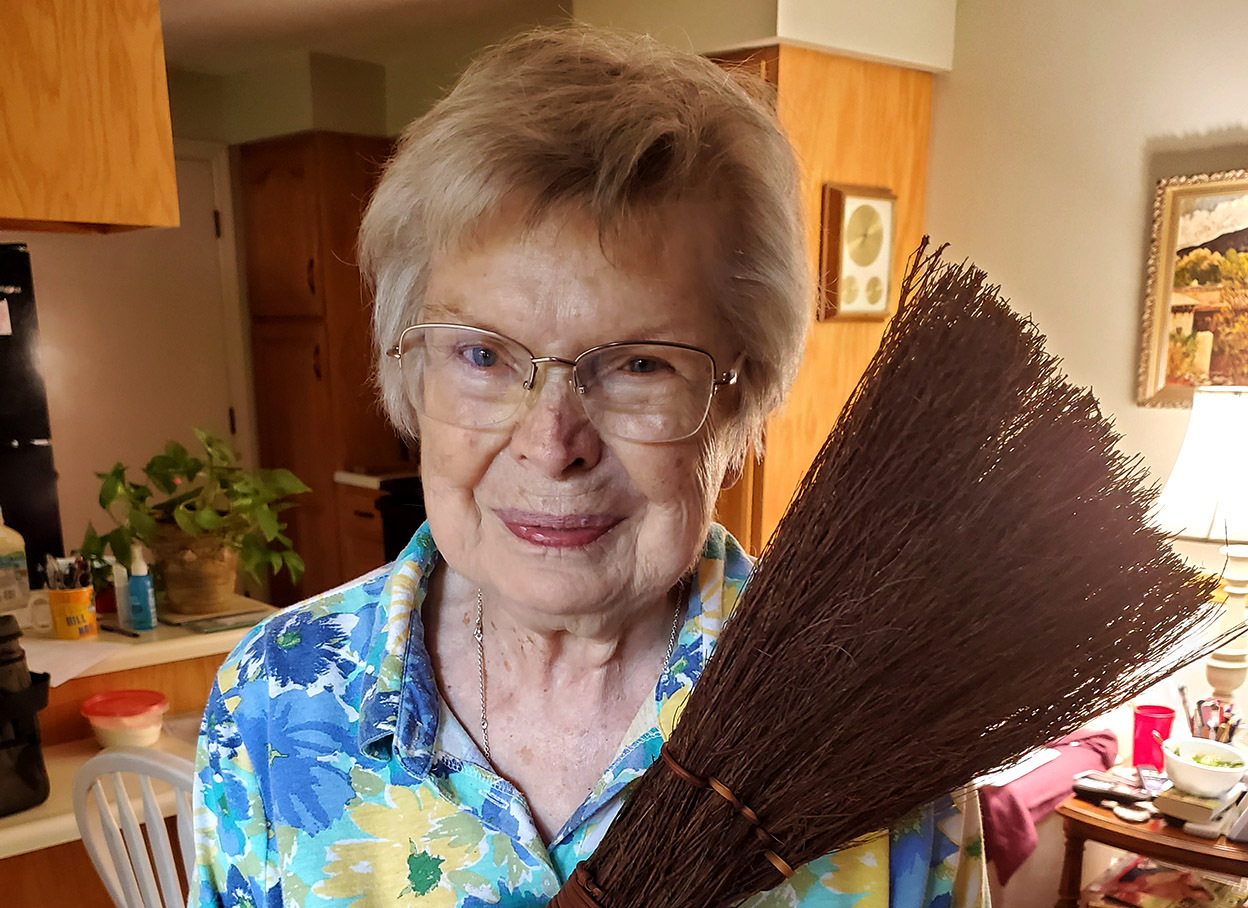
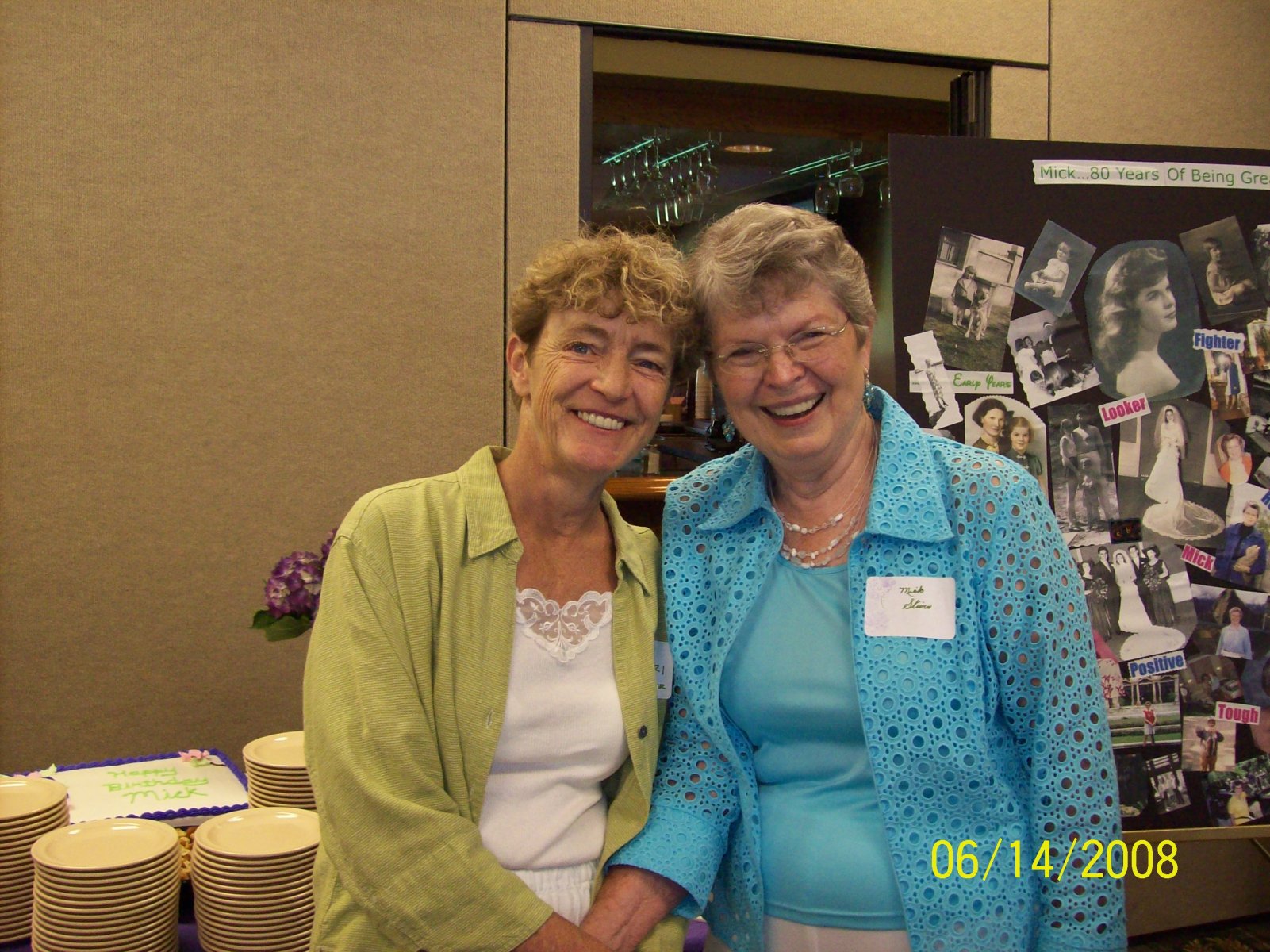
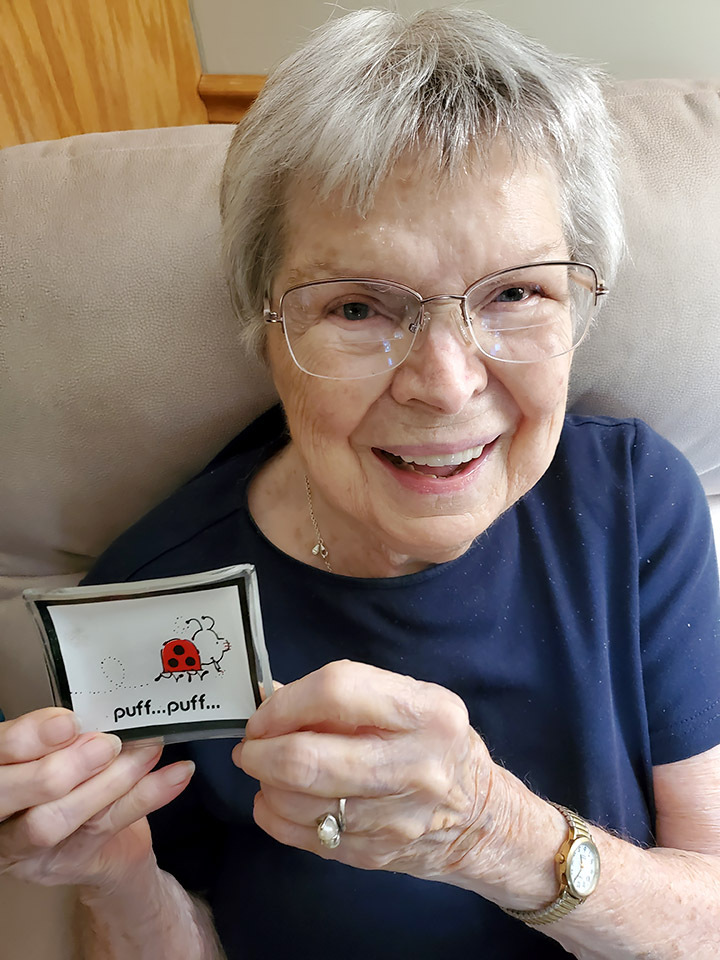
The best thing about reconnecting with Shari was meeting her mother, LaFern (who is also know as Mick to a lot of her friends).
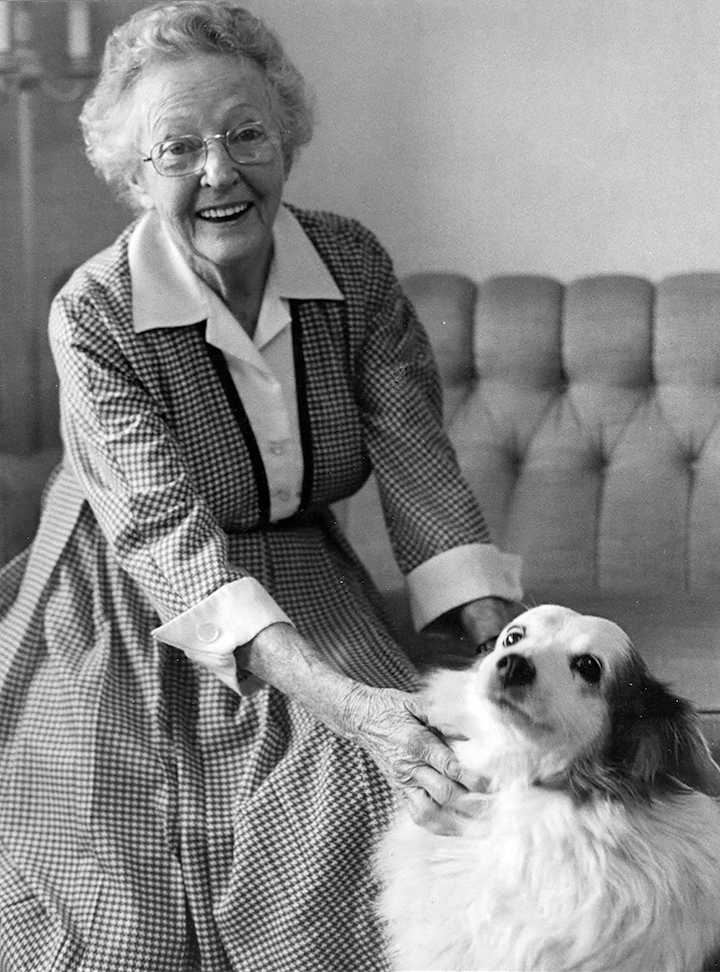
As of this writing, LaFern is 96, sharp as a tack, and an endless source of stories about growing up in Oriole and teaching in one-room schools.
I go over to her house a couple times a week to drop off leftovers, attack computer problems and to fill the Mother void after my own died.
After LaFern and Shari’s dad got married, Shari handed her new mother a pearl ring and said, “Mom, I want you to have this.”
“I intended to pass it on to her after I died.”
She called me “mom” right away, and Skip did, too. I mean, their acceptance of me was just fantastic. It really was. It was almost like they were relieved I was in the family. And I thought it was so kind of Shari when she asked me to be her mother. I thought that was one of the greatest honors I’ve ever received in my life and. We had an adoption party, so she’s my daughter, she’s not my stepdaughter.
How she got into construction
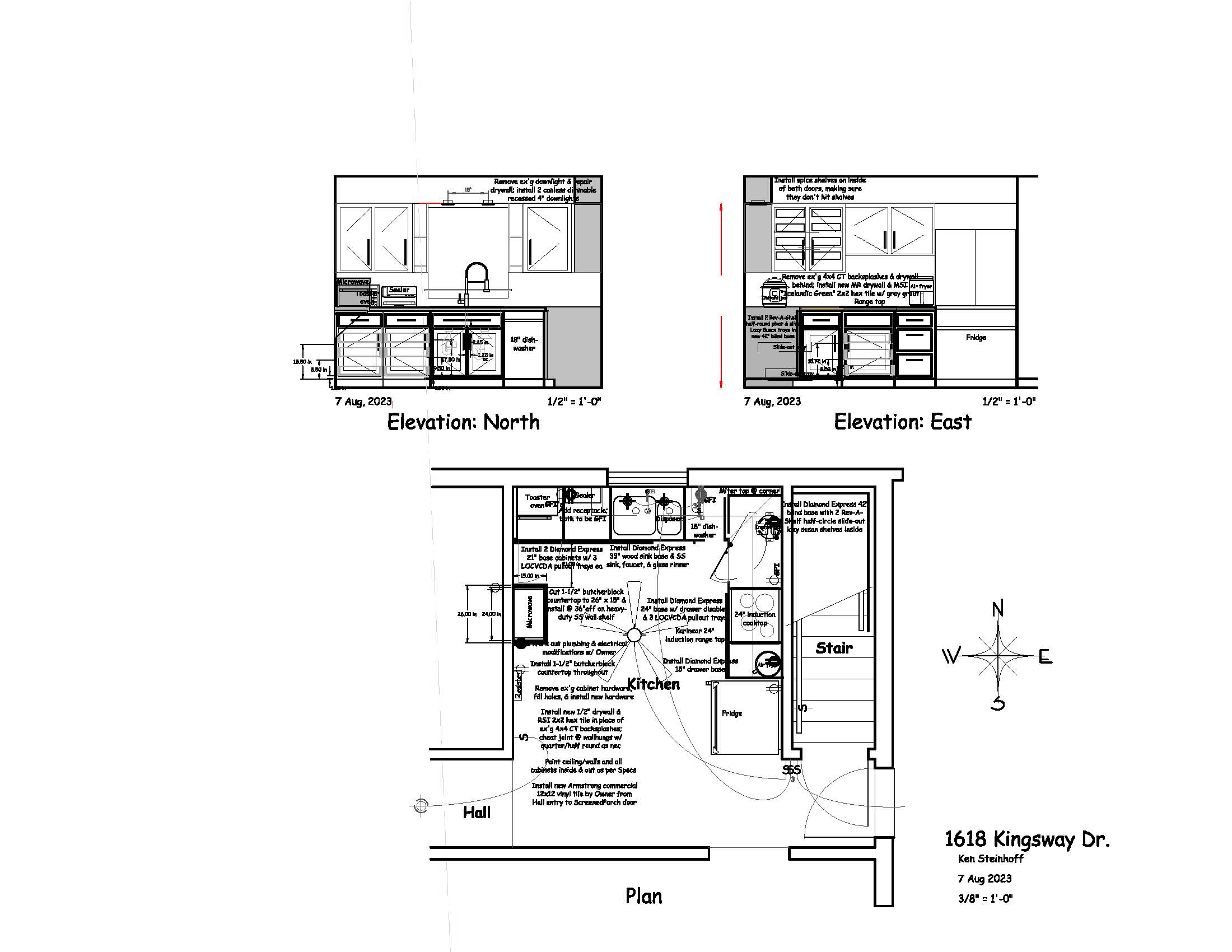
[Editor’s note: this was Shari’s floor plan for a remodel of my kitchen. It, alas, has not yet been done.]
LaFern: The first time we visited her new home in St. Louis, she warned, “Watch out for the hole in the floor.” . Right there, I mean a hole, a gaping hole. And if you stepped in it, you went down to the basement. And then we went into the bedroom, and I’m not lying, you could look up and see the rafters. There was no ceiling in that room. And I said, “Shari, does it ever rain in? And she says, well not here, but right over there it does. And I thought, for crying out loud. And so that’s how she became a contractor.
As Shari put it, “After paying contractors $10,000 to repair the house and $25,000 to repair their damage,” she decided to oversee the job herself.
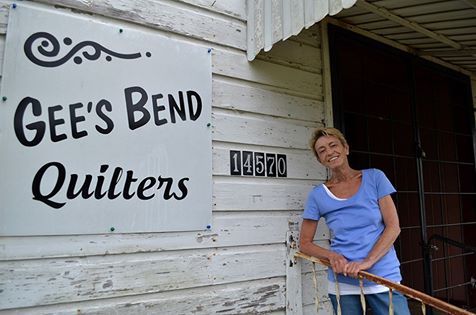
Soon, friends were asking if she’d take on their projects. It didn’t take long for her to decided to switch careers to somewhere she had a chance of actually fixing what was broken. She became a general contractor specializing in design-build rehab in St. Louis’ historic districts.
I remember her saying that she loved putting up walls a lot more than working in the court system because the walls would stay. And she said, with people, they say they’re going to, but they don’t. They just don’t change, and that was frustrating for her because when she got done with something, she wanted it done
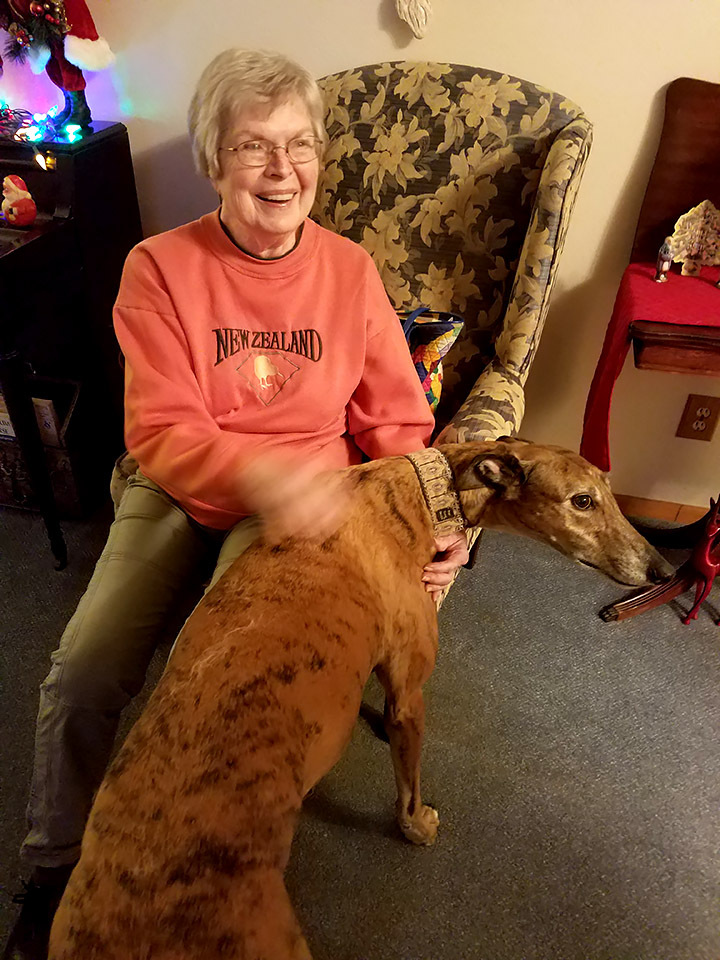
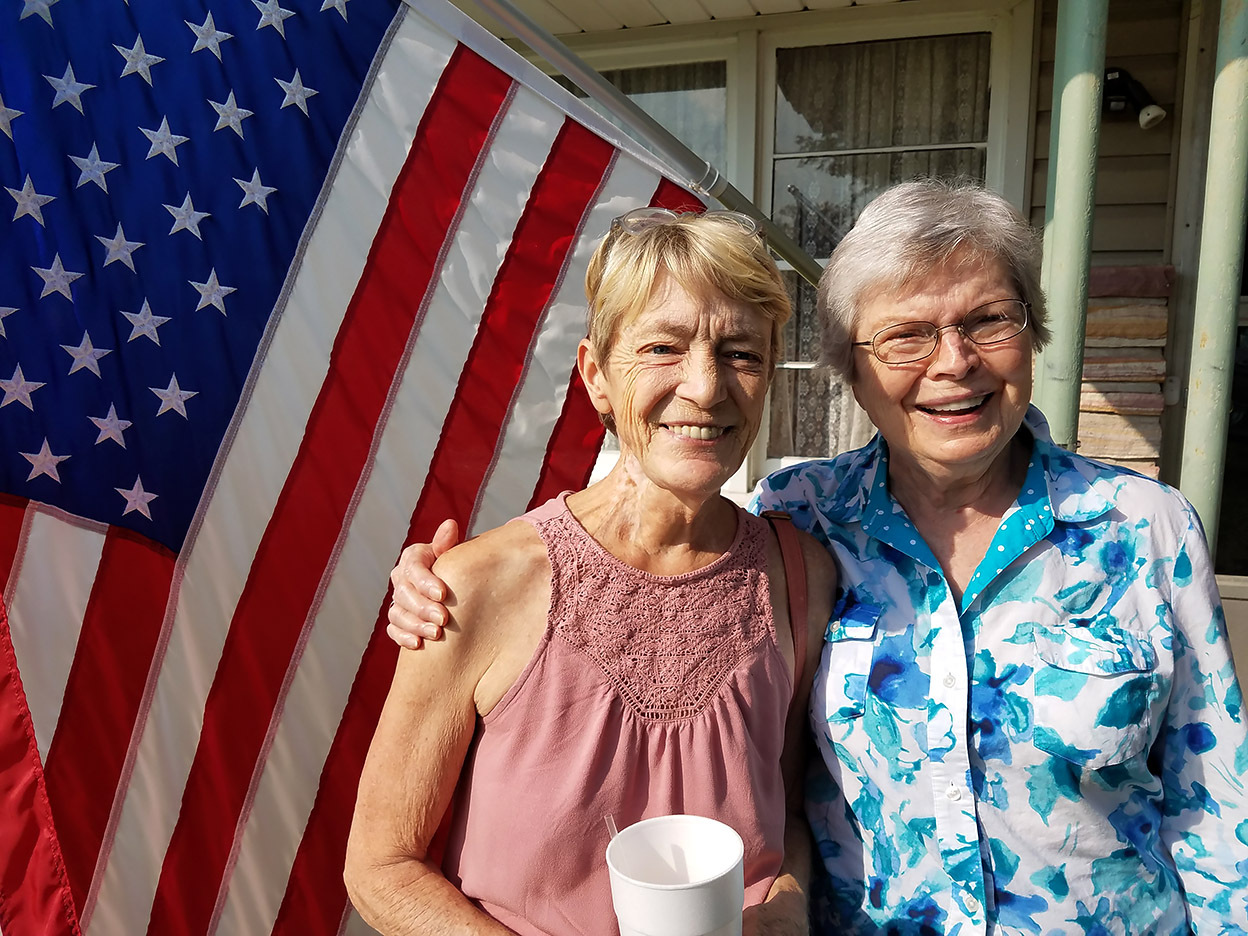
Gallery of a mostly smiling LaFern
Shari on the road
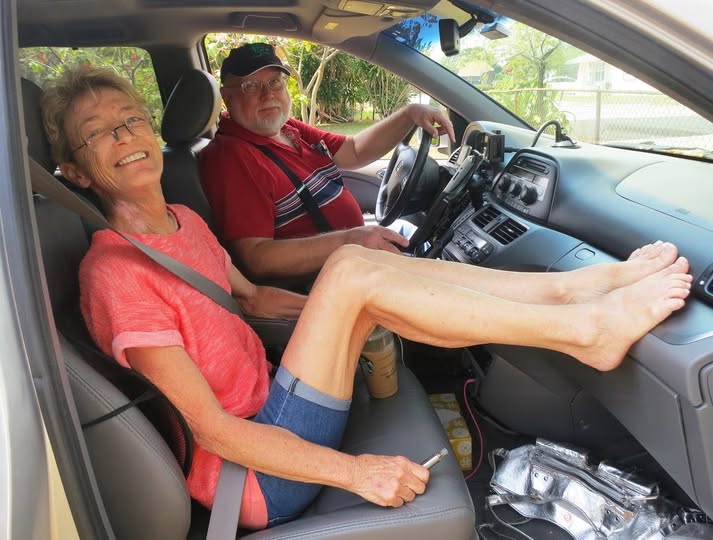
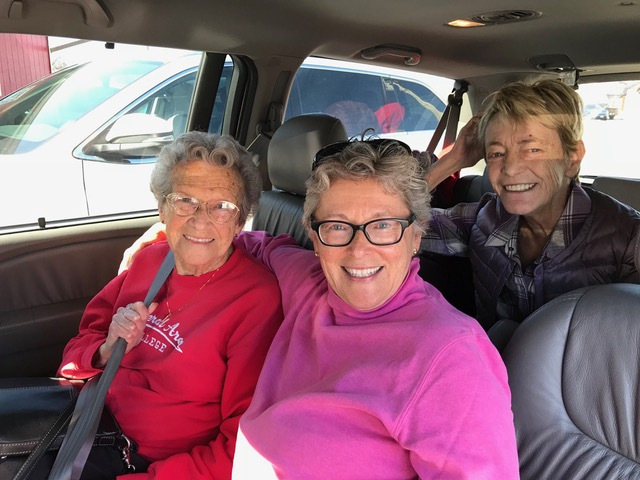
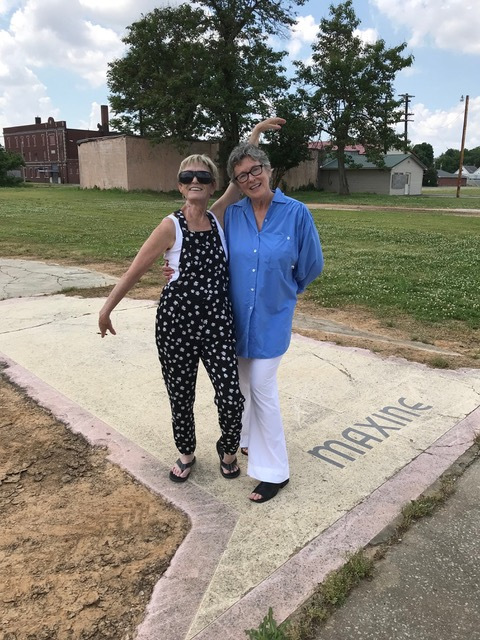
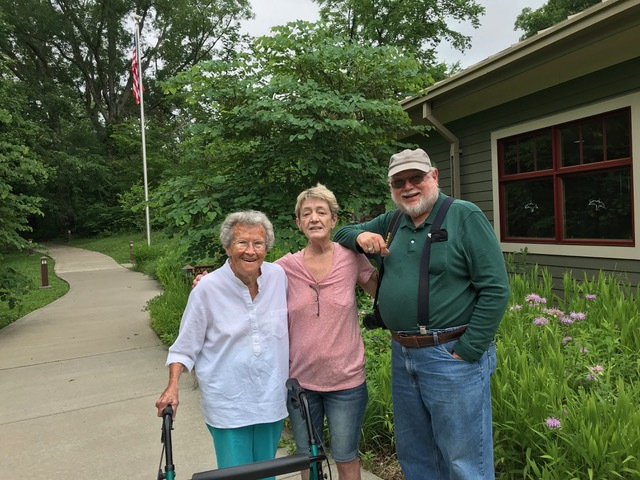
I traveled all over the Southeast with a group of women I called my Road Warriorettes. Most of them were fellow newspaper people, bike partners or a museum curator. The one thing we all had in common was the rule that anyone in the car could holler, “STOP! Turn around” if something interesting was spotted.
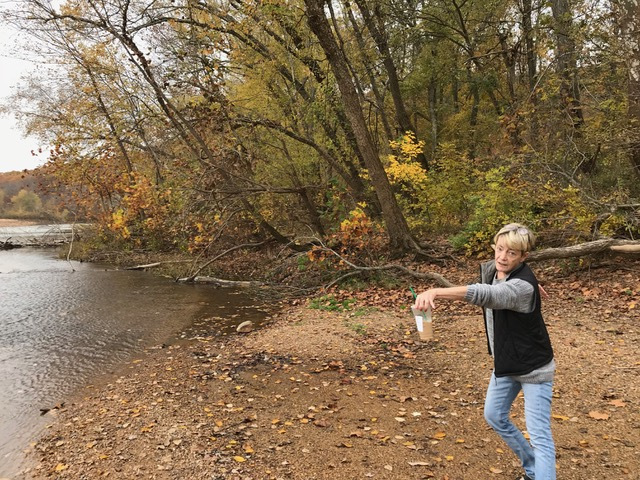
When I hauled her ashes from St. Louis to Cape, I commented, “This will be the first trip where I won’t have to say, “Get your bleeping feet off the dash if you don’t want to wear your shinbones around your ears if the airbags deploy.”
A real friend
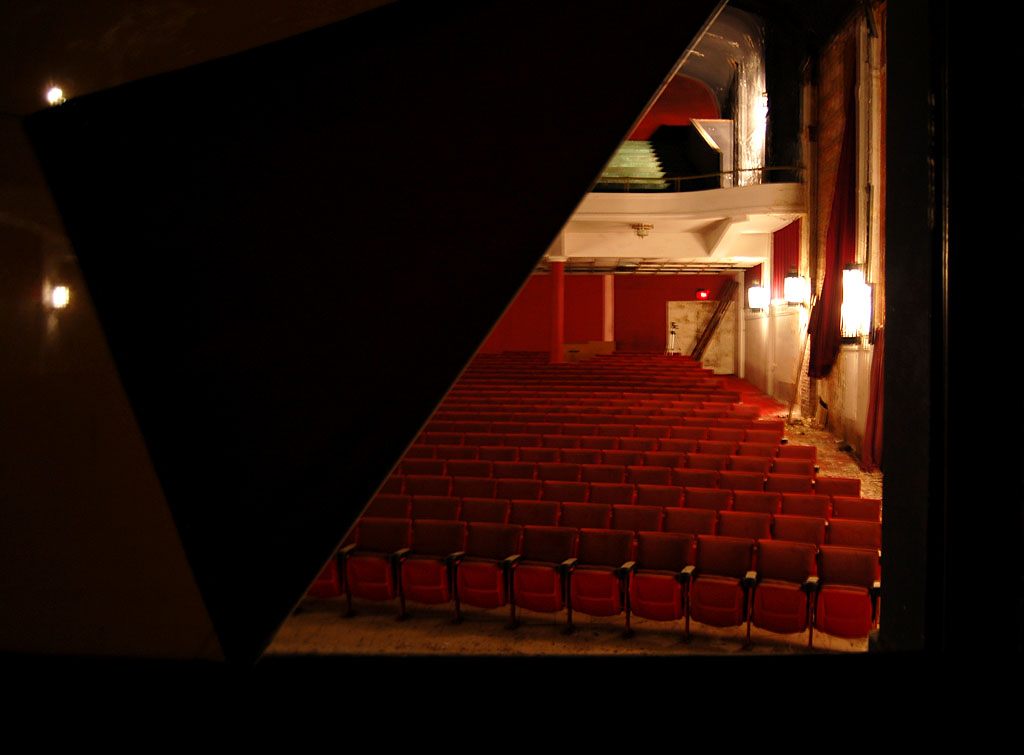
Broadway Theater – 805 Broadway 12-16-2010
I had been trying for years to get into the old Broadway theater. When I finally got permission, I realized that it would be REALLY helpful if I had someone along to help me light the place.
I called Shari in St. Louis. She tried to beg off, saying she had a cold. I did a pitiful lip quiver that must have transmitted over the phone, so she came down and bailed me out.
Random Shari photos
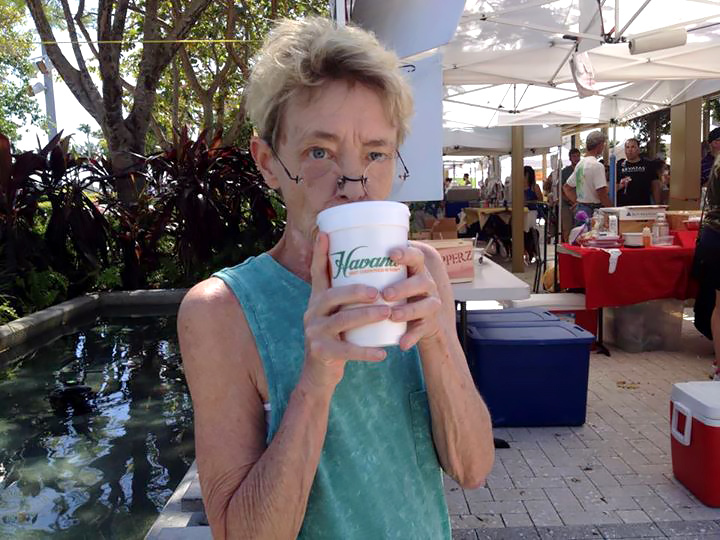
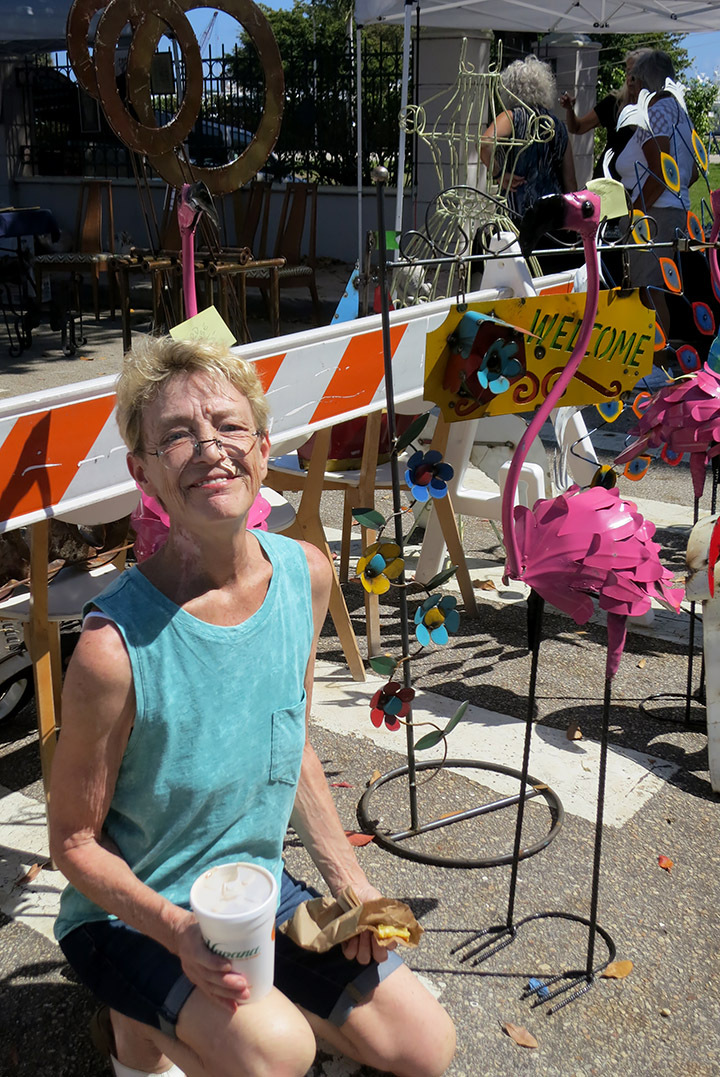
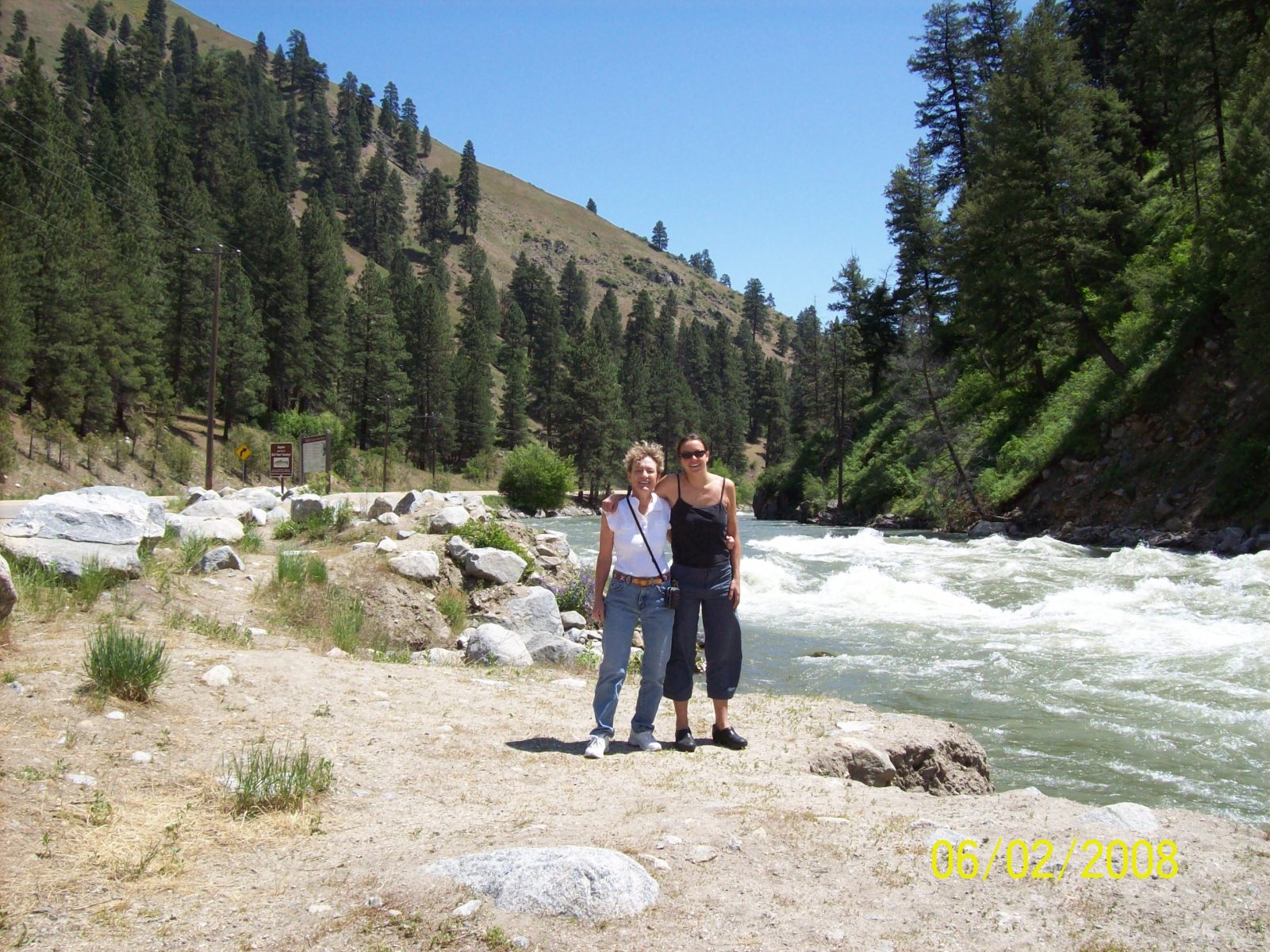
When Shari was in the hospital, I brought fruit and veggie platters in for the staff. I attached this so they could see a vital Shari instead of someone with all kinds of leads and lines hanging off her.
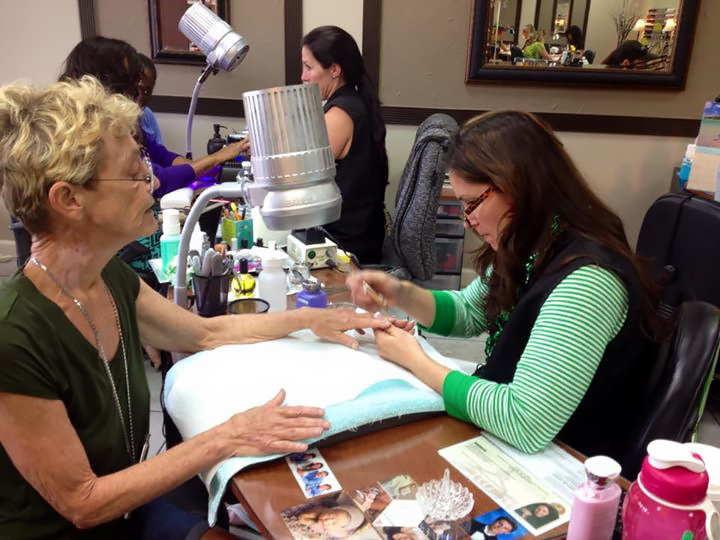
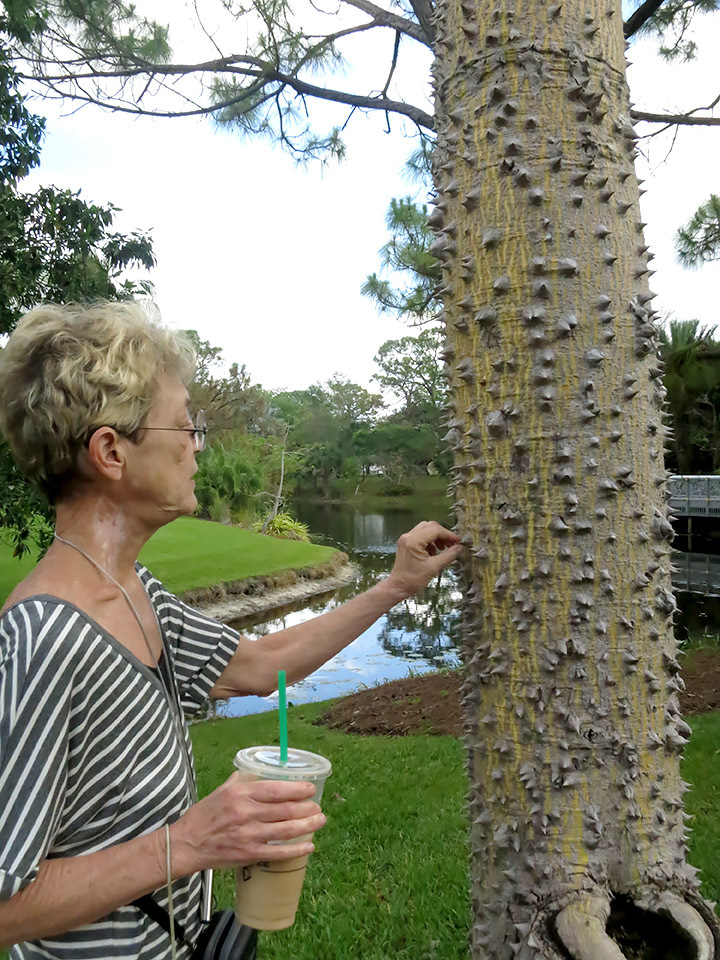
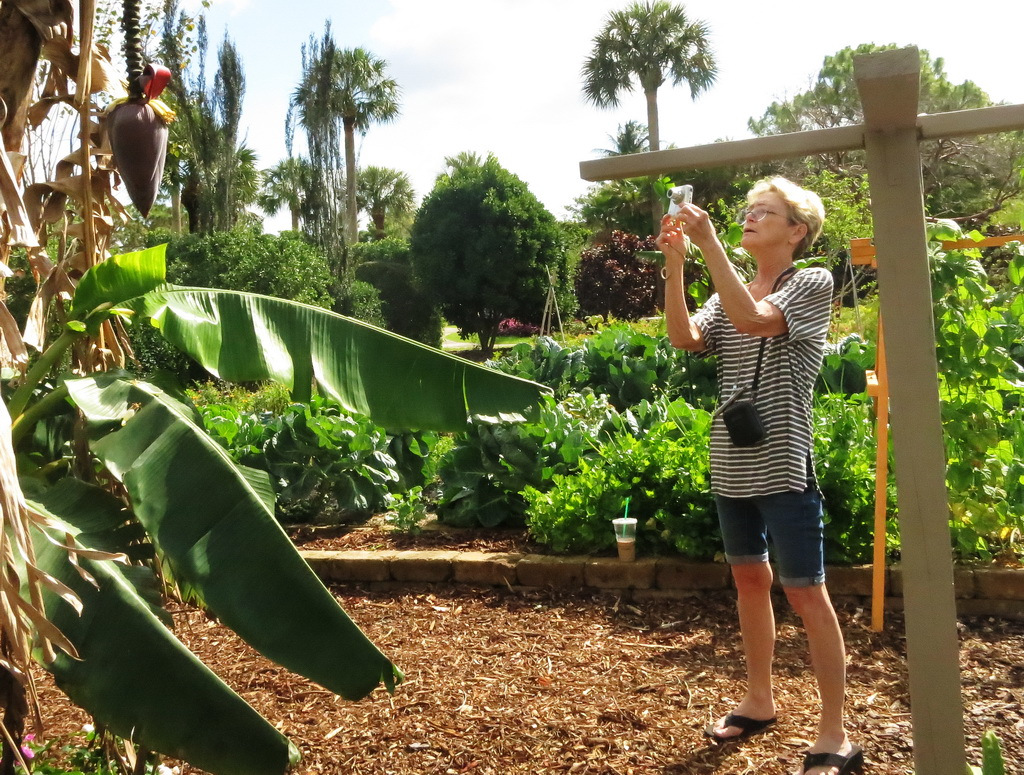
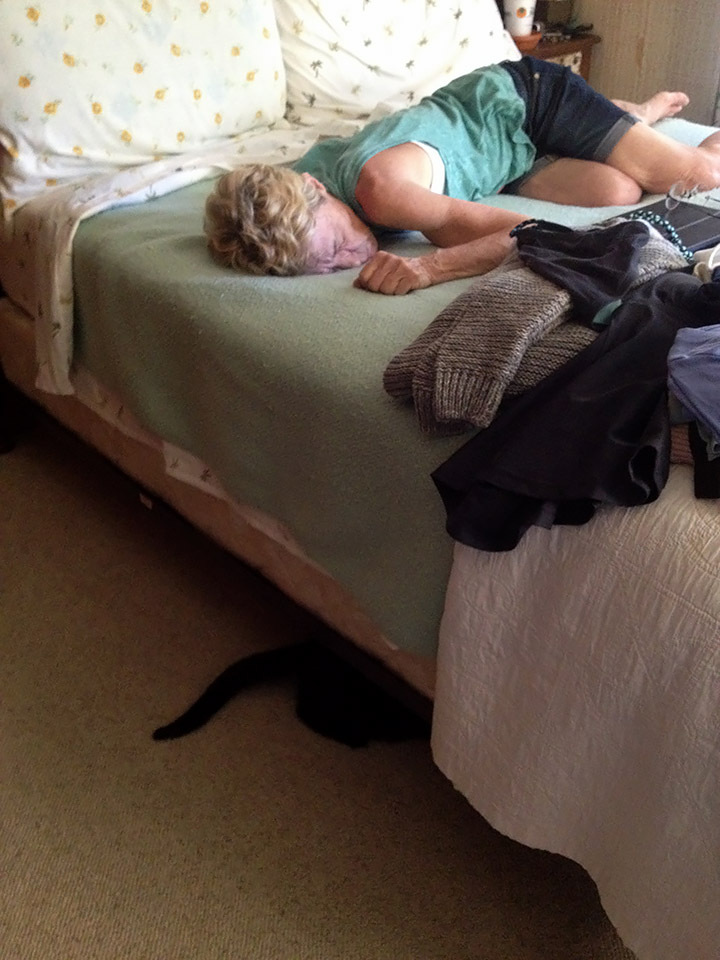
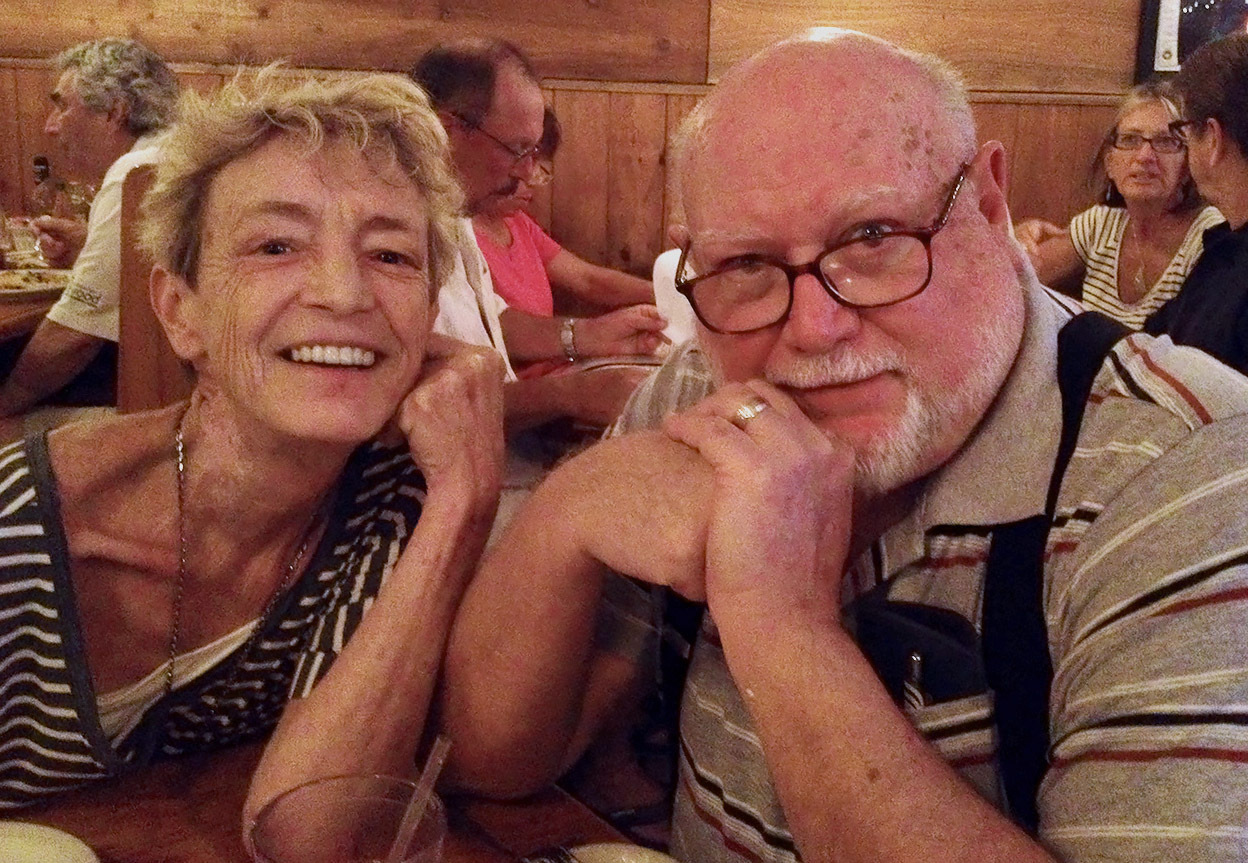
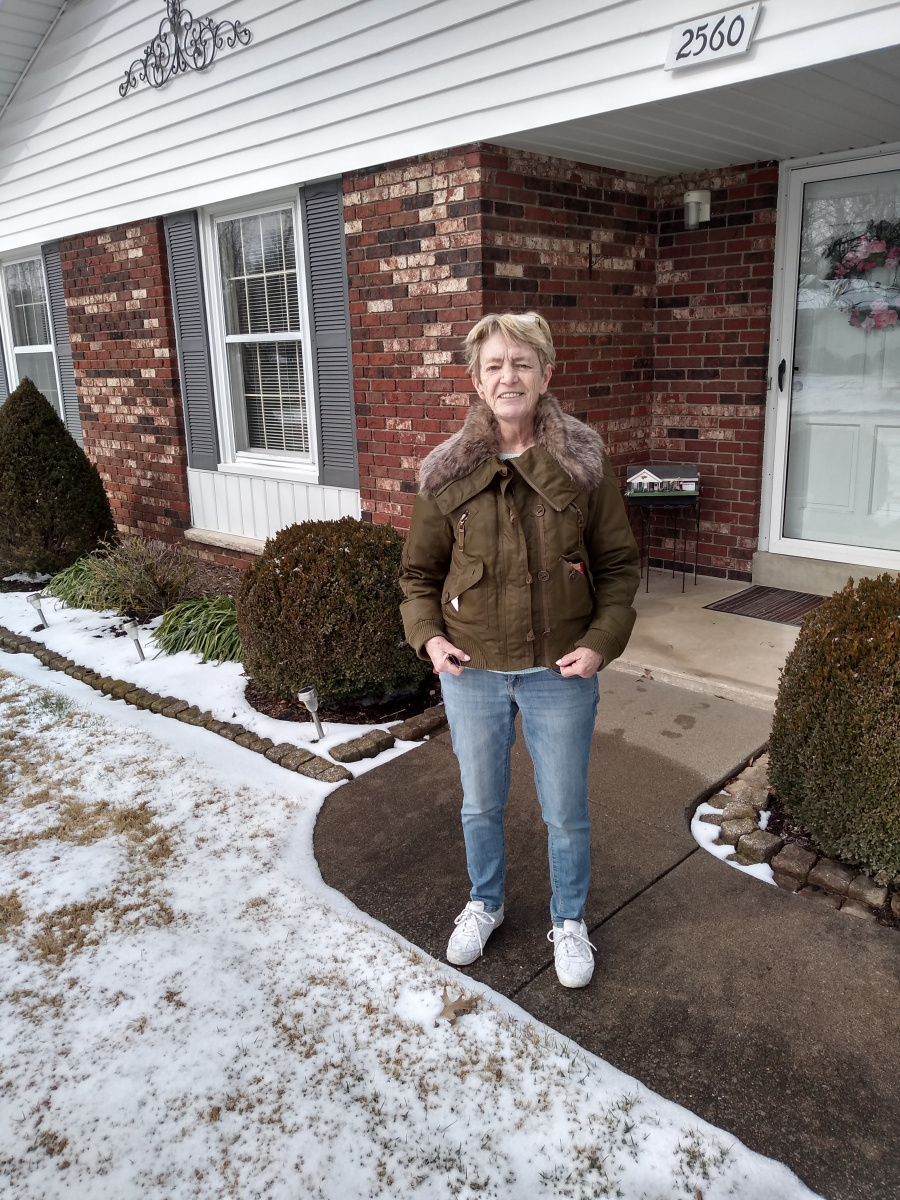
Shari hated to be photographed, and she insisted on final photo approval (which I usually didn’t seek). Here’s a gallery of photos over the years.
You’d think that after nearly 6,000 words, I might have a clearer picture of Shari, but I’ve mostly ended with more questions than answers.
Almost every evening, I’d give her a call, mostly a health and welfare check, and, to be honest, I usually felt relief when I got her voice mail.
These lines from John Prines’sHello in There rang true:
Me and Loretta, we don’t talk much more She sits and stares through the back door screen And all the news just repeats itself Like some forgotten dream That we’ve both seen
Someday I’ll go and call up Rudy We worked together at the factory But what could I say if he asks, “What’s new?” “Nothin’, what’s with you? Nothin’ much to do”
You know that old trees just grow stronger And old rivers grow wilder every day Old people just grow lonesome Waiting for someone to say “Hello in there, hello”
Dangling Conversation
I had a hard time deciding whether John Prine’s verse or lines from Simon and Garfunkel’s Dangling Conversation were more appropriate. Electrons are cheap, so I’ll go with both.
Yes, we speak of things that matter With words that must be said
And how the room is softly faded And I only kiss your shadow, I cannot feel your hand You’re a stranger now unto me Lost in the dangling conversation And the superficial sighs In the borders of our lives
Boy in the Rain
When I read this poem she wrote in the style of e.e. cummings, I wondered if I was the boy in the rain.
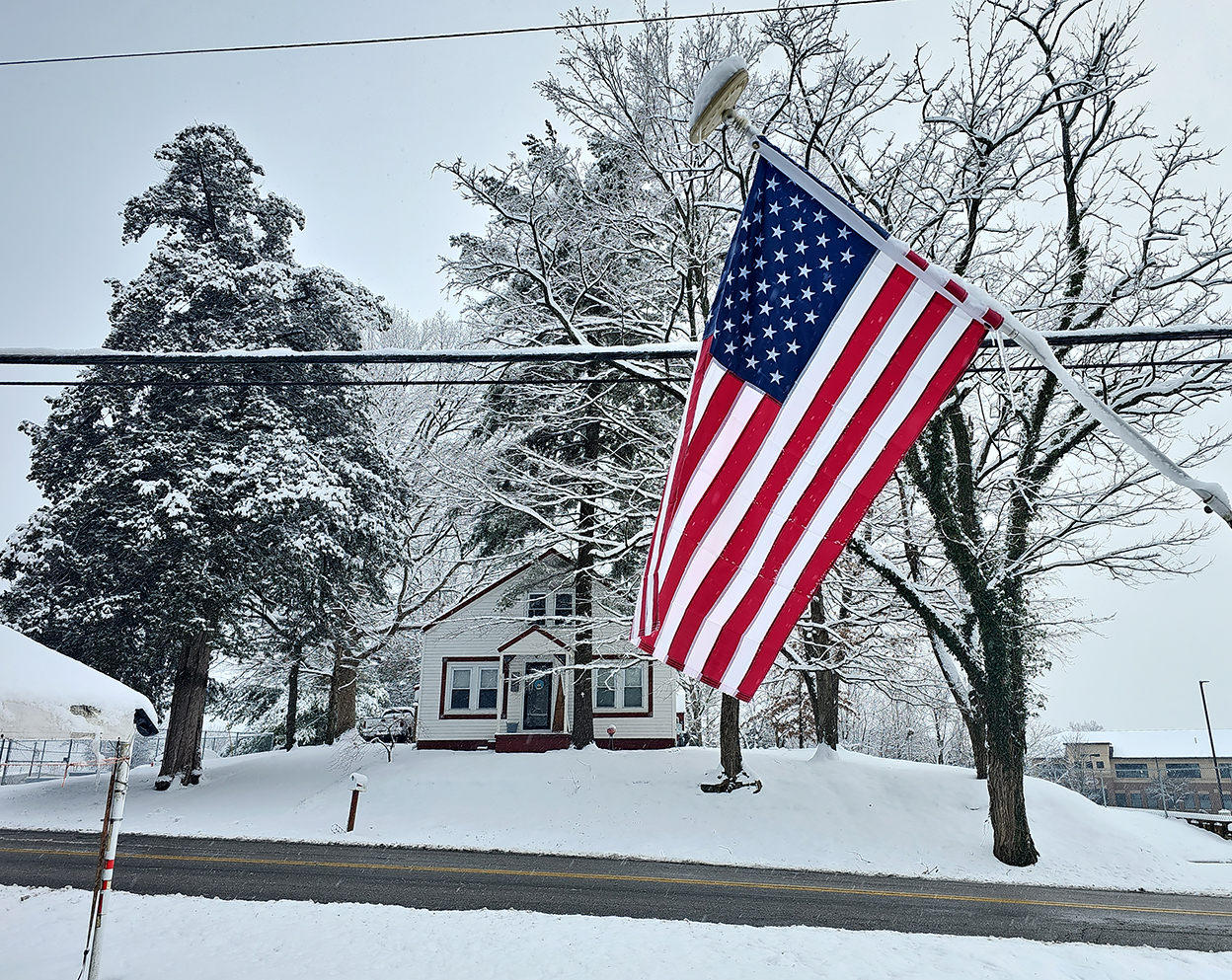
The forecasters were pretty much right. They promised us a wintery mix, and we got the whole gamut: rain, freezing rain, half an inch of ice and about five inches of snow here on Kingsway in Cape.
Here is my standard photo looking across the street to the Bolton house.
Wib’s emergency
Wib’s BBQ sandwich 01-09-2025
When the weather started to look iffy, I figured I should journey to Wib’s, remembering when I made a similar pilgrimage in 2013.
An outside combo, with French fries, slaw and iced tea fueled me up for a trip to grocery stores.
Empty shelves at Schnucks
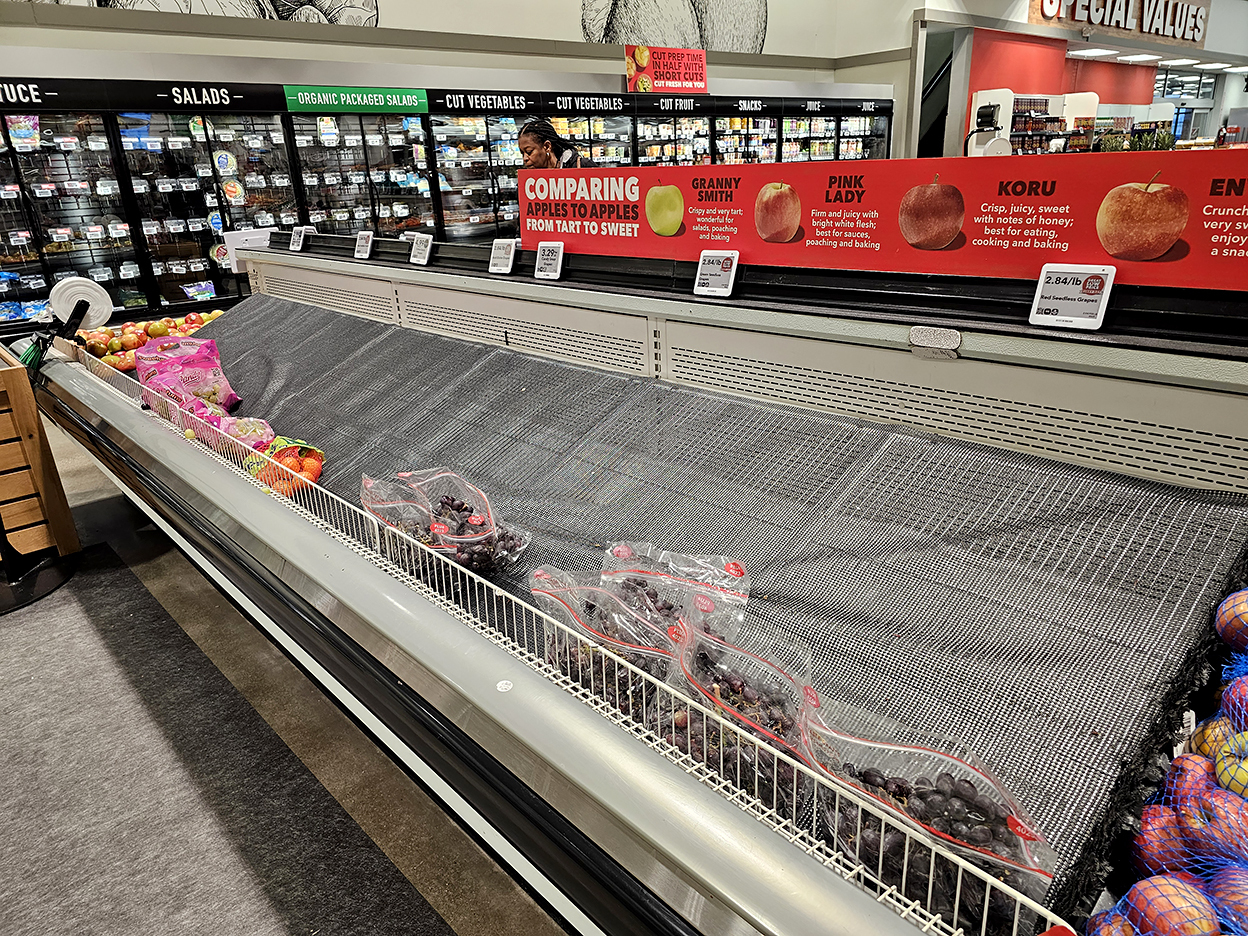
I went to Schnucks specifically looking for key limes and bacon-wrapped pork steaks. They had neither.
I asked the guys in the produce and meat departments if they were hiding any, but they said the supply truck hadn’t arrived, but it should be there the next day.
I thought there wasn’t a snowball’s chance in Hades of that happening with the forecasts for the rest of the week.
A combination of supply chain issues and panic buying left many shelves virtually empty. Click on any image to make it larger, then use the arrow keys to move through the gallery.
Studded tires will start you, but not stop you
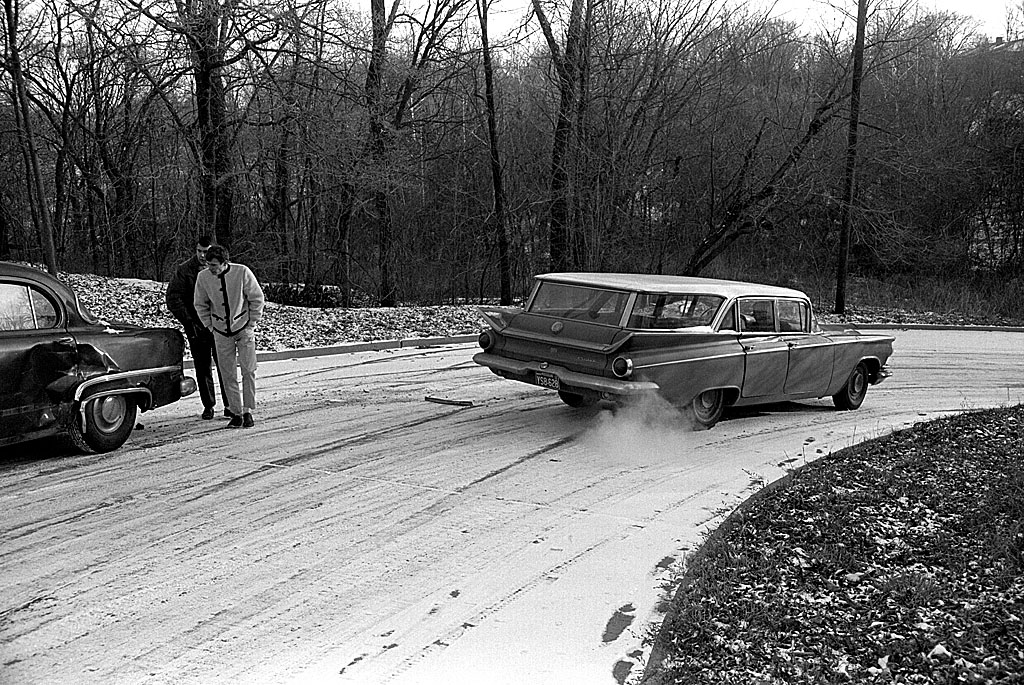
1966 minor crash on icy street
There was a time when I would have fired up the old 1959 Buick LaSabre station wagon and roamed all over town documenting the wintery weather, but I’m older and wiser, and the Buick has long since gone on to its eternal reward. (Dad gave it to one of his workers to haul firewood on his farm. It was a straight-ahead vehicle, meaning that it no longer worked in reverse.)
Here is where I learned in 1966 that studded snow tires might help you get started on ice, but they didn’t do diddly when it came to stopping.
The guy in the black car was on the wrong side of the road when I was heading down the hill.
Roughly five inches
Snow 01-10-2025
While I was visiting family in South Carolina and Florida over the holidays, the birds emptied about 2/3 of the bird feeders in the back yard. The ice storm froze the ropes and pulleys I use to hoist them past the squirrel zone, so I couldn’t do much for them.
I saw some woodpeckers looking at the few pitiful scraps of suet block, so I managed to replenish that feeder.
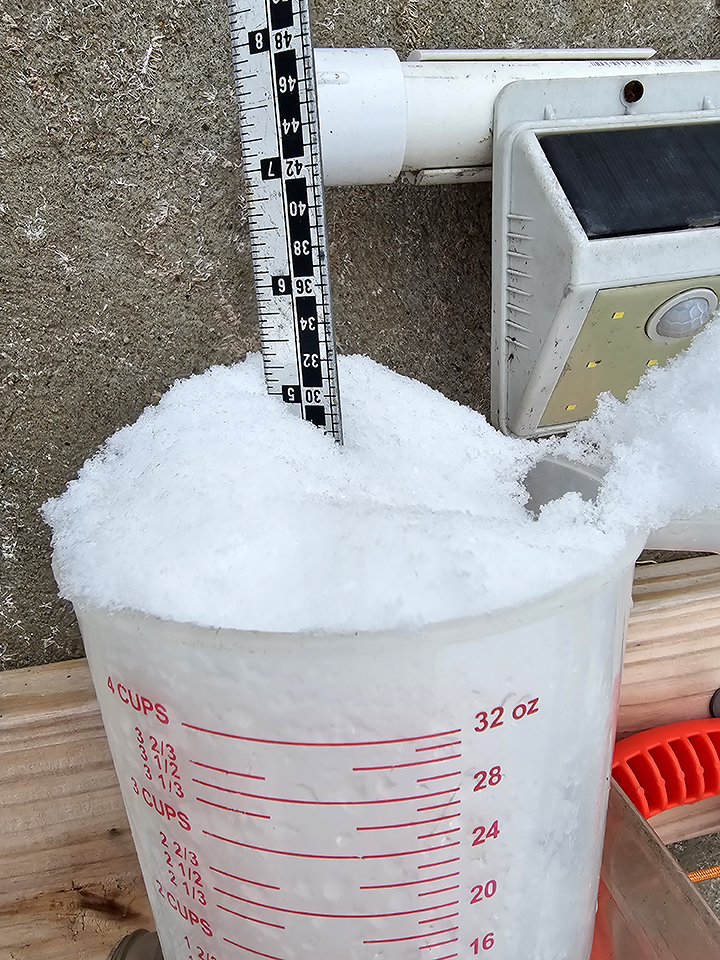
I used a measuring cup to fill a feeder down low, then promptly left it hanging on a Shepard’s crook. When I went outside the next morning, it had about five inches of snow in it. I couldn’t get any wind or precipitation readings from my weather station because it was a solid block of ice.
Heated water dish
Snow 01-10-2025
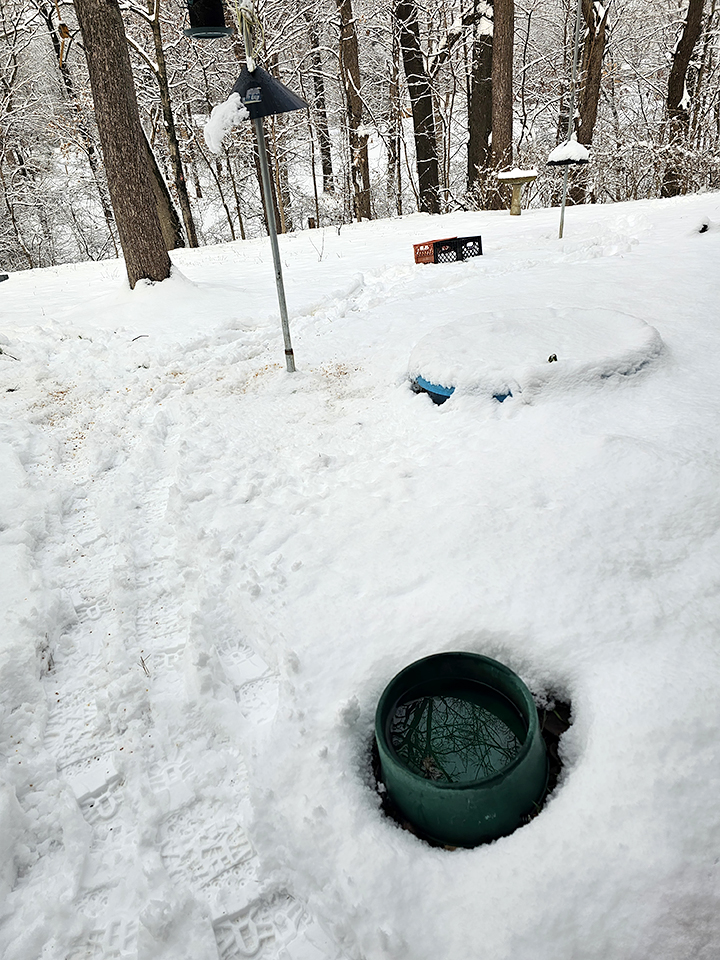
Before Phoebe the Bleeping Cat was granted indoor privileges a couple of winters back, I kept a heated drinking dish for her. I bought a kiddie pool to hold water for all the back yard livestock, but it was frozen so solidly that even a posthole digger wouldn’t break the ice.
The dish stays liquid even if the rest of the world is a white, solid mess.
Cool mailbox
Snow 01-10-2025
After a distracted driver mowed down my mailbox, I replaced it with this bigger one so the carrier doesn’t have to make as many porch deliveries.
USPS has this cool app that lets me see what mail is coming, so I didn’t have to wade through the snow to see there was nothing in the box that was urgent.
Snow covers a multitude of sins
Snow 01-10-2025
Nothing like a fresh blanket of snow to cover up all the ugly parts of my front yard.
Older and wiser, remember?
Snow 01-10-2025
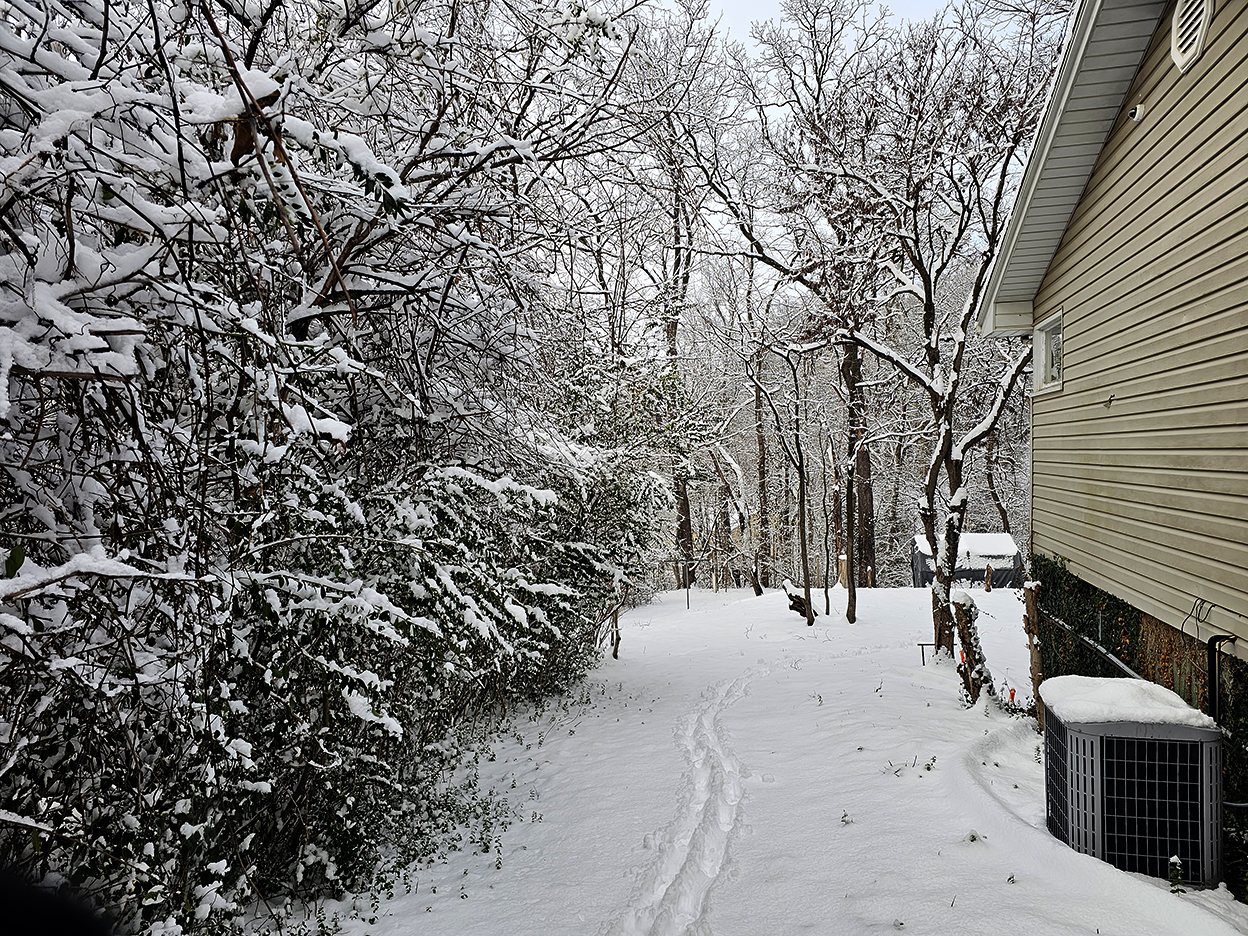
I walked the perimeter of the yard checking for damage, but I was pretty much OK except for some minor limbs down.
I saw several people leaving stores with sleds under their arms, but I opted out of trying to sled down the hill on the west side of the house.
In fact, when I was in Buchheit’s last week, I saw some handy ice cleats that were nice to stick on my rubber boots. I have some hip pain, but I’d prefer not to break what I’ve got.
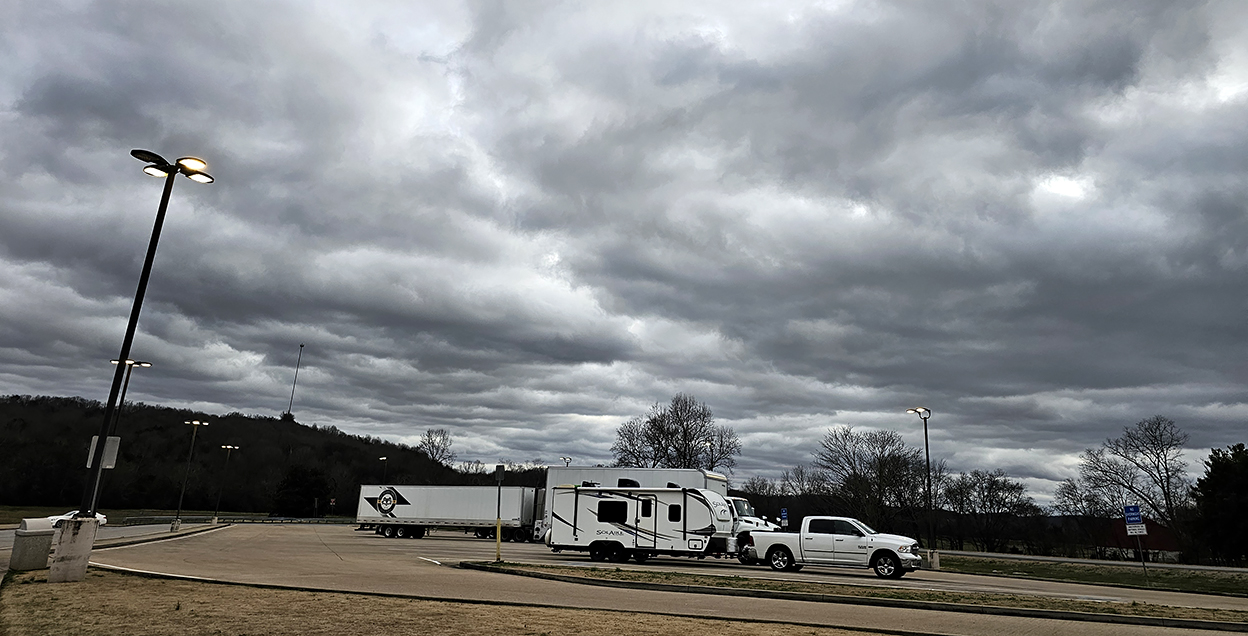
Cold weather causes my bladder to shrink, so I took advantage of every rest area between Cape and South Carolina (Son Adam) and West Palm Beach and back over the holidays.
This was my last sunset of 2024, taken at a rest area just over the Tennessee state line. Those clouds were part of a cold front moving in.
I had planned to make it as far as Cadiz, but elected to get off the road in Nashville before the drunks had time to get fueled up.
First 2025 sunset
Jan 1 sunset 1/1/2025
I spotted this while I was unpacking my van on January 1.
Dad would have commented that “the moon is fixin’ to spill water.”