Downtown Cape Girardeau Vintage Aerial Photos from the 60s

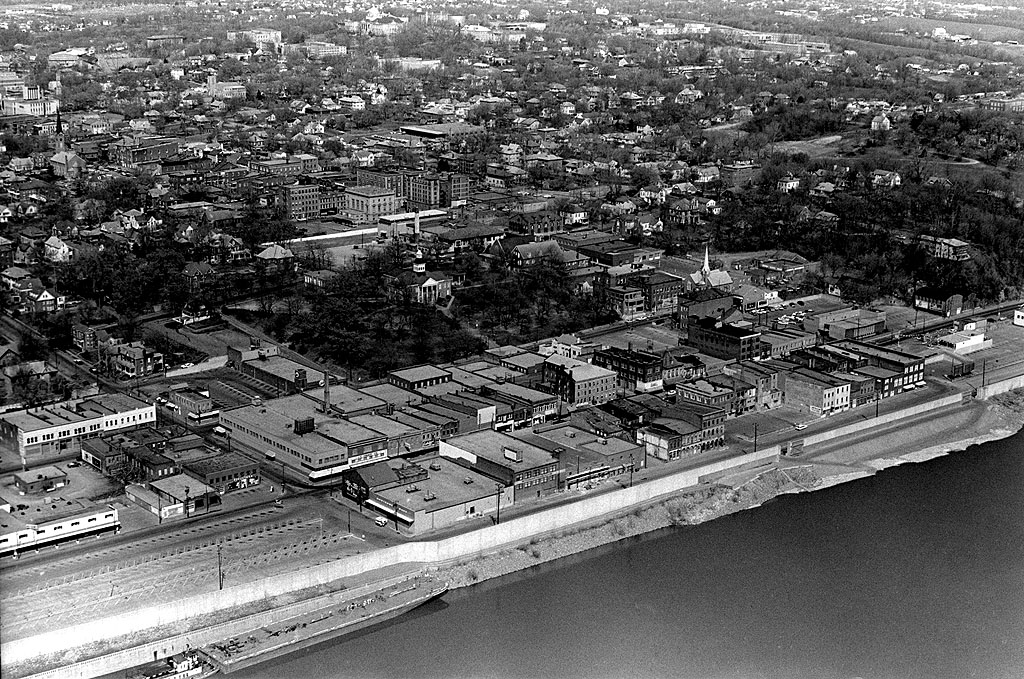
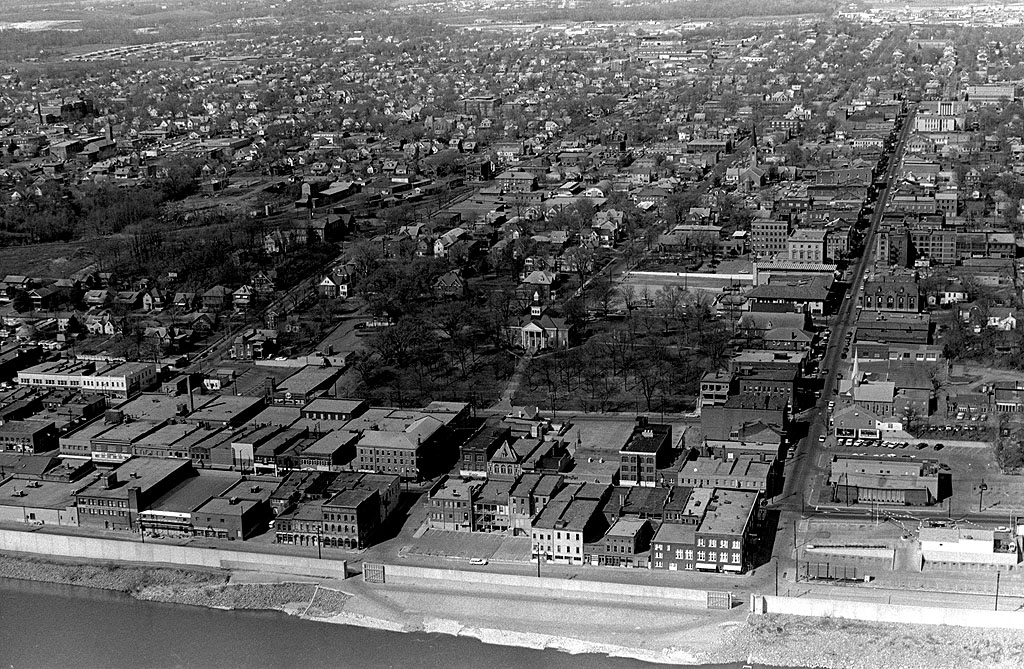
Fred Lynch had a Frony picture of cars parked on the Mississippi River wharf before the floodwall was built. I had a couple of frames I took from the air of the downtown area that shows the riverfront area after the floodwall and before the wharf area had been refinished.

(Click on the photos to make them larger. Click on the left or right side of them to step from one to another.)

Many landmarks are clearly visible. The most prominent, in the left center, is the Common Pleas Courthouse, high on a hill overlooking the city. Right behind and above the Court House, look for a white chimney. That’s the Southeast Missourian Tower, which stood 70 or 80 feet above the ground and could be seen as far away as McClure, IL. The tower was razed in 1978 when a new boiler was installed and it became obsolete. It also had shown signs of structural weakness.

Way up at the top center left is Academic Hall at Southeast Missouri State University. The tall, dark steeple of Trinity Lutheran Church is at the left of the frame.

Al’s Shops and the St. Charles Hotel

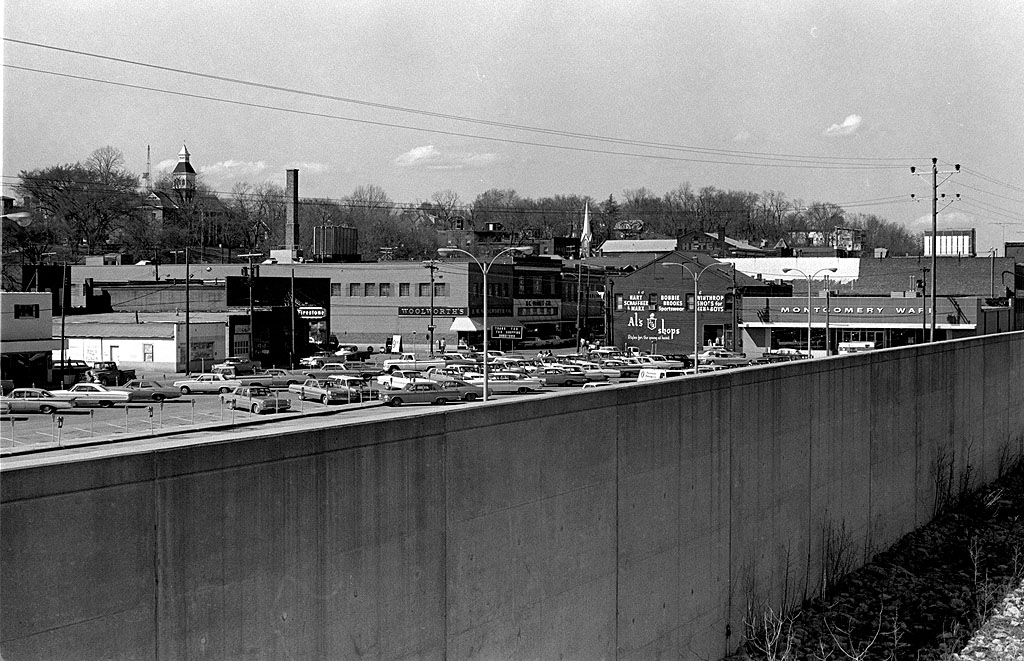
Here’s a view peeking over the floodwall from the south end of Main Street. Al’s Shops is clearly visible in both the aerial and this photo. Right over the top of Al’s, you can see the sign on the side of the St. Charles Hotel.You also can see the Firestone Store, Woolworth’s, J C Penney’s and Montgomery Wards.

I wonder if all the cars in the parking lot are shoppers or if they are store employees displaced when wharf parking was no longer available.

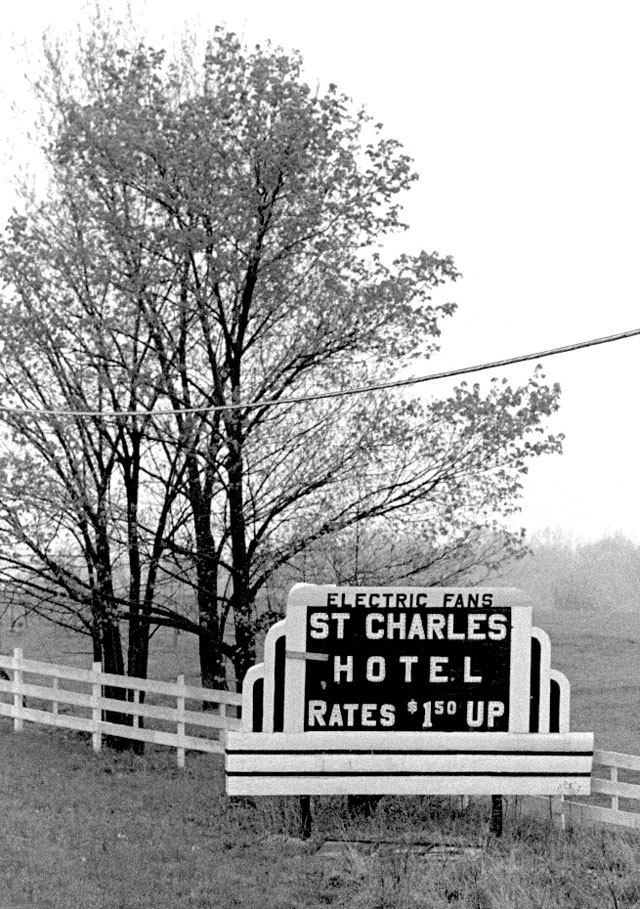
Stay at the St. Charles for $1.50 a night (and up)

Here’s a sign on Highway 61 between Cape and Jackson that promised ELECTRIC FANS and room rates of $1.50 a night and up at the St. Charles. It was taken April 16, 1967.

That’s even cheaper than the $2-a-night room I stayed in when I covered a Flying Saucer Convention in a small town in the Missouri Ozarks. I don’t recall if it had electric fans for the addition 50 cents. I know the bathroom was down the hall.

I’m still looking for some pictures I have of the St. Charles being razed. In the back of my mind, I see a crumbling brick wall and a window with either a bird flying through it or sitting on the windowsill.

Funny how some things flicker in and out of your memory.

Downtown Cape Girardeau, looking up Broadway

The Common Pleas Courthouse is, again central in the photo. Broadway runs from top to bottom at the right of the photo, Themis is behind and in front of the Courthouse, and Independence is at the left of the photo. Buckner Ragsdale is at the foot of Broadway. The building that became Port Cape Girardeau is at the foot of Themis. The peaked roof, one building to the right of Themis on Main St., is Hecht’s. I can’t make out its iconic wind vane in this photo, unfortunately.

The Idan-Ha Hotel at Broadway and Fountain is visible above The Missourian building and across from the Marquette Hotel. The KFVS tower hadn’t been built yet.

National Register Listings

The Missouri Department of Natural Resources has an excellent resource for anyone interested in historical buildings. Go here for a listing for Cape Girardeau County’s National Register Listings. Some of the files are large, so they may not be suitable for folks with slow connections. There are histories of the buildings, maps and photos. It’s a great way to kill some time and learn a lot about the area.

The downtown area is covered by three files all tagged Cape Girardeau Commercial Historical District (with boundary increases).

If you are on Facebook, check out the Old Town Cape fan page and the Cape Girardeau fan page. There’s a lot of interest in Cape on the Internet.

Other visits to the riverfront and downtown area

CapeCentralHigh.com’s Business Card

I mentioned that I was coming back to Cape next week to look for sponsors and advertisers. After procrastinating way too long, I stayed up until 2 a.m. trying to come up with some iconic photos that would work for the business card and for headers on a redesigned web site.

Son Matt came up with several designs (you can see them below), but the one above is the best at capturing the voice of CapeCentralHigh.com.

  • Everyone who grew up in Southeast Missouri in the 60s will recognize it.
  • It’s black and white.
  • It has the feel of the site.
  • It’s visually interesting.

Someone’s farm from a speeding car

This is the first design he sent me.

I really like the image. Based on the comments I received when it ran, so did you. The only problem was that it just a little bit too rural to say “Cape Girardeau” at first glance. Cape’s a relatively small town, but it IS a town.

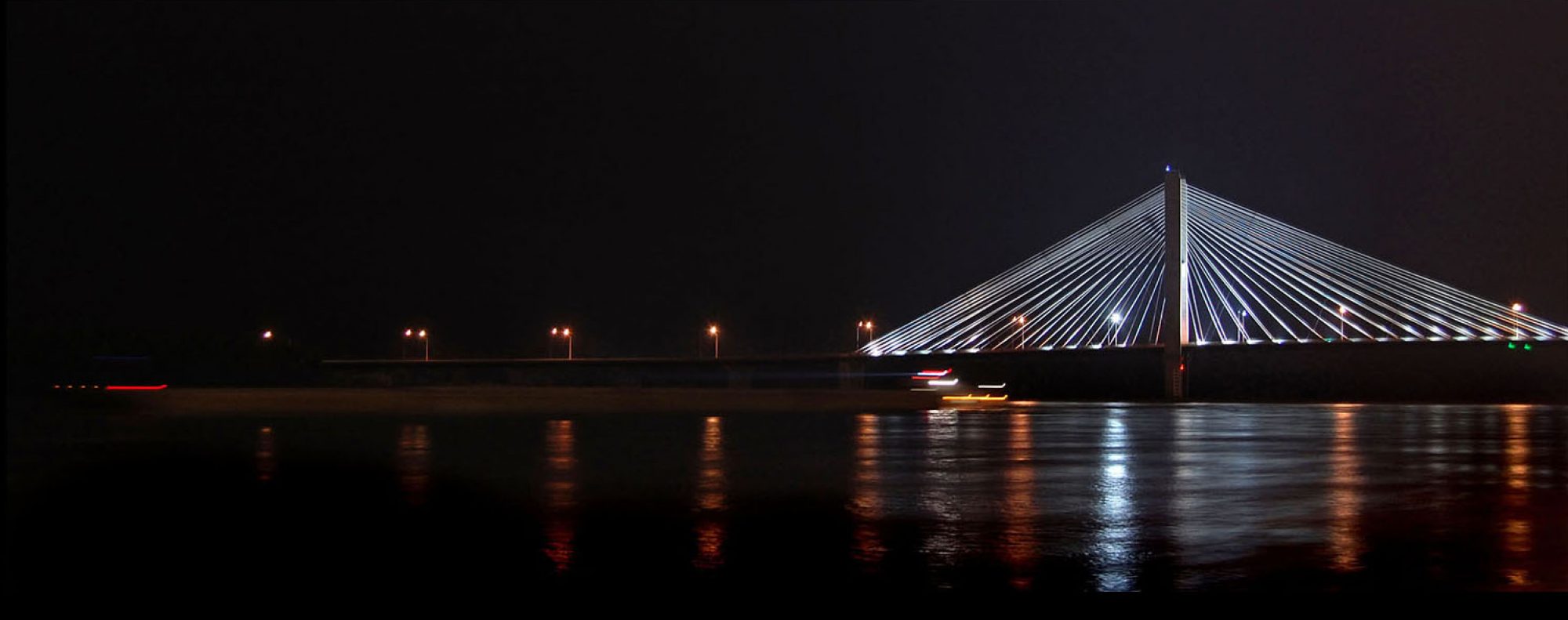
The Bill Emerson Bridge was striking

Wife Lila’s eyes popped when she saw it. It’s great from a graphical standpoint. The subtle colors are nice and the elements come together to give a nice place to put the text. It was also the subject of my very first blog post on Oct. 20, 2009.

It would make a GREAT business card for someone in Cape, but it screams Today, and my site is all about Yesterday.

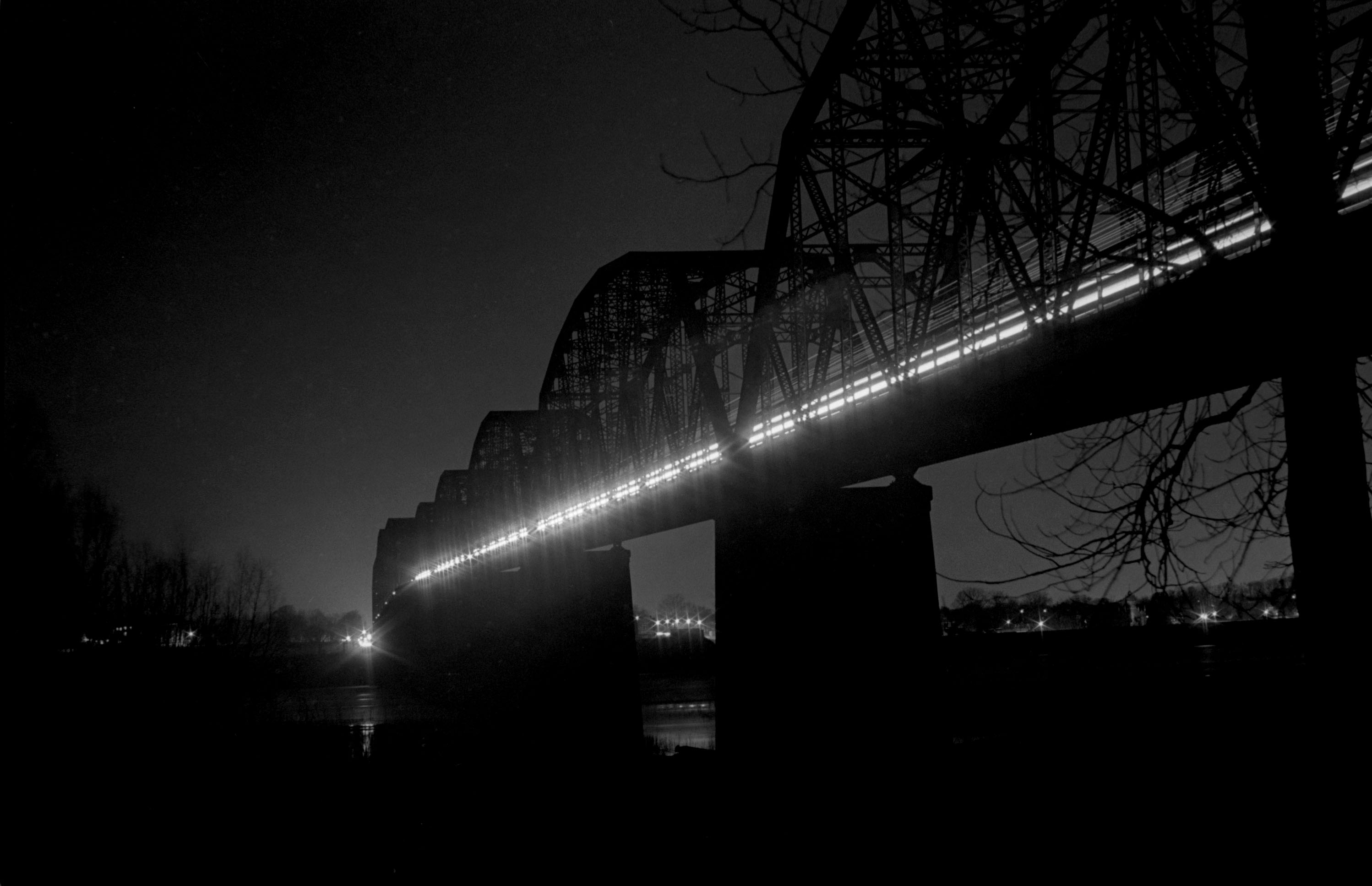
Then Matt tried the old Traffic Bridge

I knew right away that this was going to be the one, but I didn’t like the Class of 1965 line. That’s not to say that I’m not proud to be a member of the Central High School Class of 1965. I am.

It’s just that that’s not particularly relevant to the site nor to who I am. I’ve never identified much with the schools I attended, whether it was Central, SEMO or Ohio University. I was always a photographer, an observer on the sidelines, whose primary allegiance was to the publication I was working for, whether it was The Tiger, The Girardot, The Capaha Arrow, The Sagamore, The Jackson Pioneer or The Missourian.

Besides, the site has already switched from a narrow focus on a single high school in Cape Girardeau to the area as a whole. I’ve run pictures of shoppers in Jackson (even if I didn’t know that’s where I was), an I-55 interchange at Scott City, the Bald Knob Cross, Ernie Chiles riding around Horseshoe Lake and  written about my wooden stick phobia because of Dr. Herbert.

I have Notre Dame and College High students clamoring to see their pictures and I’ve just scraped the surface of my SEMO art.

I had him change Class of 1965 to 1960s Cape Girardeau. I’d like to have used Coming of Age in Southeast Missouri, but that was too long.

Brother Mark weighs in

I sent the choices to my brother Mark, who does advertising for Schnucks. (I see they spell it without the apostrophe these days.) Being my brother, he wee-weed all over my choices and pitched the shot above.

Matt asked if I could reshoot it with the film arranged differently so the type would show up better. “You can shoot it in black and white, if you like,” he said.

I explained that I had a couple of problems with the image

  • It couldn’t be re-shot. I took it while I was unrolling the Coffee Can Film for sleeving in plastic pages. That train had already pulled out of the station.
  • It looks like I’m pitching photo finishing or commercial photography, not nostalgia. It’s not a bad graphic, it’s just not the message I wanted to convey.

Cape Girardeau , The City of Roses

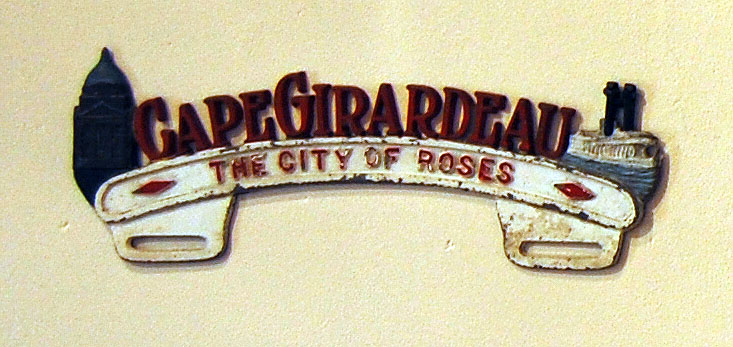
That reminded me that Mark has a bunch of Cape memorabilia at his home in St. Louis. Way over in the corner of a picture, I had this shot of a City of Roses license plate frame. THAT would have made a great graphic, but the quality wasn’t good enough. I’m going to reshoot it when I go back home. It might find its way onto a page header.

What do you think?

The RIGHT answer is that I made the right choice. Remember, I have photos and I’m not afraid to use them.

Alma Schrader School Turns 50 This Month

I  saw a story in The Missourian that Alma Schrader School is going to hold a 50th Anniversary Celebration March 11.

The school was on my old paper route. I guess the reason I always thought of it as being a “new” school was that it WAS new – only a couple of years old – when I was slinging newspapers in the neighborhoods around it.

I don’t have any pictures from when the school opened, as far as I know, but I was there for what I assume was the first day of school on Sept. 6, 1967, if my film sleeve label is correct. I’m also guessing that this is a kindergarten class, based on the signs.

This poor boy never had a chance

I’m going to bend the rule that “good photographers never show their bad pictures” by including some that are a little on the marginal side. You may spot yourself, a sibling or a neighbor and won’t mind if the exposure is a little off or it could be sharper.

The difference between boys and girls

Gender differences show up even in kindergarten. The boy has this “Oh, my god, I’ve got a girl hanging off the end of my arm” look on his face. His buddy on the right is thinking, “Neat sneakers.”

The girl in the background is placing an imaginary order for her bridesmaid dress.

Who was Alma Schrader?

It dawned on me that I’ve said or written Alma Schrader School scores of times without wondering, “Who the heck is Alma Schrader and what did she do to get a school named after her?”

It’s almost like memorizing someone by naming something after them turns them into a phrase instead of a person.

The Missourian had a long front page obituary for Miss Schrader when she died January 15, 1959. She taught in Cape Girardeau for 50 years, including serving 34 years as principal at May Greene School. (Quick pop quiz: who was May Greene?)

Miss Schrader was born in 1886, the daughter of a shoe cobbler who had a shop on North Middle. She started her teaching career in 1906 at Old Lorimier School, where she taught for three years. She spent three years as a teacher at the old Jefferson School at South Ellis and Jefferson; she was promoted to principal, a post she held until 1921. When the new May Greene School opened in 1921, she was named the school’s first principal. She continued to work with the school system after her retirement in 1956.

UPDATE to Alma Schrader Celebration

Follow this link to see pictures from the 50th Anniversary Celebration.

Gallery of Alma Schrader School Kindergarten Class 1967

Click on any picture to make it larger, then click on the left of right side of the photo to step through the gallery.

Cape Girardeau’s Art Deco Esquire Theater

Esquire Theater Oct. 28, 2009

Cape Girardeau’s Esquire Theater opened Jan. 21, 1947, to 1,300 customers in two showings. A block-long line of moviegoers were treated to a double feature of Blue Skies and Two Years Before the Mast at 6:15. A late crowd caught the 9 p.m. showing.

It was the third of Broadway’s theaters – the Rialto and the Broadway were the others – to open. Within 18 months of each other, all three were closed by 1985. The Esquire was the last to go dark.

There’s a lot of interesting reading in the National Register of Historic Places registration form filed in 2005. [This link takes you to a pdf file that may require a special plugin for your browser.]

Windstorms and a truck accident damaged the marquee

The city blocked off the sidewalk in front of the movie theater when the marquee was deemed unsafe. This photo was taken Oct. 24, 2007, before it was removed.

The Esquire gave its last first-run movie show  – Prince’s Purple Rain on Oct. 7, 1984, with four shows – 2:00, 5:00, 7:15 and 9 p.m. Newspaper accounts of the day don’t say if that particular movie led to the theater’s demise. (It scored 7 Rotten Tomatoes on the Tomatometer.)

The Esquire experienced a brief revival on Mar. 22, 1985, when it opened as a second-run movie theater, charging $1.50 a head, but it closed again in December of that year. A church held services in the building for a time. It’s being used for storage today.

When it was built, the local newspaper said that it had more than a mile of neon lights, more than any other theater in the South. Sometimes boosterism collided with facts, so this may or may not have been exactly true.

Terrazzo tile extension still visible

The National Register application says the interior of the theater retains its original space configuration of lobby, foyer, auditorium, restrooms and projection room. Many of the original interior finishes, including the mosaic tile and painted designed walls in the auditorium remain. The original seating and screen have been removed.

The multiple-colored terrazzo floor of pink, gray, buff and green blocks in a geometric designs runs up to the red doors and into the lobby.

Curved glass blocks guide you into the entrance

The gently-curving glass blocks that guide you into the entrance of the of theater are a characteristic of the Art Deco style of architecture. Other Art  Deco touches are the use of steel, marble, colored steel enameled panels and curved walls.

When construction started in 1946, the projected cost was $75,000. By the time it was finished, the total cost had doubled to $150,000. Gerhardt Construction Company of Cape was the general contractor. Preston Neon Sign Company installed the neon lighting.

Few homes had air conditioning in the Esquire’s heyday, so Cape Girardeans took refuge in the movie houses during scorching summers. A heating and air conditioning system installed in the basement was powerful enough do a complete air exchange in the theater every minute.

The 100′ x 60′ building used no lumber in its construction to make it as fire safe as possible.

Remember the fancy ticket dispenser?

When you finally made it up to the ticket window, you would speak to the cashier through a hole in her glass window, tell her (it was always a woman) how many tickets you wanted and for what ages. She would push some magic button (I don’t know if it was hand or foot-operated) and the requisite number of tickets would come shooting out of slots in the top of the counter.

The apparatus is still there, but it’s been heavily decorated with bird poop over the years.

Help! The Beatles movie played the Esquire in 1965

I wrote earlier about ordering special infrared film and flashbulbs to cover the teenybopper reaction to the Beatles movie Help! when it played at the Esquire in September 1965.

You can read the whole account at this link. Who knows? You may see yourself in the audience.

Did you ever try to sneak in through the fire exit door?

And, if you did, were you caught by one of the male ushers (they were always male) who prowled the aisle maintaining order. Hint: it was a Bad Idea to sneak in during a daytime movie. The blast of bright daylight was sort of noticeable in the darkened theater.

Do you miss those days when unruly patrons were shushed or ejected?

Did you work at the Esquire?

Were YOU an usher, cashier or concession stand worker? Based on the stories that Wife Lila tells from her days as a cashier at the Rialto, I bet you have an experience to share.

Here’s a gallery of Esquire photos

Click on any image to make it larger, then click on the left or right side of the photo to step through the gallery.