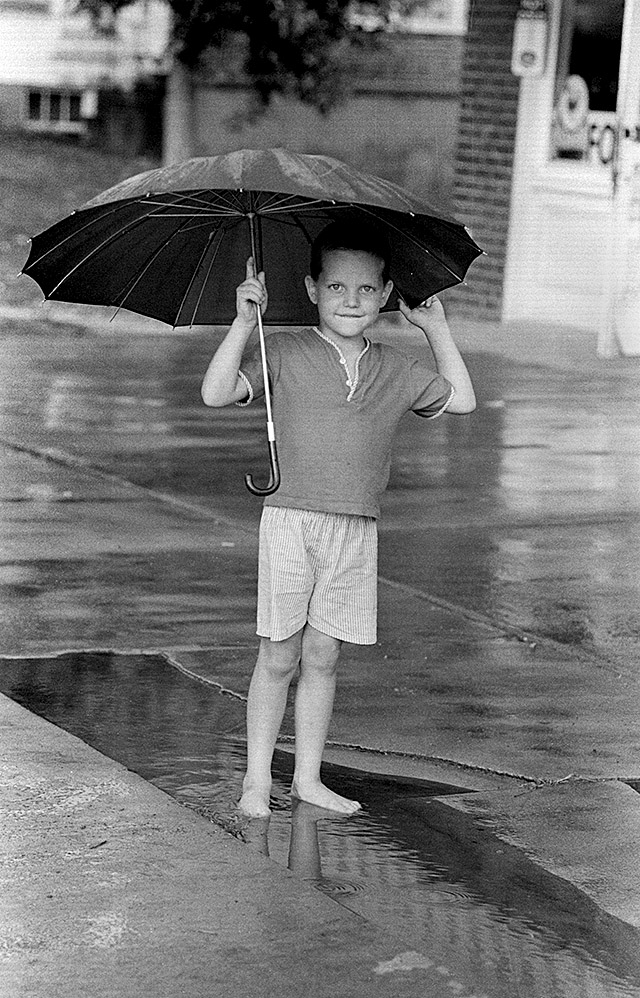
Boy with Bumbershoot

Boy with umbrella c 1966These photos of a boy and his bumbershoot got me thinking about clothing and customs. I don’t recall carrying an umbrella much until we moved to Florida where we can count on brief, but fierce localized thunderboomers showing up just about every afternoon in the summer.

I don’t know who this youngster is, where it was taken or even when. That storefront peeking out of the side might give someone a clue. He might have kept his head dry, but his feet clearly in the splash zone.

Ken in the rain
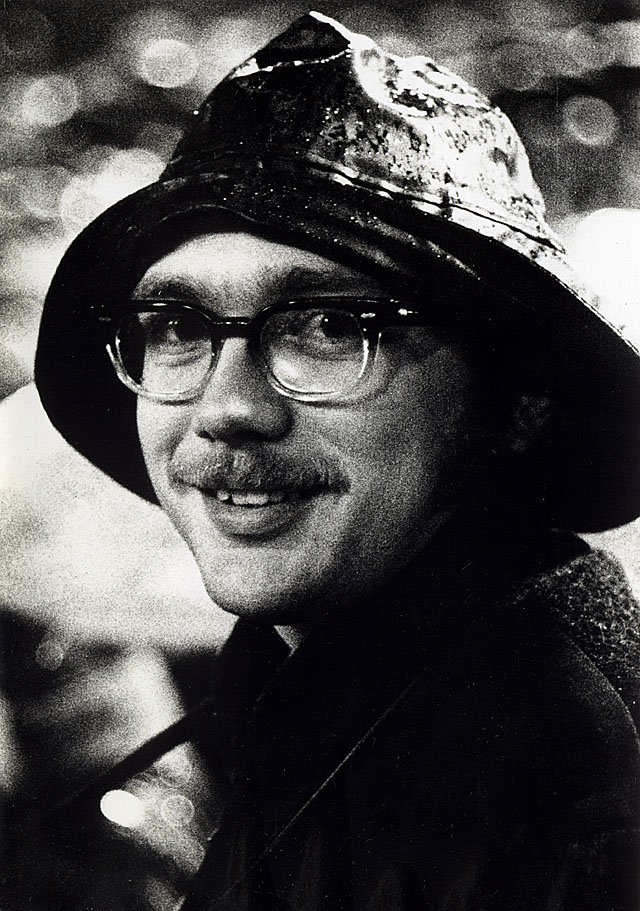
KLS covering rainy football game in Logan OH 1969Here I am covering a night football game in Logan, Ohio, with nothing but a jacket and a rain hat to keep me dry. I think I stuck a towel under my jacket to wipe the camera off from time to time, but those old Nikon F bodies were pretty bulletproof. Was there a “sissiness” factor attached to umbrellas in those days? I definitely used an umbrella by the time I got to West Palm Beach.

At what age did boys stop wearing shorts?

Boy with umbrella c 1966There was a cutoff time for wearing shorts, too, wasn’t there?

I remember going to construction job sites with Dad when I was about 10 and wearing long pants. None of the guys on the crew wore shorts. In fact, they’d have been laughed off the job if they had shown up showing knee. MEN didn’t wear shorts to work.

That’s not the case these days, particularly in Florida.

How about blue jeans?
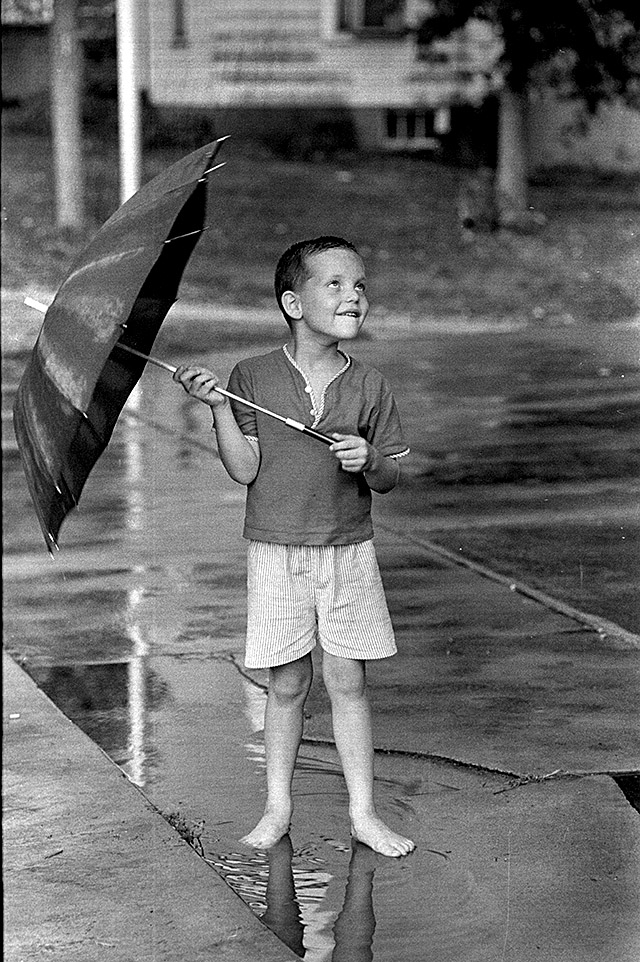
Boy with umbrella c 1966My uniform of the day is blue jeans (when I bother to put on pants to go out in public), but I don’t think I wore jeans at Central. Didn’t most of us wear chinos? Or course, there was the swish-swish sound of corduroy pants in the winter.

What other informal clothing standards did we have?

Of course, girls had a whole ‘nother’ set of official rules, including having to kneel down to make sure their skirts were long enough to touch the floor, but that’s a whole other topic.

Missourian Crime News

1967-09-17 Hanning Burglary 2I’ve been working my way through the seven weeks of newspapers that stacked up while I was out in the Midwest. Maybe it’s just because I’m getting a concentrated dose of local news, but it seems like every paper has a story about multiple people being shot, stabbed, bludgeoned or poisoned. Cops shoot perps; perps shoot at cops.

The big story for several days was a woman who went missing; her body was found with her head and fingers cut off and abandoned out in the swamps. Cops, who had been staking out her doctor husband, saw some of his relatives removing something large from his house and discovered it was his body, dead from an overdose.

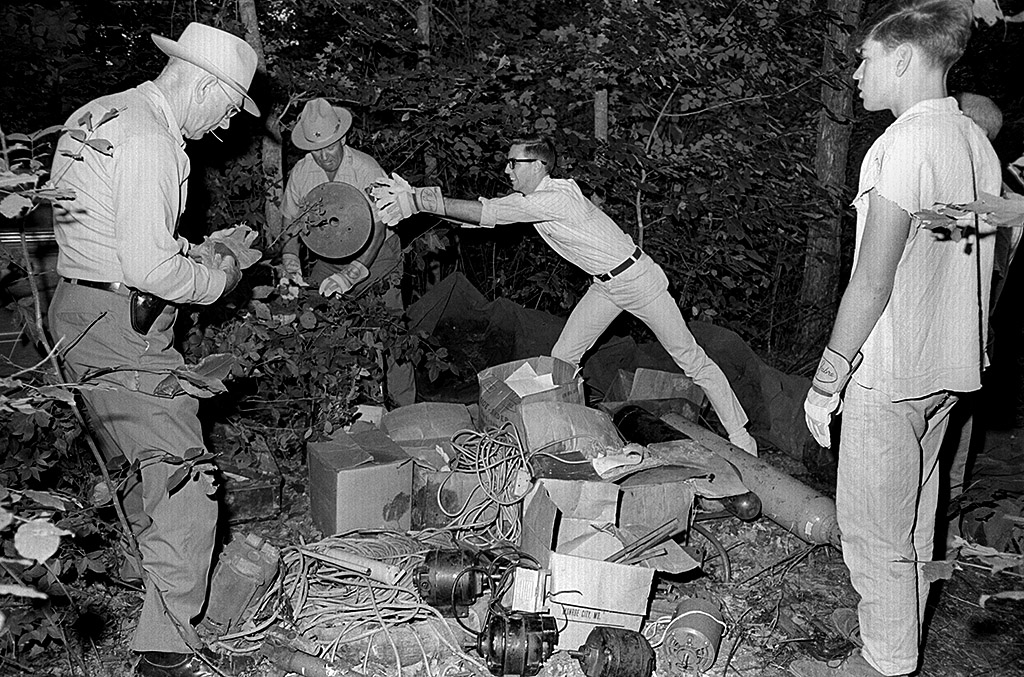
It was refreshing to step back in time to these photos and a crime account in The Missourian September 18, 1967, by comparison:

A squirrel hunter, Charles H. Meyer of Gordonville, Sunday stumbled onto what was thought to be stolen goods near Gordonville. Loading the goods onto a truck are from left, Deputy Sheriff Bill Sperling, Larry Meyer, son of the hunter, Deputy Vernon Sebastian, Deputy Jon Knehans and Mr. Meyer.” The story ran on P3A, not the front page, but it was still big news.

Burglary goods in briar patch

1967-09-17 Hanning Burglary 3The Cape County Sheriff’s Department Sunday recovered items estimated to be worth $500 to $600 which were taken in a burglary August 5. The items, found by Charles Myers, in a woods on his farm as he was squirrel hunting, were believed taken from the R.L. Hanning farm near Whitewater.

The Sheriff’s Department said the loot consisted mostly of electrical equipment, appliances and tools and were spotted by Mr. Myers wrapped in a tarpaulin in a briar patch.

Chief Deputy Wm. A. Sperling said the briars were 12 and 14 feet tall and it was difficult to even open a truck door after backing in to pick up the recovered items.

He said the loot was stashed not far from Route Z west of Gordonville, but could not be seen from the roadway because of the thick foliage. Mr. Myers, however, was hunting further back in the woods and spotted the tarpaulin in the briar patch, Mr. Sperling said.

Wrong AND inconsistent

There was some uncharacteristically sloppy editing in this story. The last name of the hunter and his son was spelled “Meyer” in the photo cutline, and “Myers” in the story. Chief Deputy Wm. (Missourian style, for whatever reason, was to abbreviate William) A. Sperling was referred to as “Mr. Sperling” later in the story. I’m pretty sure somebody got a crankygram from jBlue when he read the paper. Being wrong was bad, but being wrong AND inconsistent was unforgivable. The first error was probably the reporter; the second error meant both the reporter and the copy editor weren’t paying attention to detail.

Christ Episcopal Church

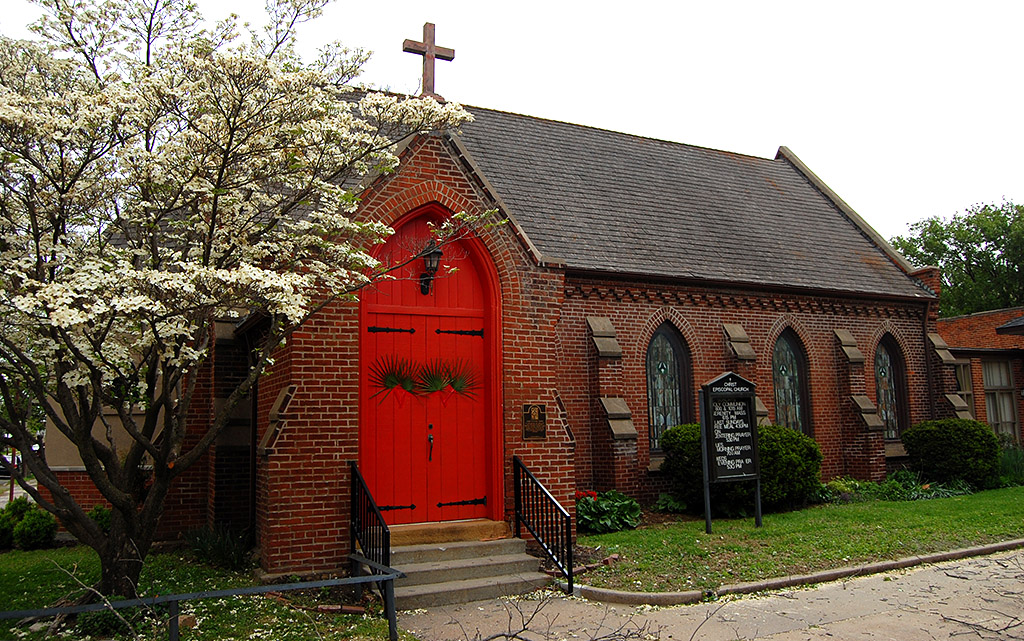
Christ Episcopol Church 04-16-2011There are two Cape Girardeau landmarks across the street from each other at Themis and Fountain that I’ve passed hundreds of time while working at The Missourian and going to the library that never caught my eye much.

The first is Christ Episcopal Church, a tiny building with a bright red door. (The original building is relatively tiny, but  Google Earth photo shows several larger buildings attached to it.) I’m pretty sure I was never inside the building, even though I had friends who went there.

May Greene Garden

May Green Garden 04-16-2011Even more invisible was May Greene Garden, tucked in behind what used to be the Federal Courthouse. It was named after May Greene, who taught in Cape schools for 53 years and had a school in South Cape named for her.

These photographs were taken in the spring of 2011. Click on them to make them larger.

More Disappearing Cairo

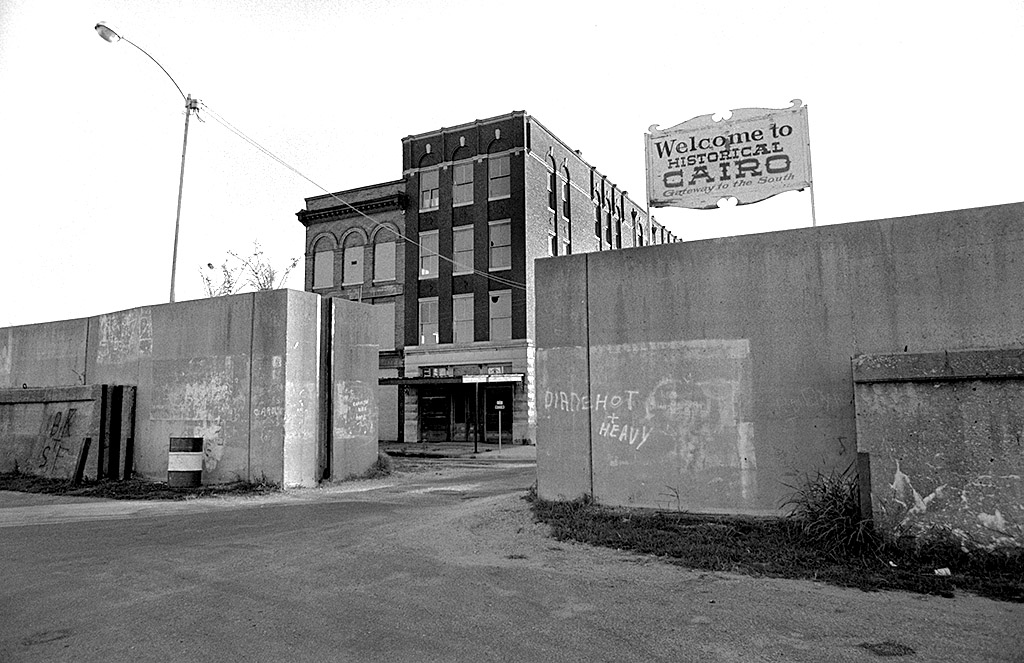
Cairo Illinois c 1967Cairo is a town of subtraction. I still take visitors there, but there is less and less to show them. It’s gotten so I hardly pull the camera out because there’s nothing but open ground where a vibrant downtown once flourished.

Here’s a view through a floodgate opening at 8th Street in some time around 1967. You can click on the photos to make them larger.

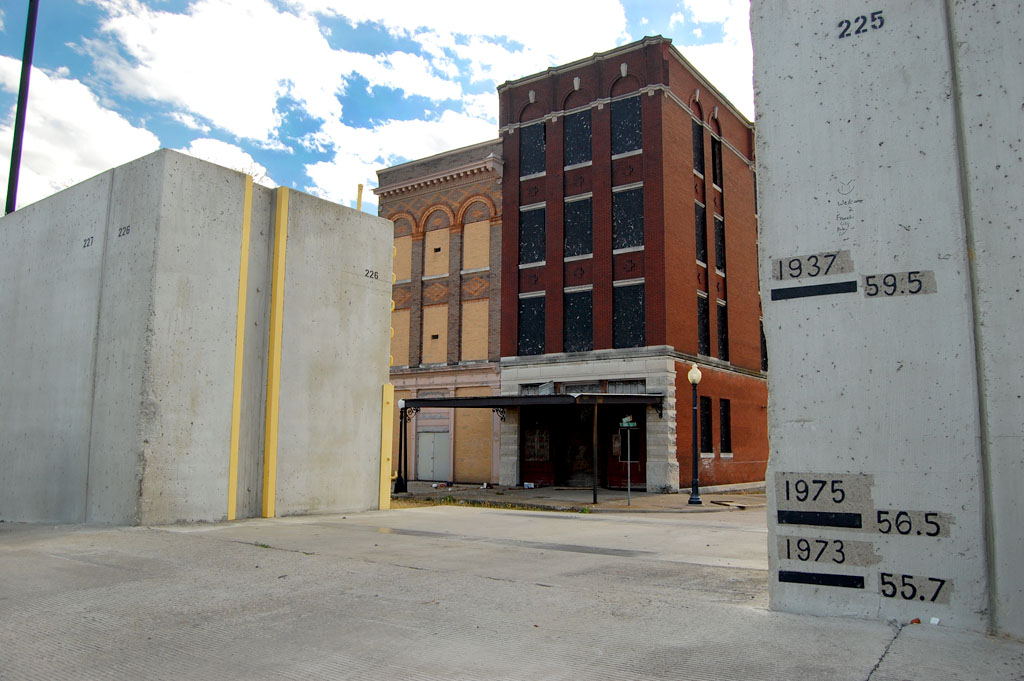
Looks pretty much the same in 2010

Cairo Floodwall 10-26-2010_8572Except for being in color, the two photos are pretty much the same. This one was taken October 26, 2010.

2012 fire erases old buildings

Cairo 11-13-2012

A fire started in an adjacent building and quickly spread to these two old warehouse buildings. This was taken November 13, 2012.

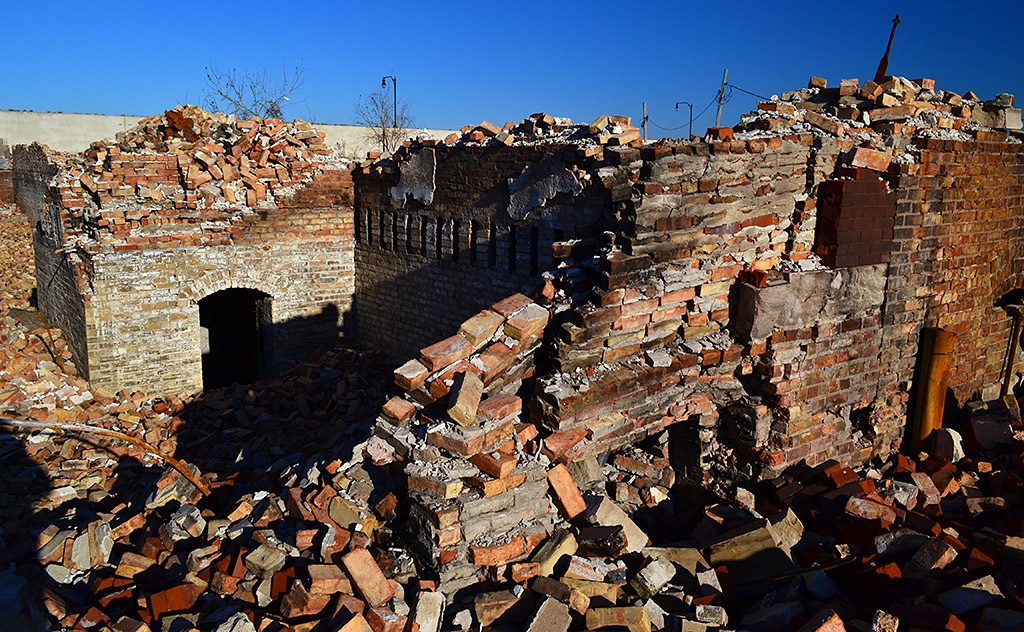
Nothing left but pile of bricks

Cairo 11-13-2012When the fire was over, nothing much was left except a pile of bricks and some columns.

Not even the bricks remain

Cairo floodwall 07-10-2013_5828

By July 10, 2013, you would never know the buildings existed.

A line has been added to show the 2011 record 61.7-foot highwater mark on the floodwall. There is a common misconception that the Bird’s Point Levee was blown just to save Cairo. In fact, it reduced pressure on the levees and floodwalls in Brookport, IL, Paducah, KY, Cairo, IL, Hickman KY and Tiptonville, TN. Some have speculated that Olive Branch might not have flooded if the levee had been breached earlier.

The reason Cairo got so much attention was that the Cairo river gauge was the one used to judge when it was time to activate the floodway that had been in place since 1937.

Older Cairo stories

I’ve photographed Cairo since the 1960s. Here are some older stories and photos.