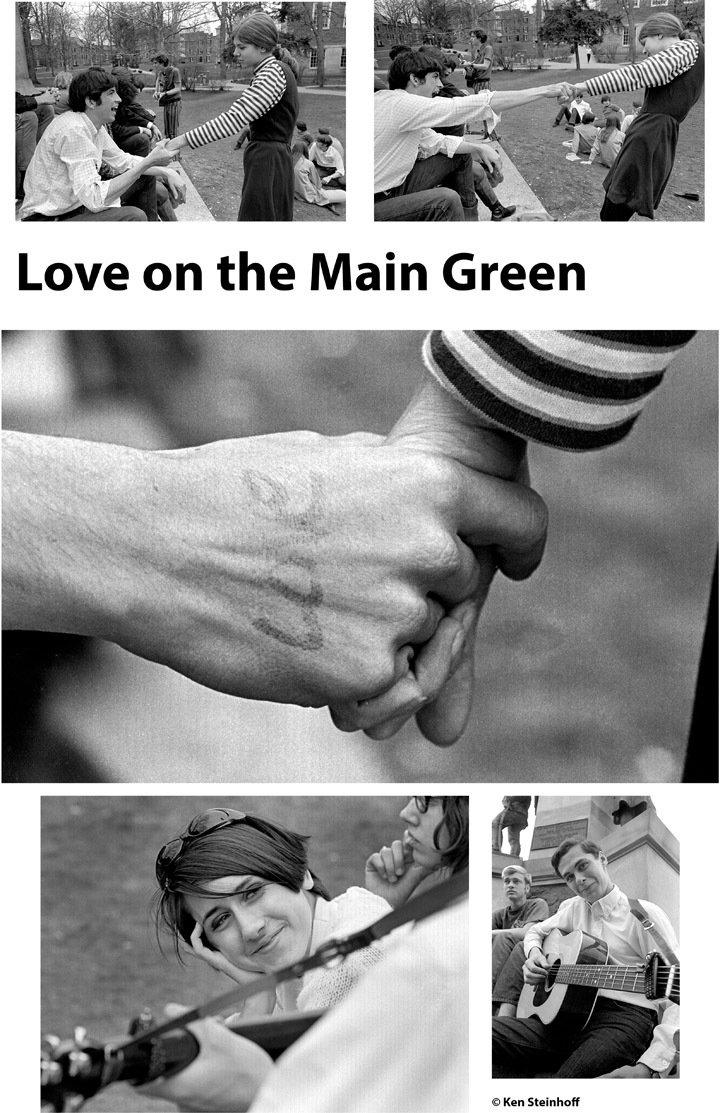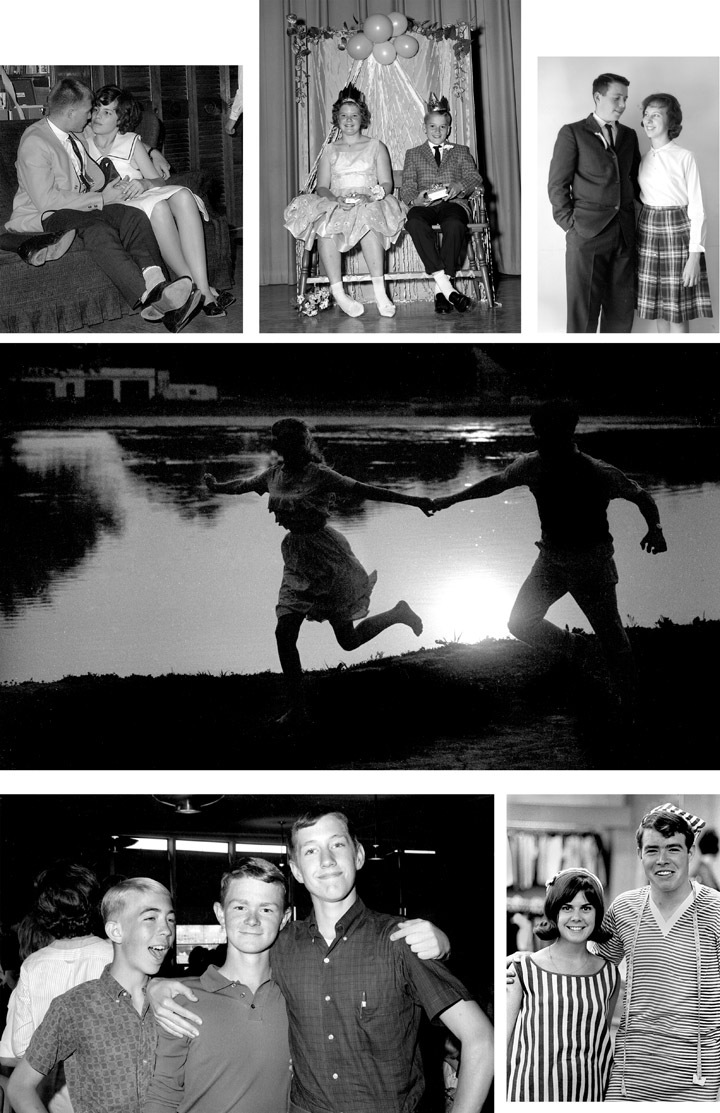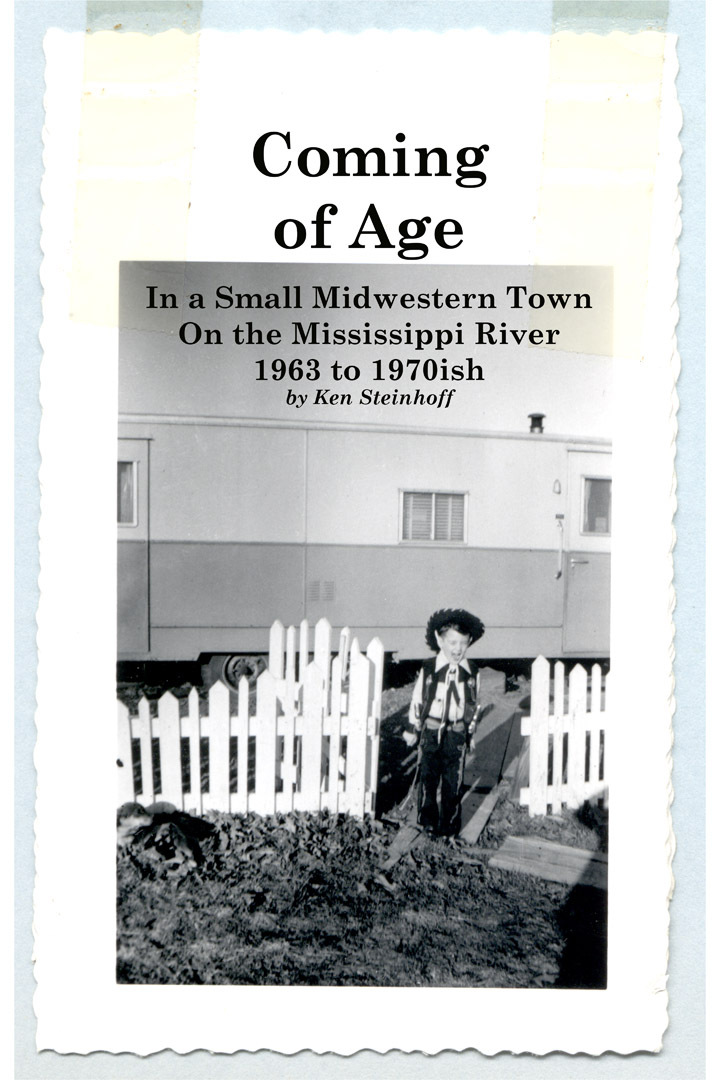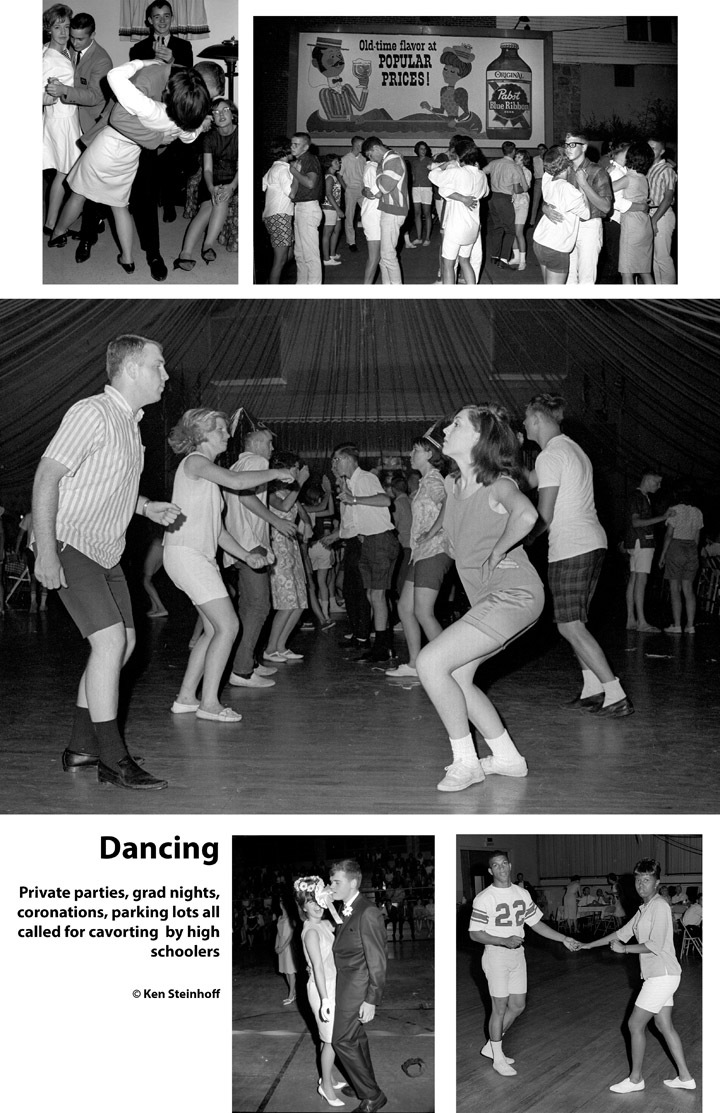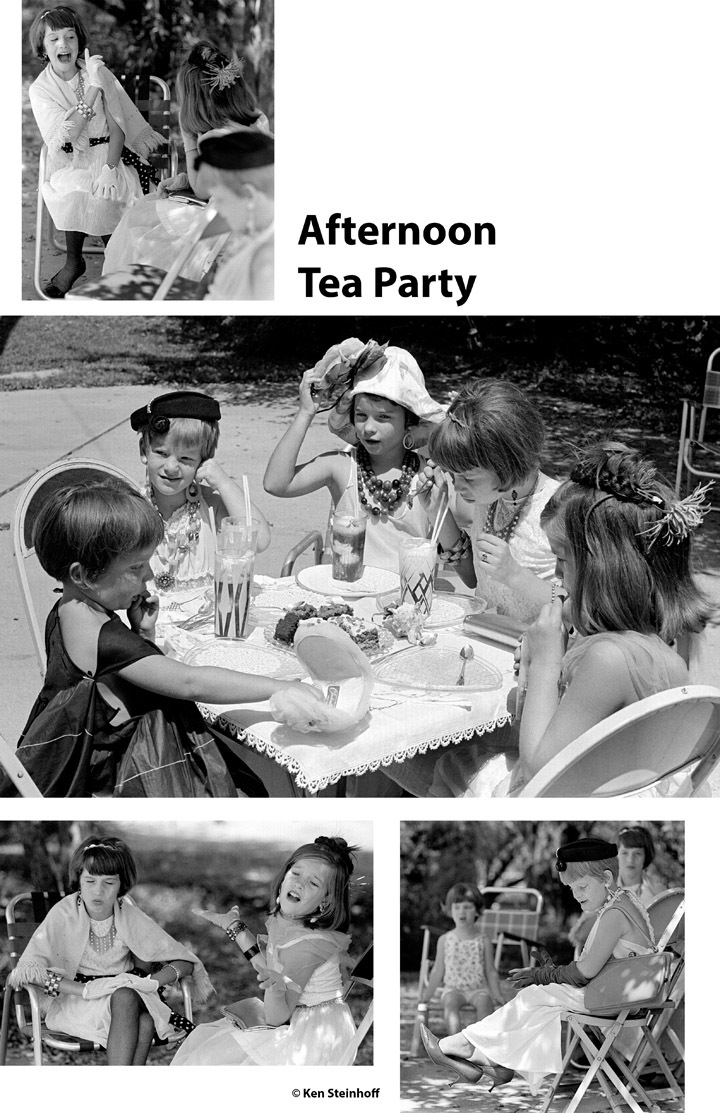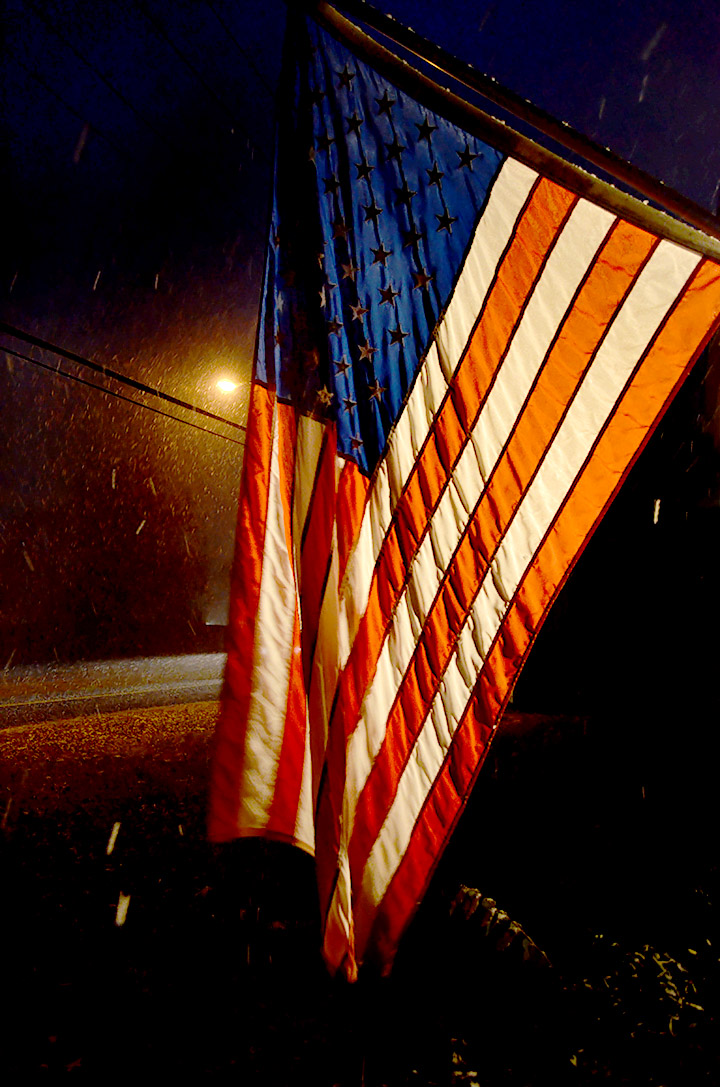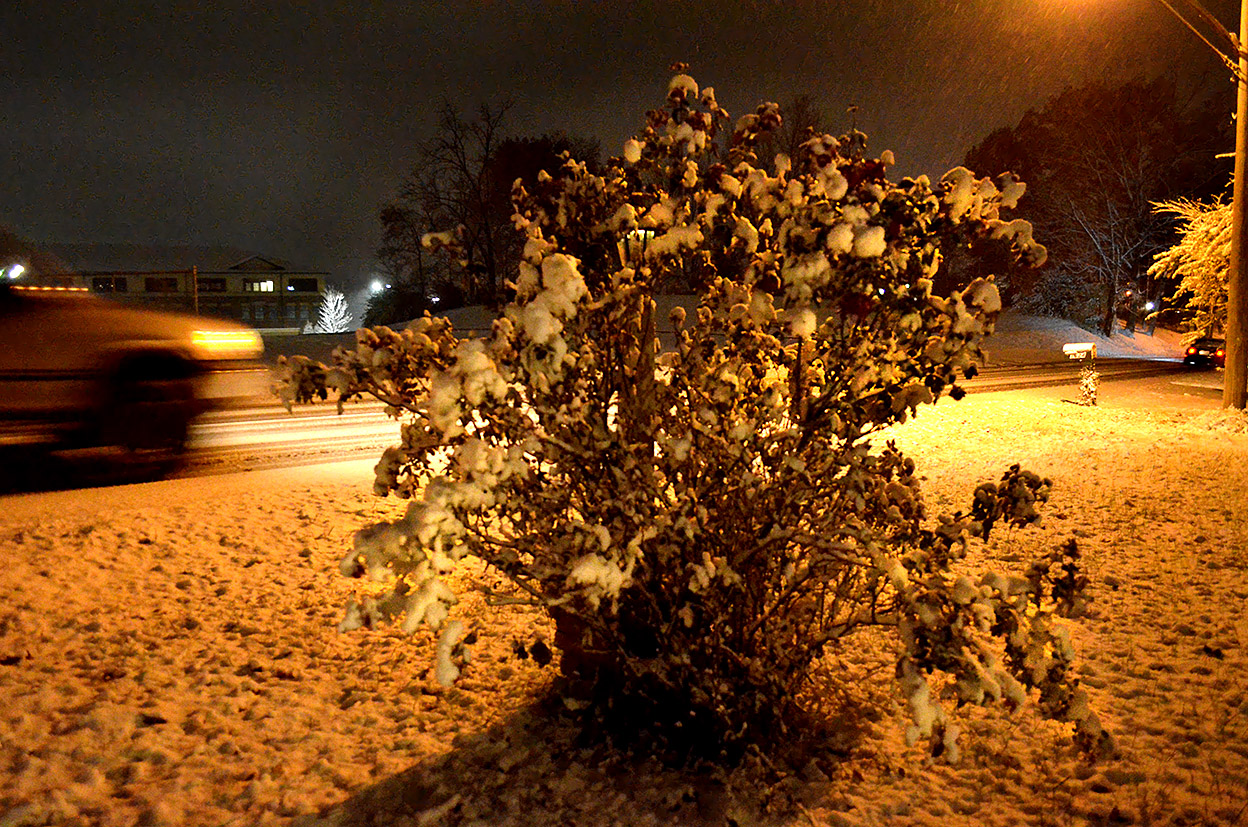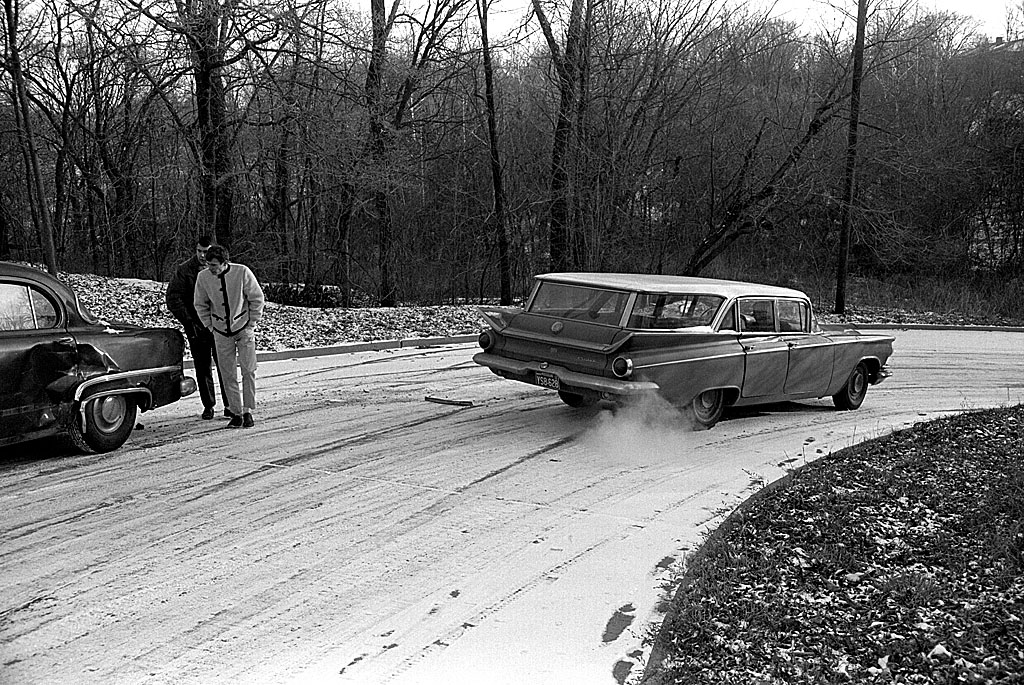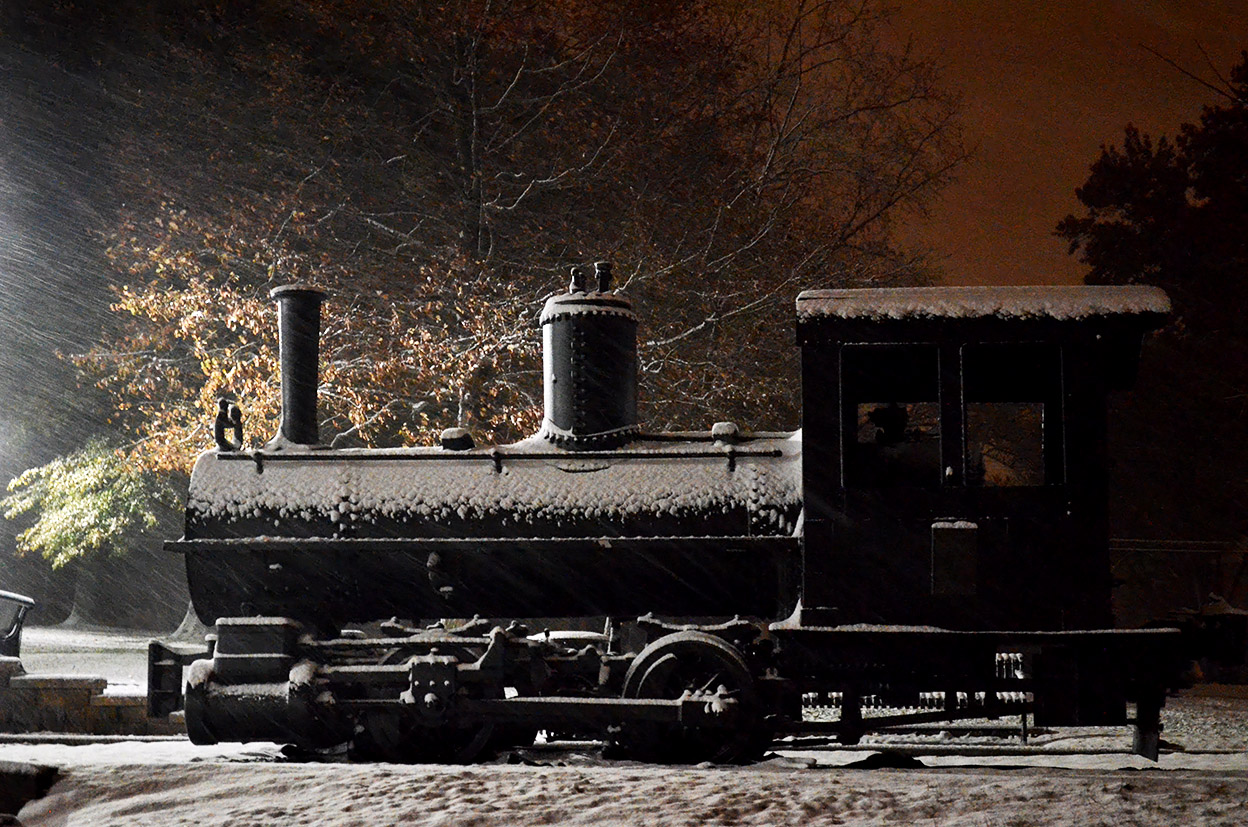
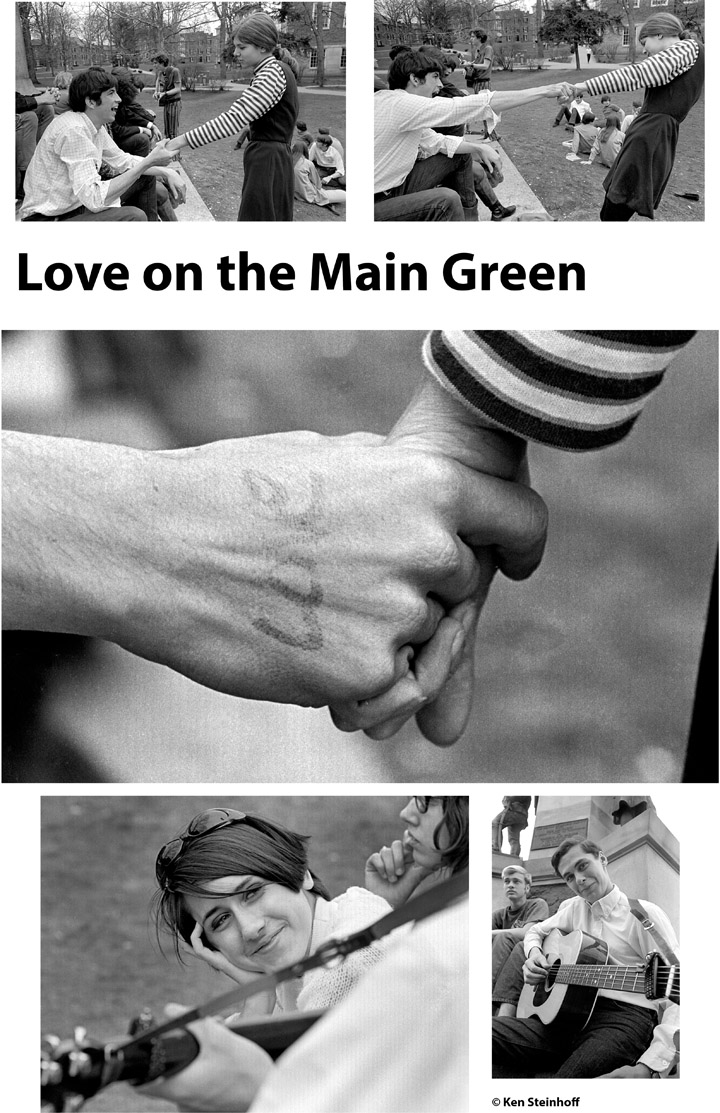
Here are some of my photo layouts being exhibited at the Cape Girardeau County History Center in Jackson.
“Couples” became “Moments”
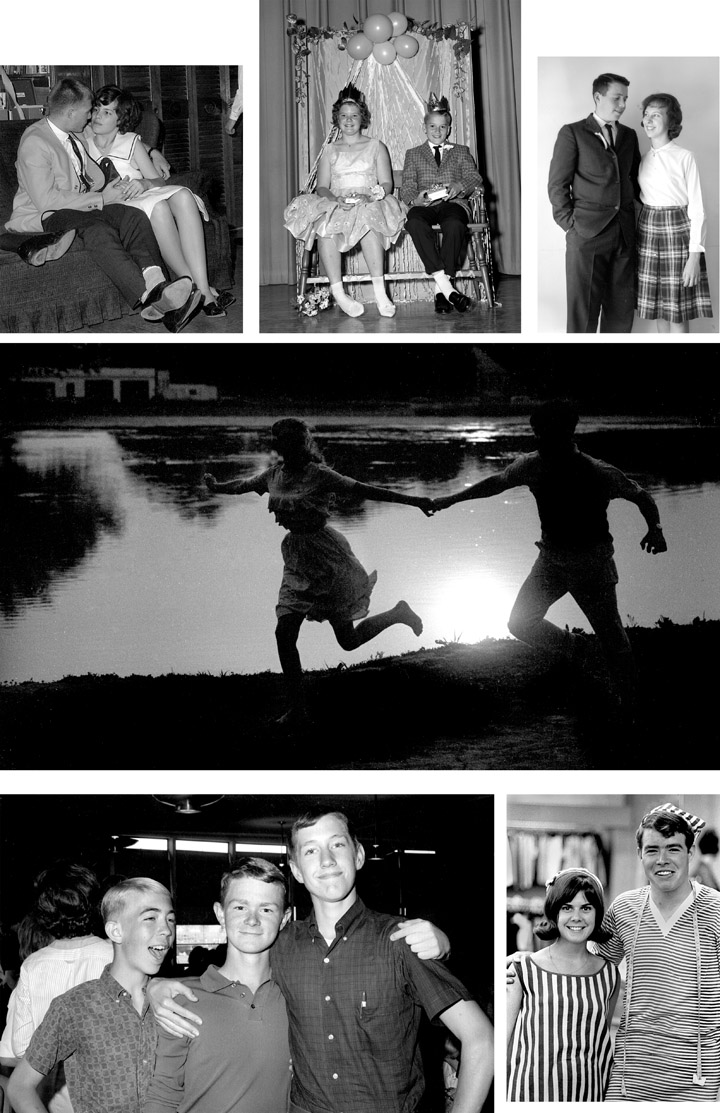
A few years ago, I created a file directory called “Couples” where I parked images suitable for a Valentine’s Day post. Over time, I added more and more pictures and layouts, which caused a change in working titles.
I look at these as Frozen Moments.
Settling down
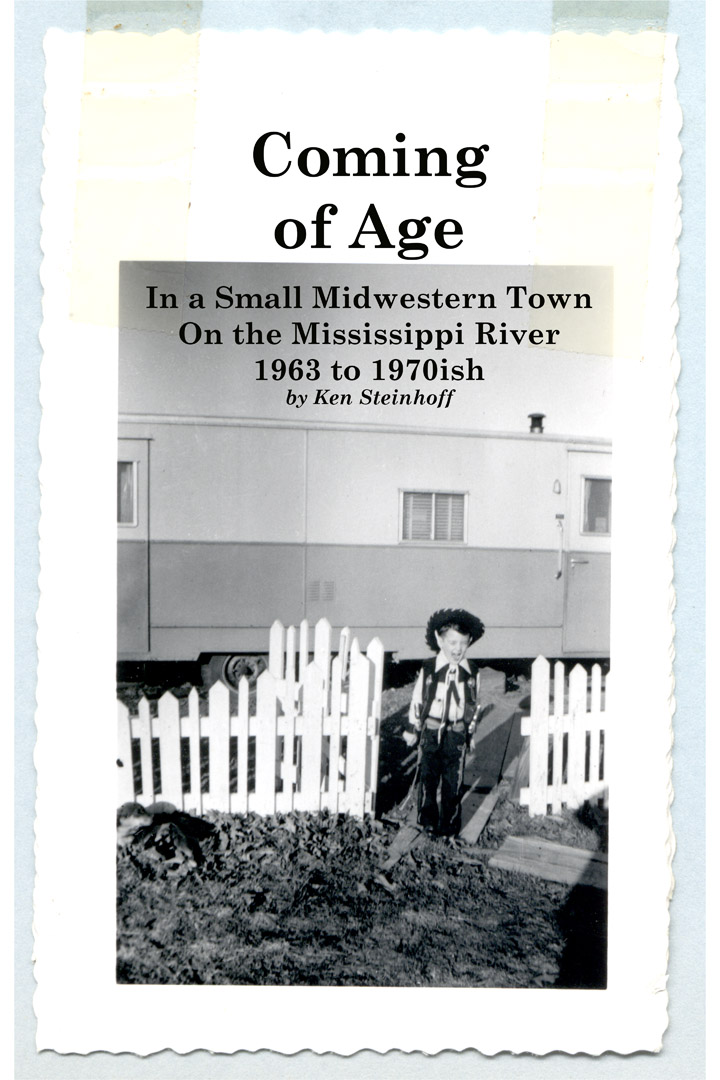
When I started school, Dad and Mother decided we’d stop living out of a house trailer Dad would pull from job site to job site (including a folding white picket fence that he built to make our rolling home look more homey).
Our first fixed home was a rental house on a hill at 2531 Bloomfield Road in Cape. When I was about kindergarten age, I looked out my bedroom window in the middle of the night and realized, with some distress, that I would never see the passing lights of those cars and trucks again.
A machine to freeze time
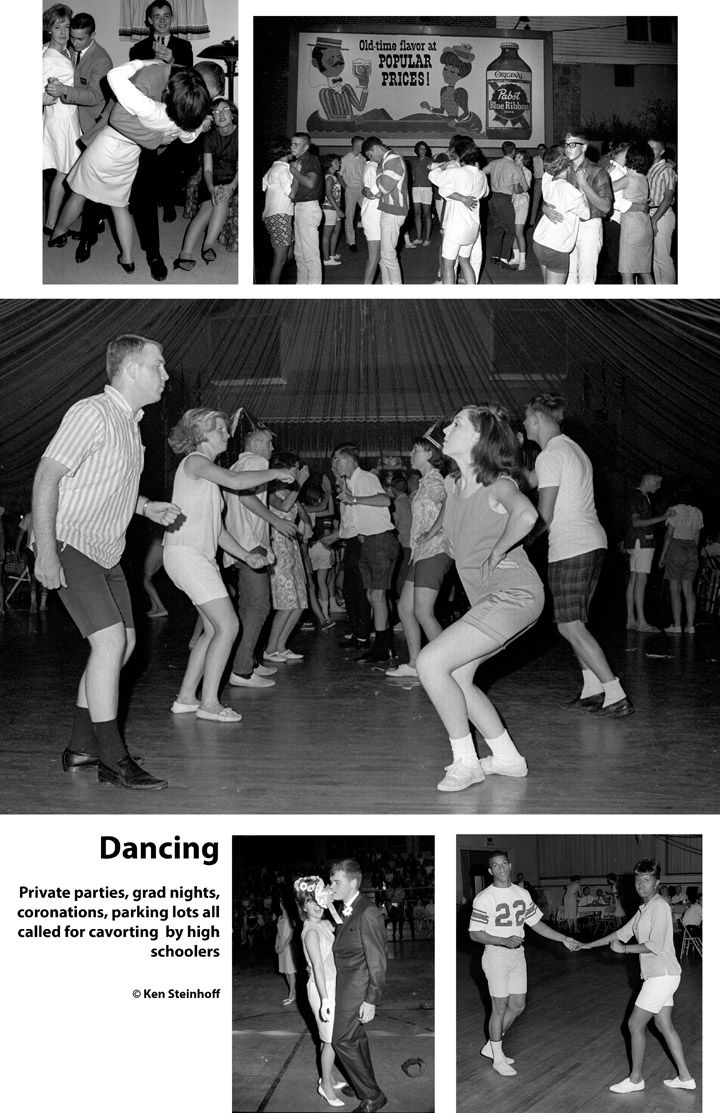
While most kids wanted machines that would let them skip forward or backward, I wanted one that would freeze time.
Hold onto that thought.
That’s what caused me to become a photographer. I carried a magic machine that would record, forever, what my eye was seeing, and I carried a press ID that gave me a license to be nosy.
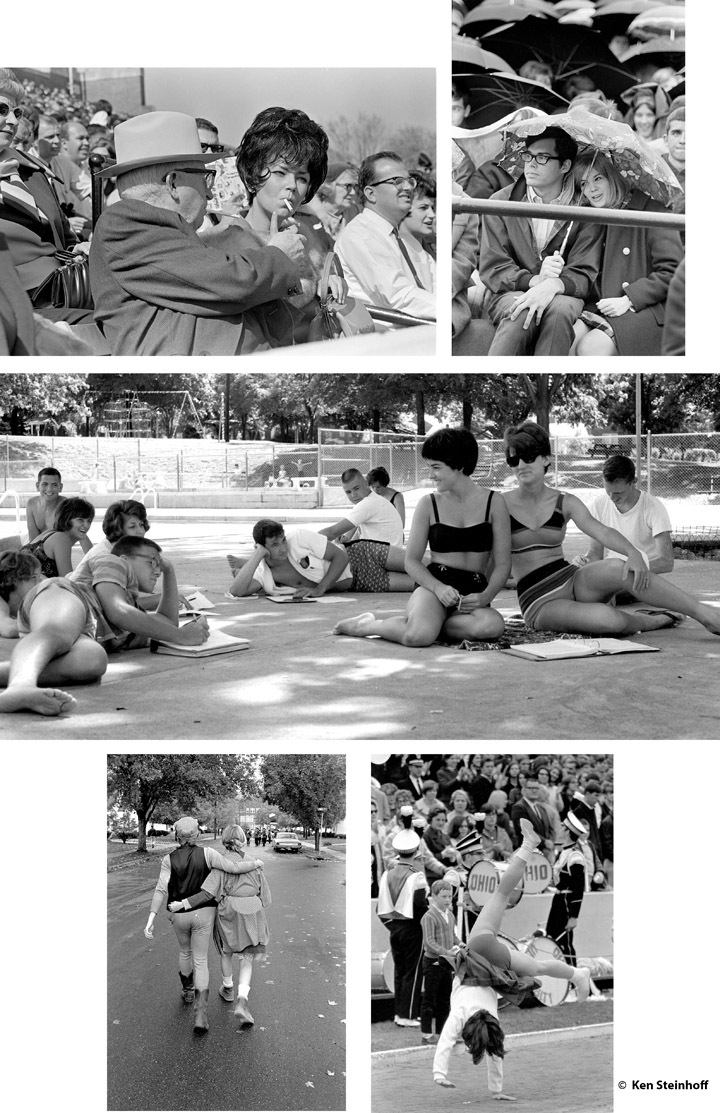
These teenagers will never grow gray, old and infirm in my photos.
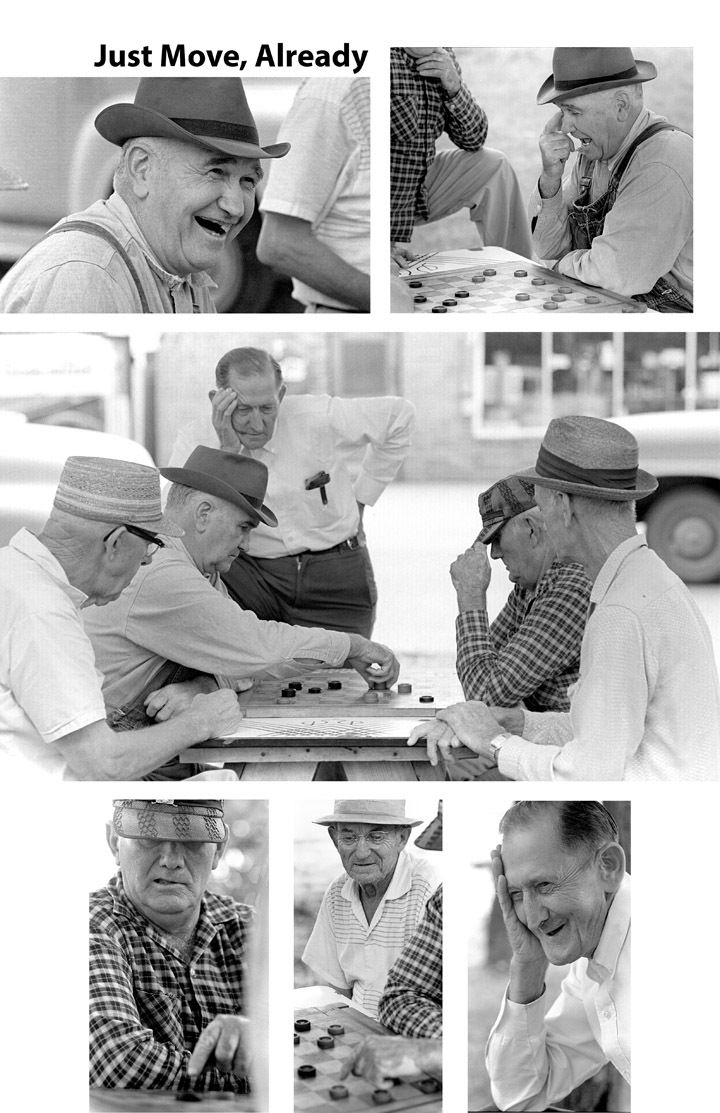
Old men endlessly playing checkers
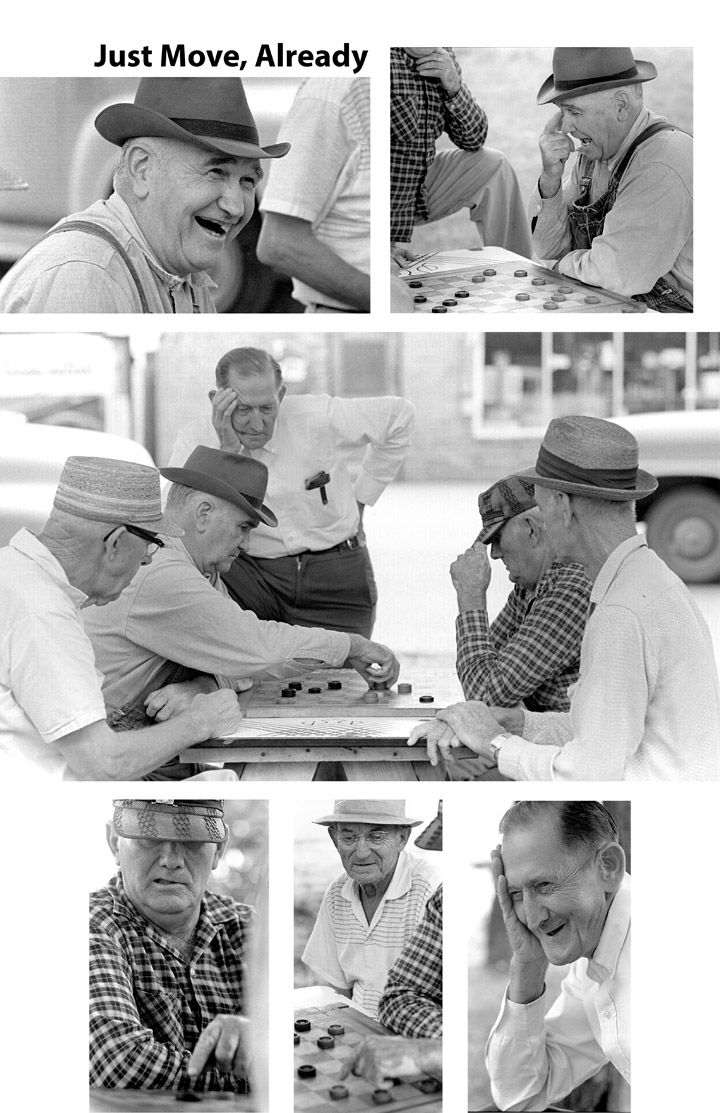
These checker players in Matthews, Mo., are typical of the old men who would while away time whittling and playing checkers on park benches and in town squares.
When the weather turned cold, the old men would gather around the big stove in the back of my grandfather’s liquor store in Advance. They had the disgusting practice of blowing their noses, then hanging their “snot rags” on the side of the stove to dry out.
I collected old geezers
Even as a pre-teen, I logged many hours sitting on porches and treasuring the stories told about taming Swampeast Missouri.
I often wondered if they were pulling my leg when they talked about having to nail boards to the hooves of oxen to keep them from sinking into the muck.
True or legend? The story of a farmer who was proud of his new Caterpillar tractor until it broke down late one afternoon sounded too good to be true.
It was starting to get dark, so he decided to put off working on it until daylight. When he got to the field the next morning, the only thing visible of his tractor was the exhaust pipe sticking up out of the soft soil.
I’ve heard those stories from multiple sources, so they must be true.
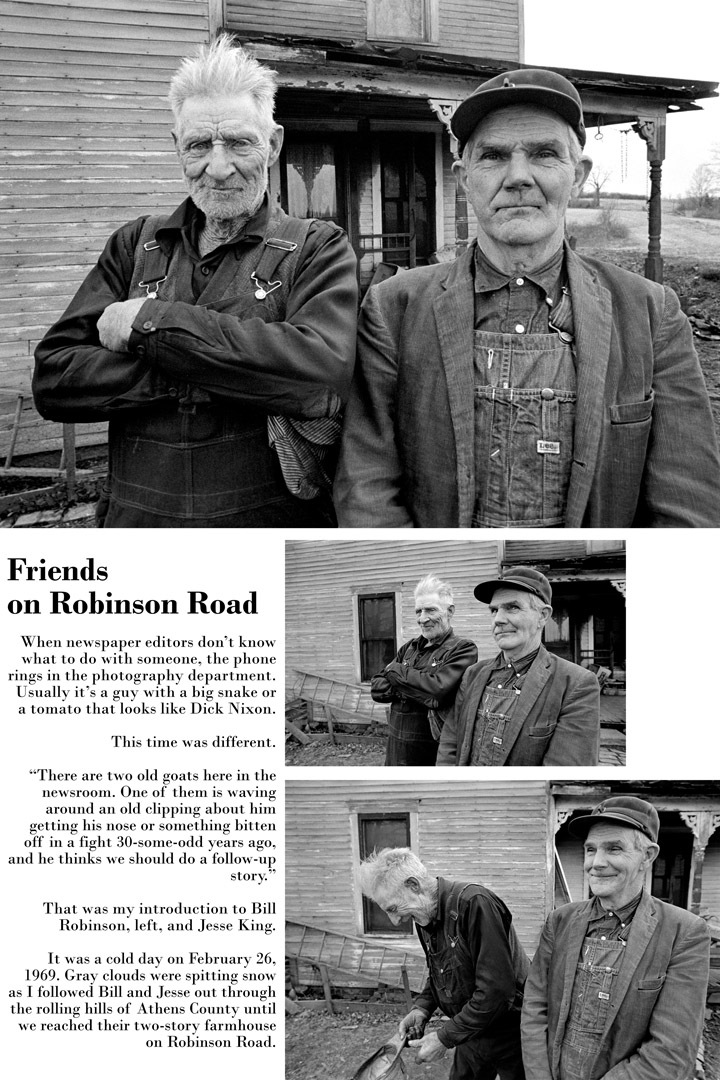
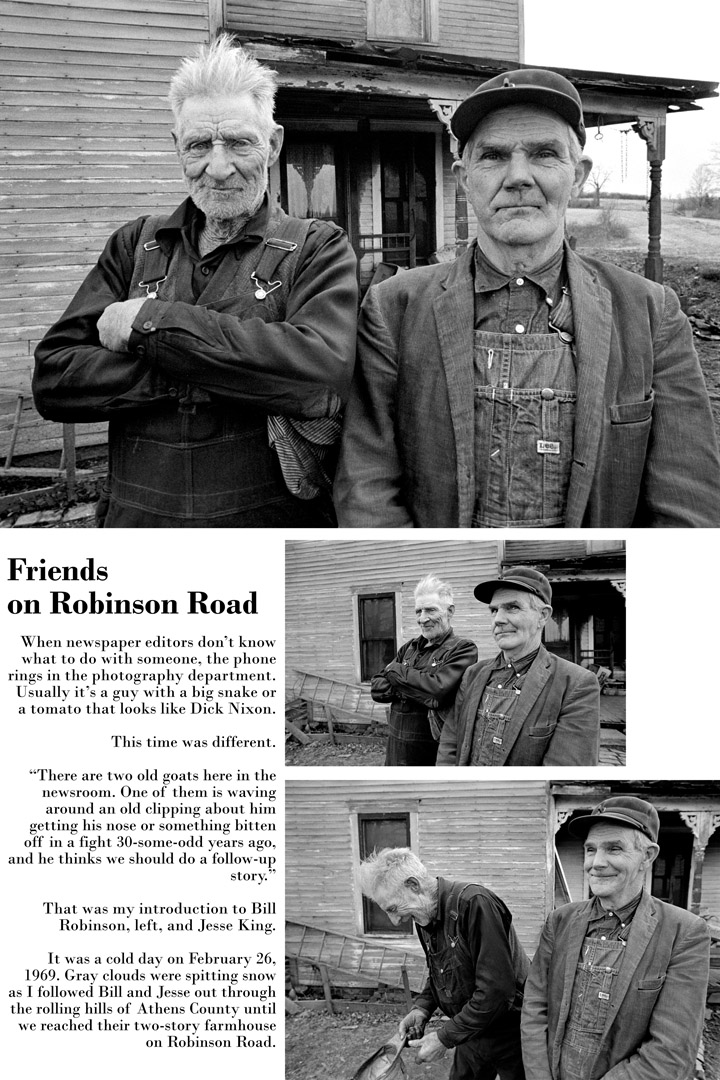
Here’s the backstory on the two friends who lived in Athens County, Ohio.
It dawned on me that I went from recording old geezers to becoming one, and if I don’t share my photos and stories, they’ll be as dead as the Robinson Road boys.
The Athens Messenger Picture Page
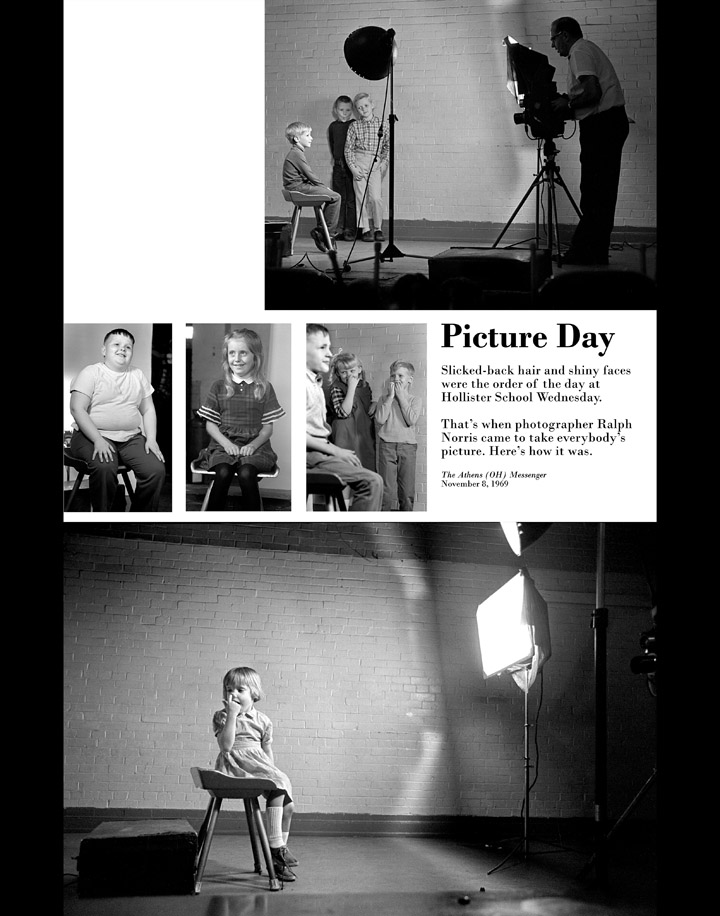
Publisher Kenner Bush, a relatively young man who had to step in as publisher when his father died, loved photography and mostly tolerated us photographers. He gave us a 9×17-inch hole five days a week to fill.
We had to find the subjects, shoot the photos, do the layouts and write the copy. The pressure of having to fill that space made us find photos of daily life that normally would never make the paper.
Nellie Vess and desperation
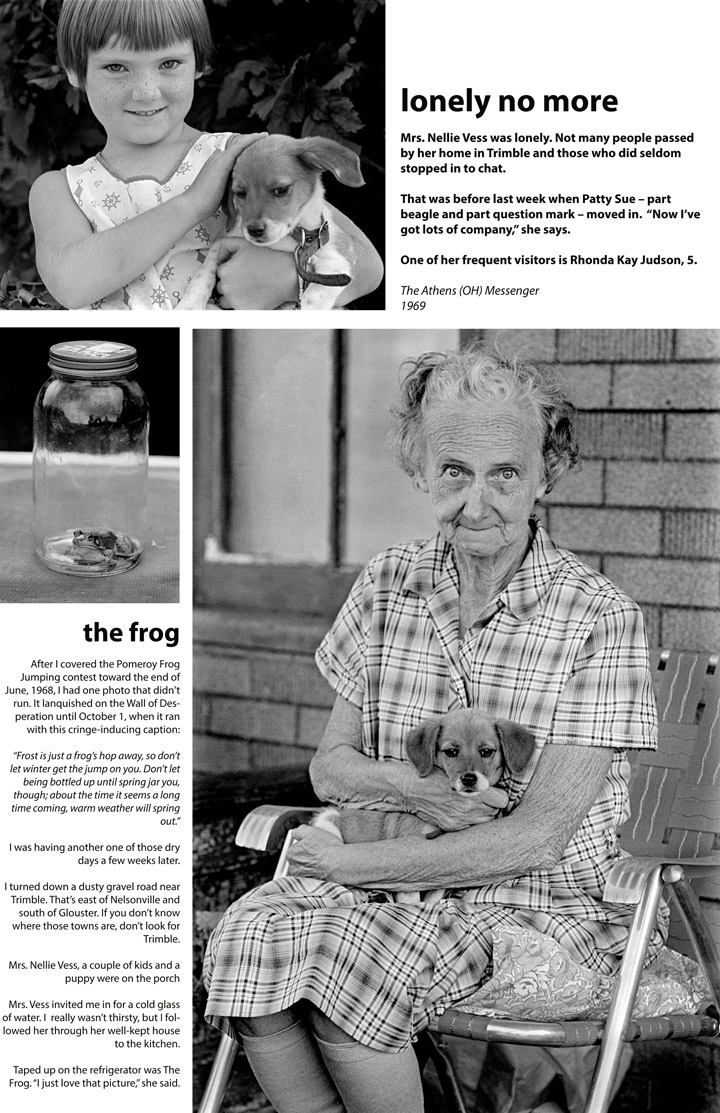
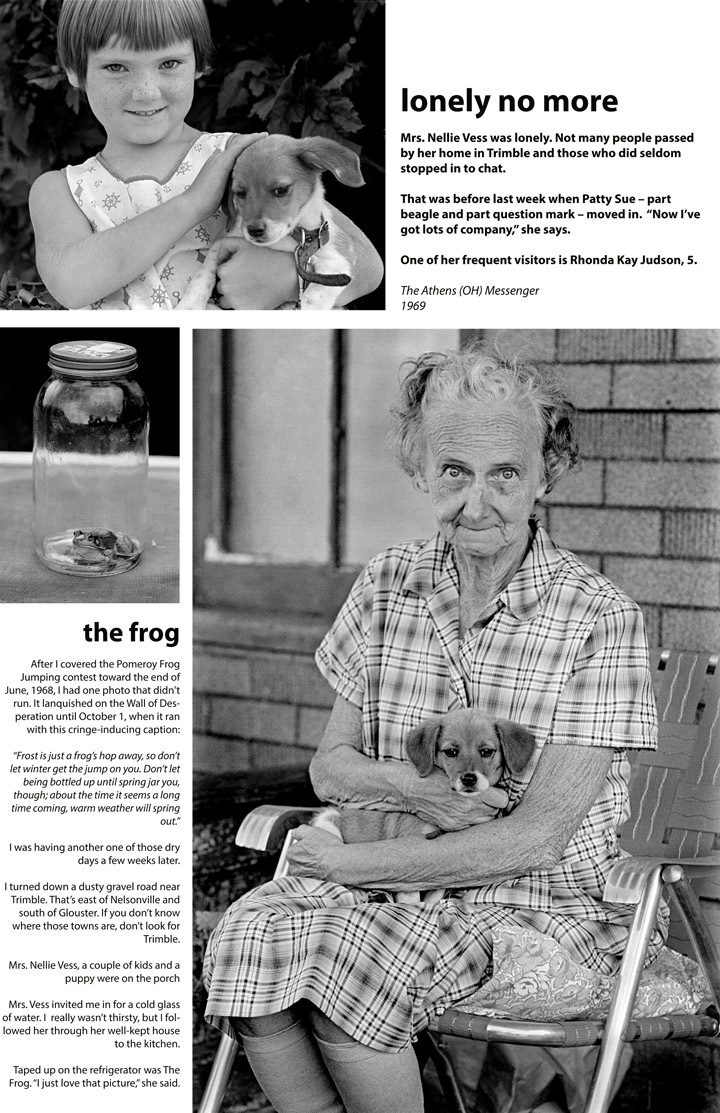
The empty space was a blessing and a curse. I covered the Pomeroy Frog Jumping Contest in 1968 and, after doing a layout, had one picture of a frog in a jar that I stuck up on what we called the Wall of Desperation – the place where we would try to cobble together a layout when all else failed.
With the 10 a.m. deadline approaching, I filled the whole space with a single photo of the frog, accompanied with the worst pun-filled copy imaginable. If you don’t believe me, go here.
On another dry day, I must have driven a hundred miles up and down the hills and back roads with nothing clicking.
Then, with the shadows getting longer and the day fading fast, I turned down a gravel road and saw this pert little old lady, Nellie Vess, sitting on her porch holding Patty Sue. She became one of my favorite subjects.
Don’t you just love heart-warming stories with happy endings? It’s too bad that too many don’t turn out that way.
A few months after the story ran, my travels took me back down that gravel road near Trimble. Mrs. Vess was sitting by herself on the porch. There was no Patty Sue. There were no neighbor kids. Mrs. Vess told me that she had to go into the hospital for a brief stay and she had to give Patty Sue away. She was lonely again.
I’d like to tell you that I stopped by to see Mrs. Vess to keep her company from time to time, but I’d be fibbing. I never saw her again. I was just starting to learn that getting emotionally involved with everyone I photographed would soon empty my empathy pot and lead to burnout or worse. I could empathize with my subjects long enough to capture their souls, but then I had to cut them loose.
I turned down her offer of a cold glass of water on the last visit. And, I didn’t look in the rearview mirror when I drove away down that dusty gravel road.
It’s all about the money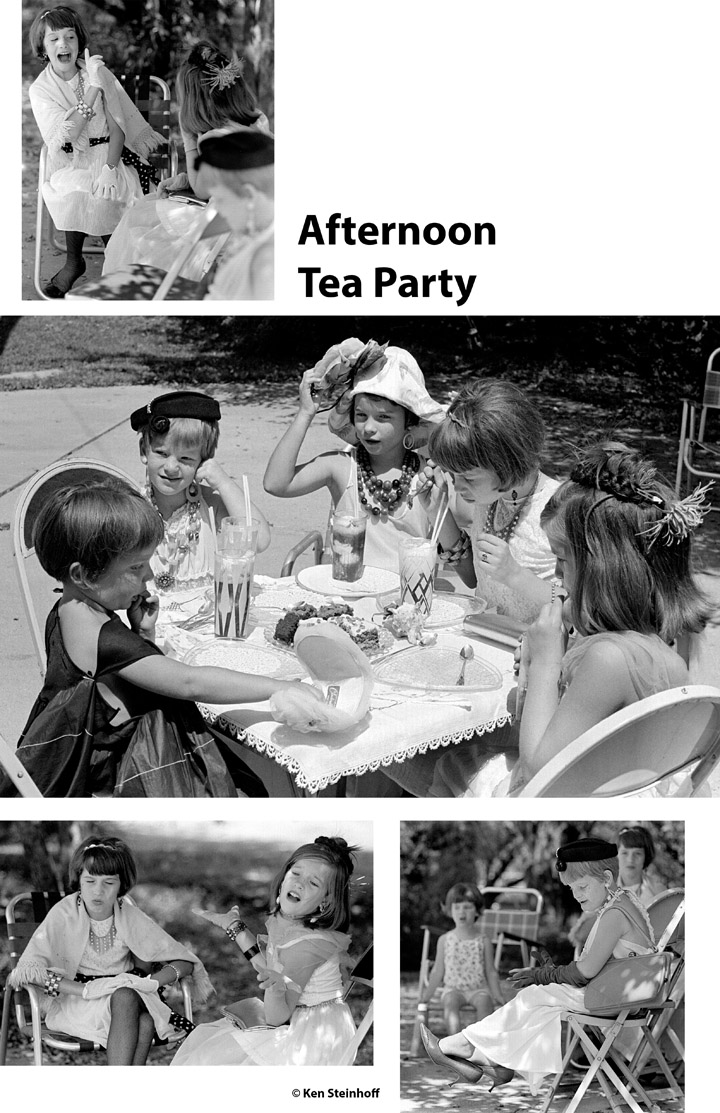
I learned a valuable lesson in my early days freelancing for The Missourian for $5 a published photo. If I shot a picture that incorporated all of the elements in one frame, I made $5. If I shot it as a layout with multiple pictures, I’d make $10 or $25.
Reminds me of the tale of the crime writer who was chided by a friend because his characters were lousy shots – “Nobody ever gets shot with one bullet. It’s always ‘BANG, BANG, BANG, BANG, BANG, BANG.'”
“It’s because I get paid a nickel a word. I’m not about to leave two bits in the gun,” he explained.
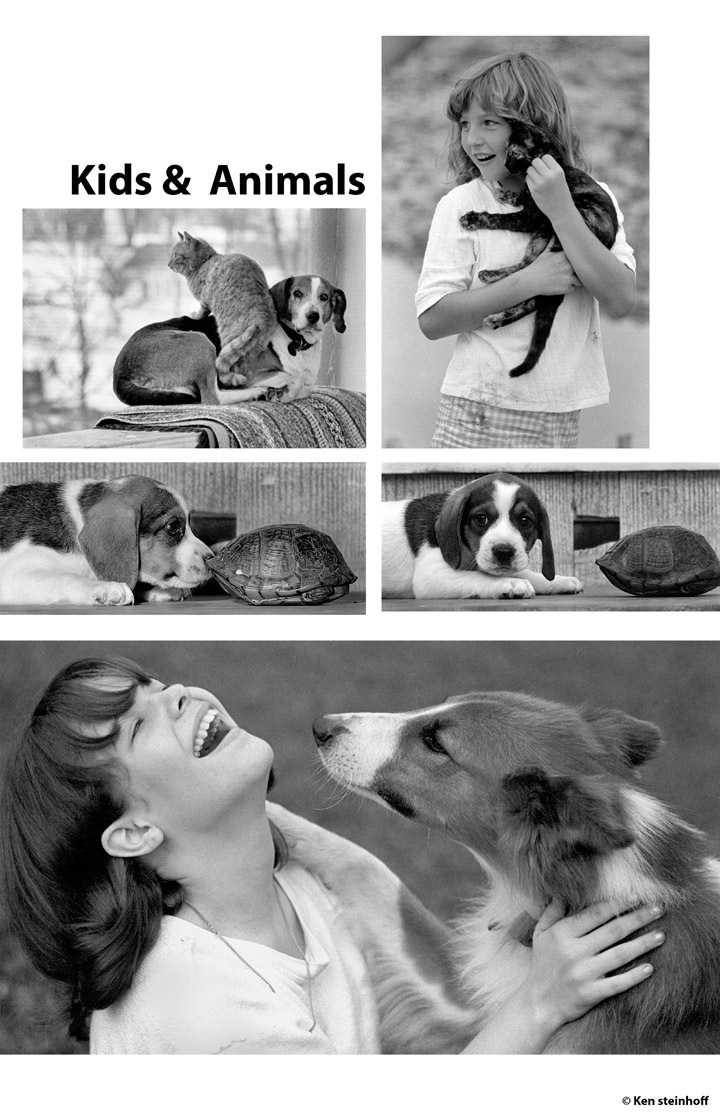
Readers love pix of kids and animals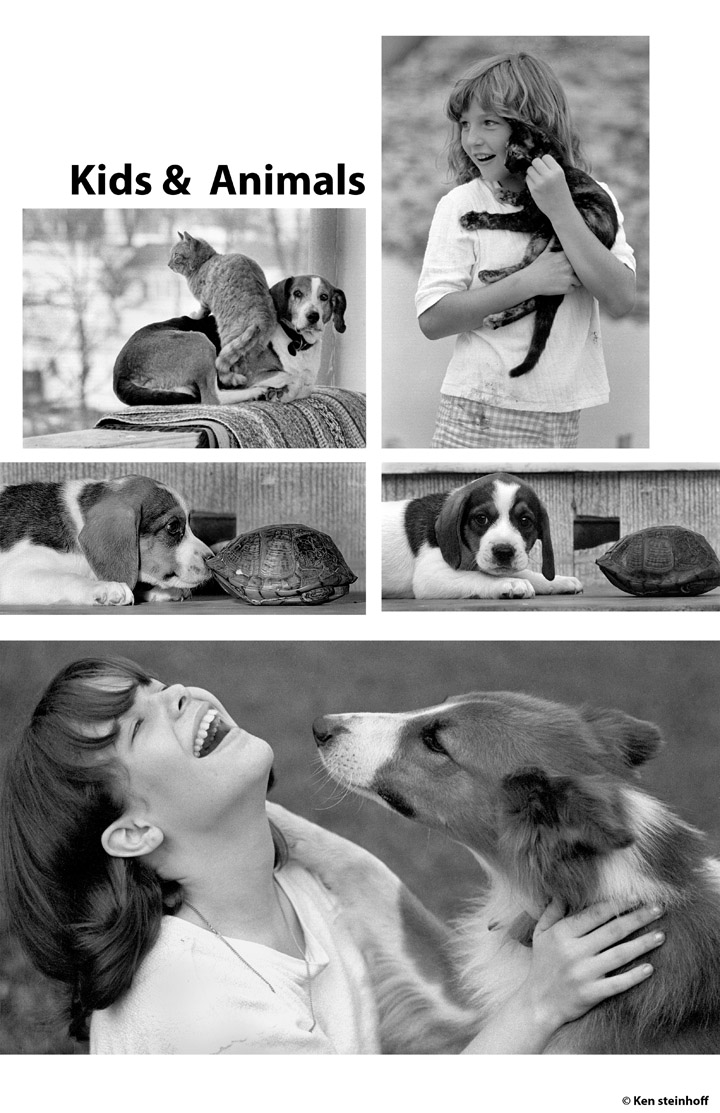
I ran into one of my formers staffers one day who had been a prolific feature wild art photographer. We talked about some of his work, and he said that times have changed.
“If I take pictures of kids in the wild, if won’t be long before somebody calls the cops to report a suspicious person. When I approach kids to get their names, they are as likely as not to scream “Stranger Danger” and run off down the street. It’s not worth the hassle these days.”
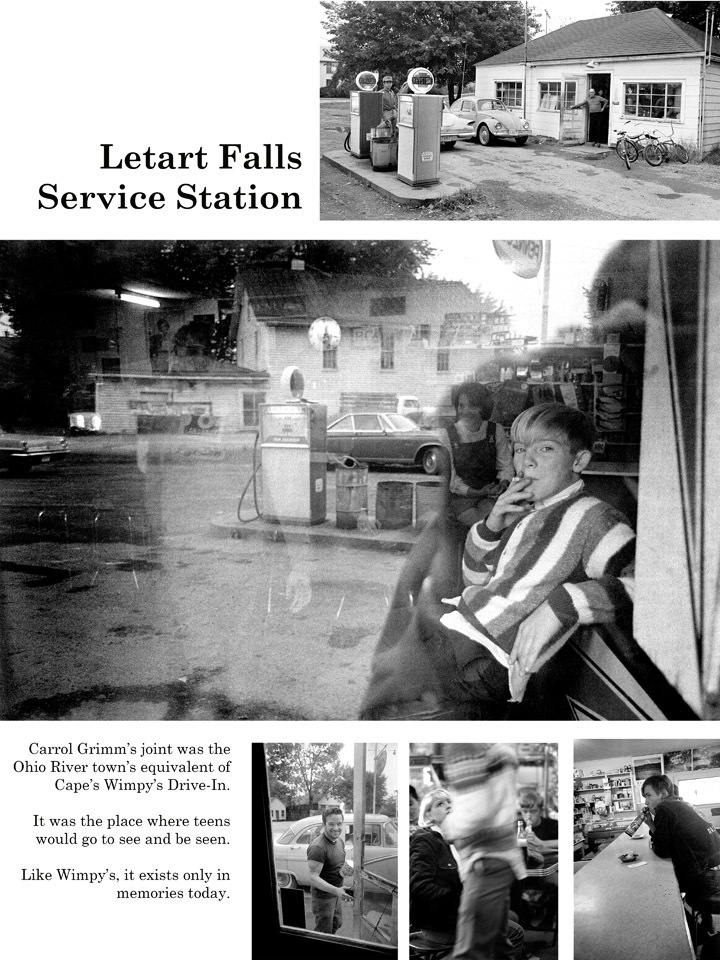
Small town teen hangouts
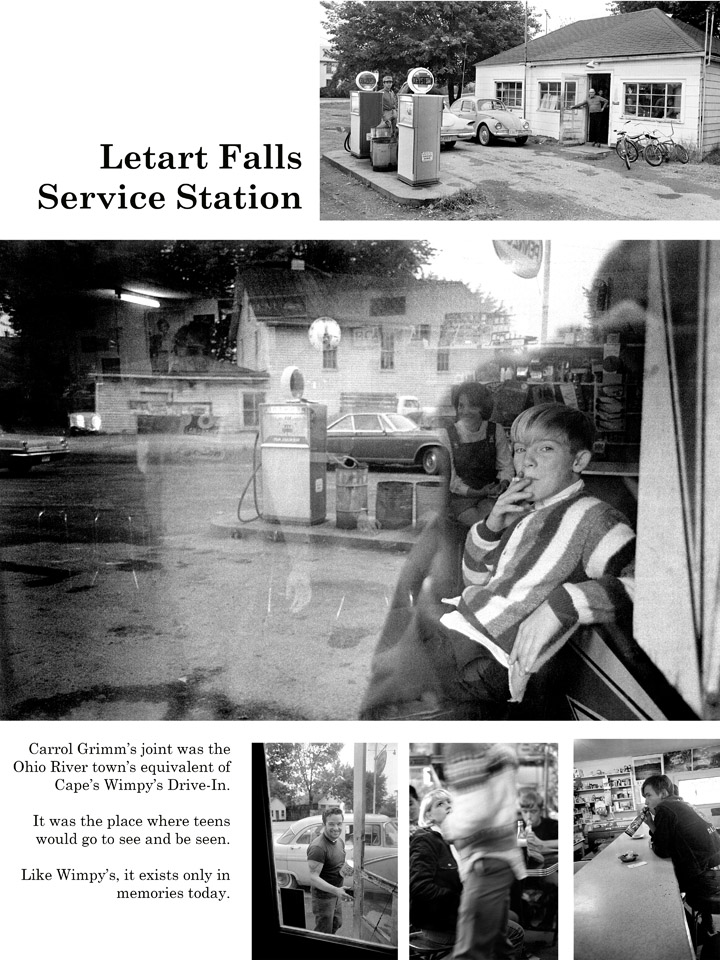
Every town had its hangouts – in Cape it was Wimpy’s, Pfisters and A&W. In Letart Falls, in SE Ohio, it was Carrol Grimm’s service station.
Telephones I have known
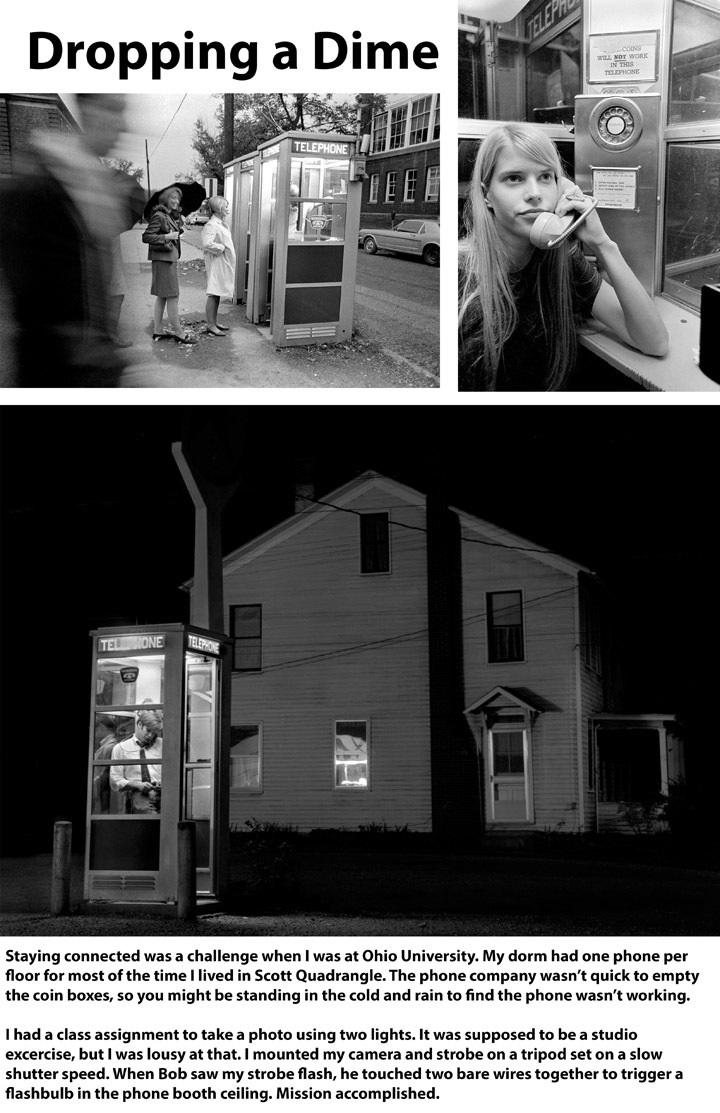
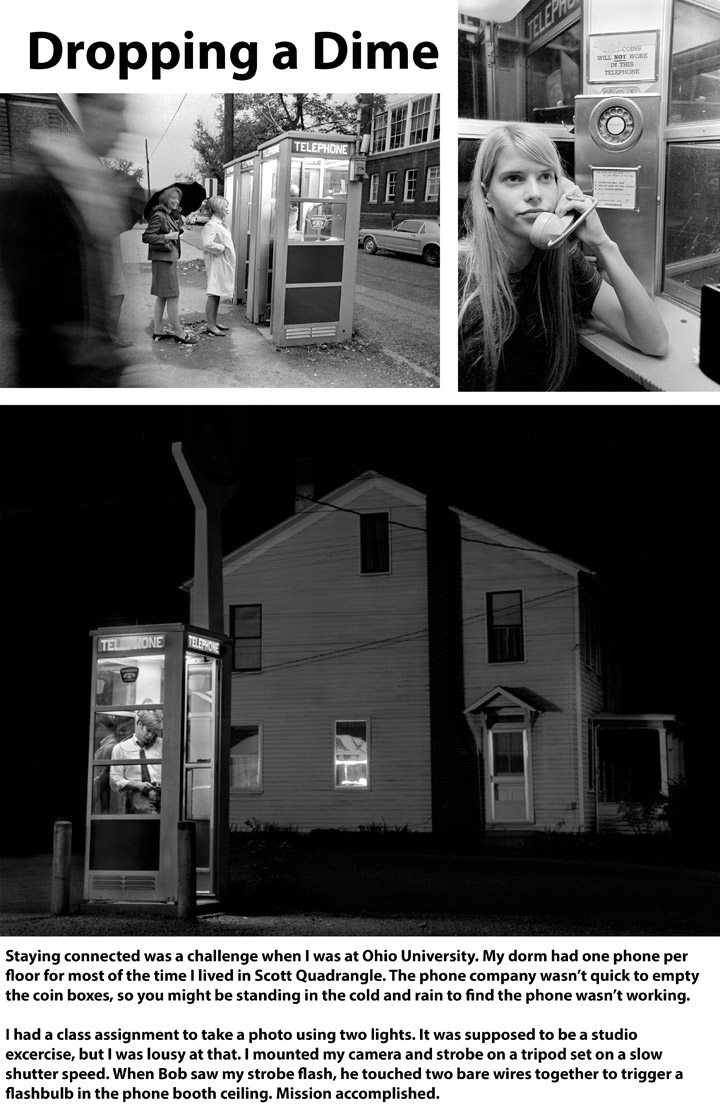 We didn’t have phones in our dorm rooms when I first moved into Scott Quad my junior year. If we wanted to call home, we had to find a phone booth that worked, a real challenge because the phone company wasn’t diligent about emptying the money out of them. When they were full, they were full.
Like Buddy Jim Stone points out, we didn’t have helicopter parents back in those days because we weren’t connected 24/7. By the time you were able to call home, you had probably already worked out the problem yourself (or had forgotten it).
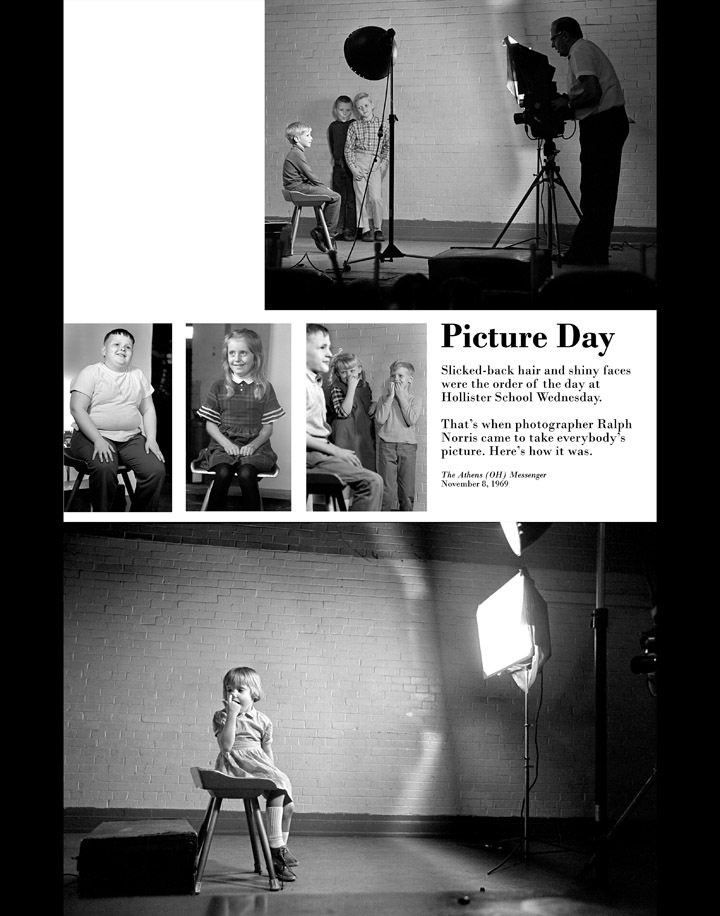
When I arrived at Ohio University, I was in for a shock. The school taught photography as a fine art, not journalism. Not only that, they were big on studio lighting and formal portraits.
The bottom picture of Bob Rogers in a phone booth is an example of how I bent the class assignments to fit my vision.
In a strange twist of fate, I spent the last 13 years of my 35 at The Palm Beach Post as telecommunications manager, a job I really liked.
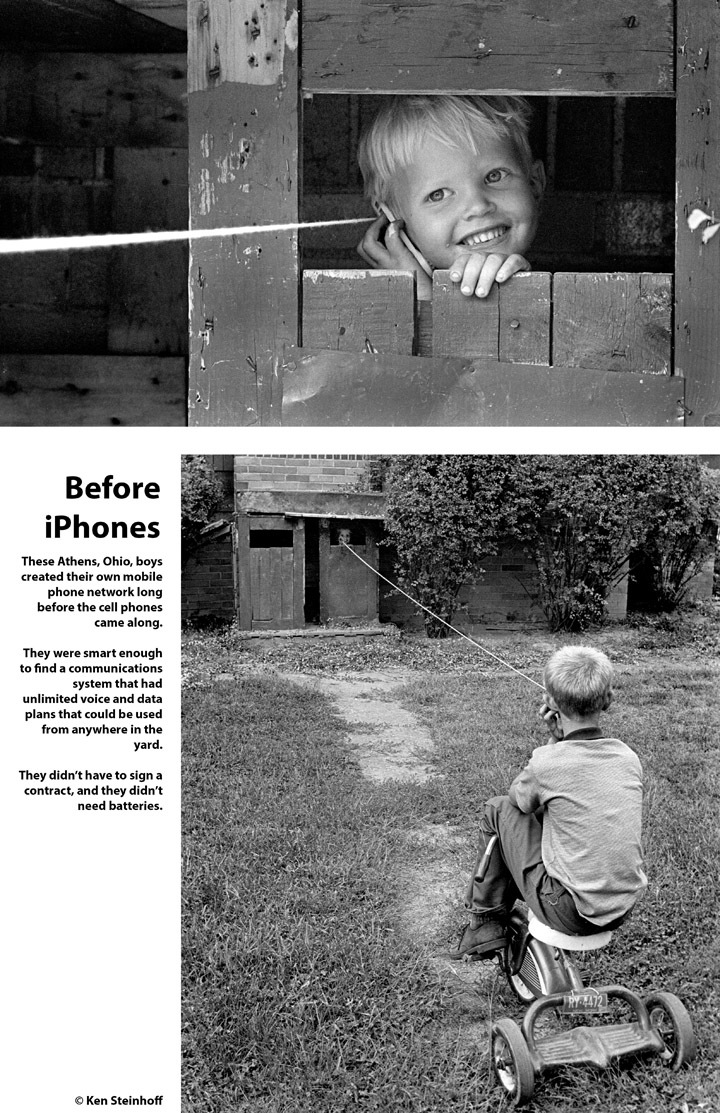
Who needs a cell phone?
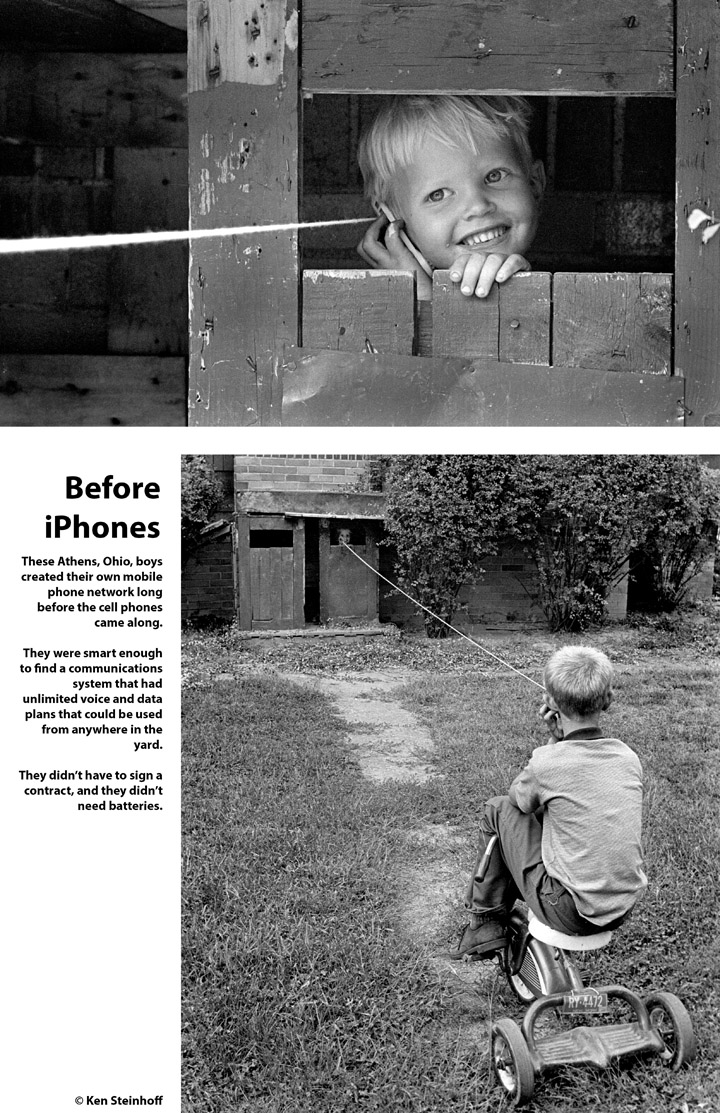
I stopped by to see my erstwhile boss, Bob Rogers, and while chatting, I saw his neighbor kids working out an effective, low-tech communication solution.
I identify with the third wheel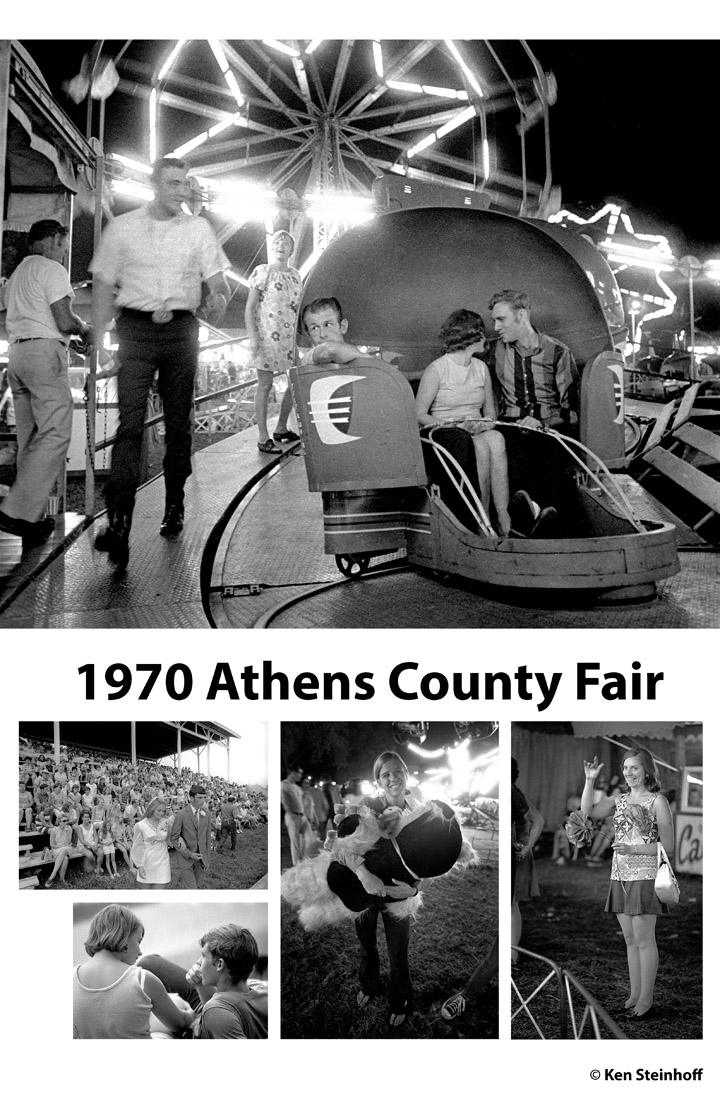
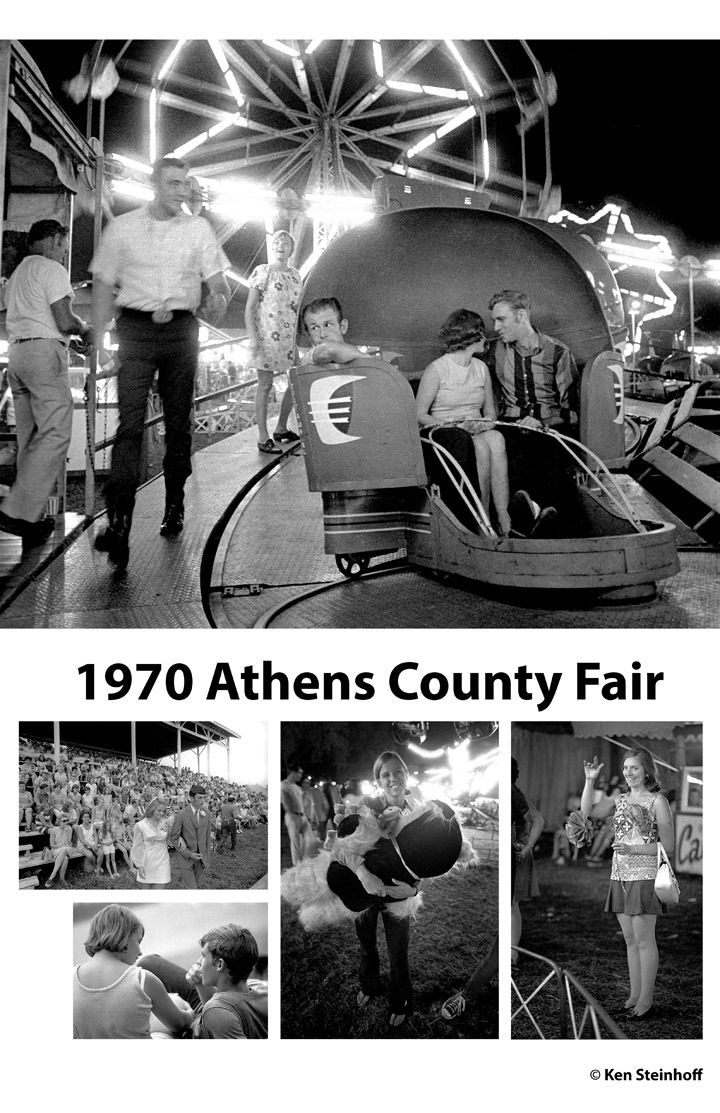
Random photos from the 1970 Athens County Fair.
My Palm Beach Post help desk person was all excited about going to the South Florida Fair.
When she asked if I was going, I said, “I covered about 13 different county, regional and local fairs when I worked for The Athens Messenger. Many of those events used the same company for rides and attractions, so finding new angles was tough. I’m happy to never go to a fair again.”
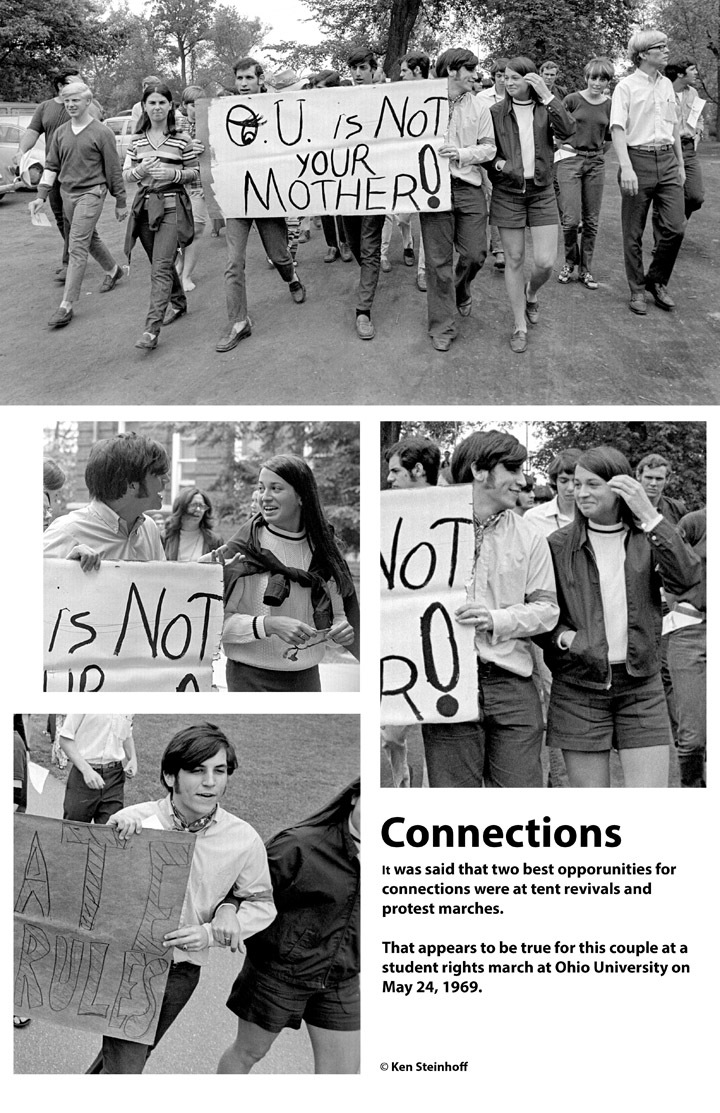
Tent revivals and protest marches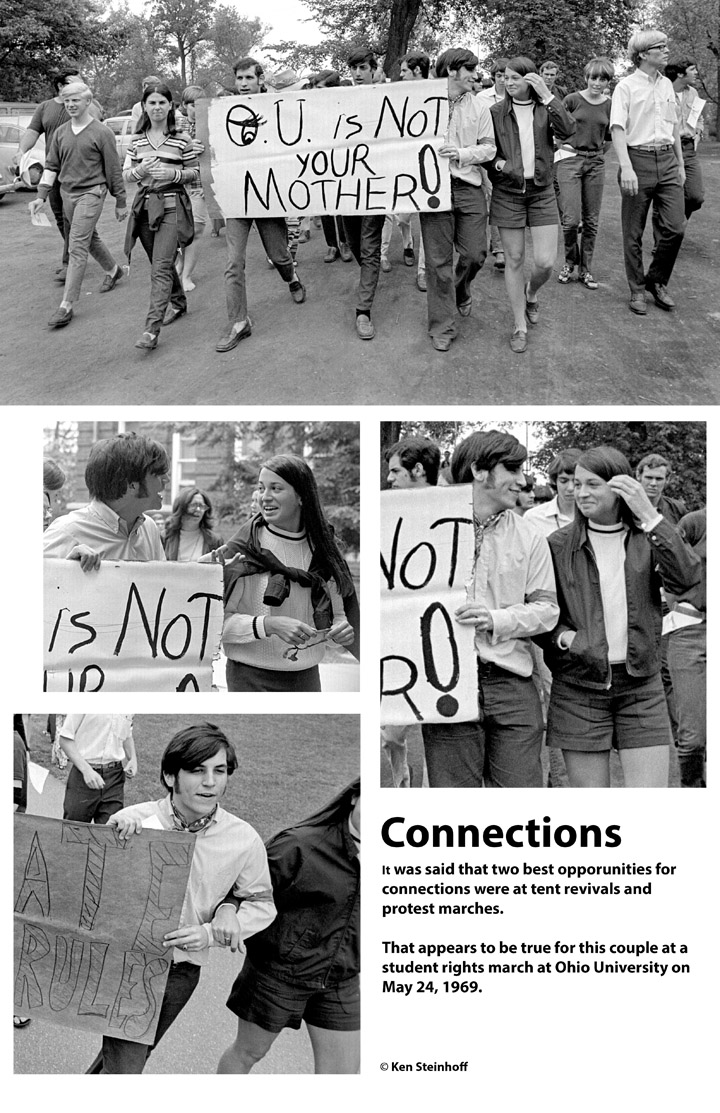
They were said to be the best place for hookups. I like the evolution of this couple at a student rights march in 1969.
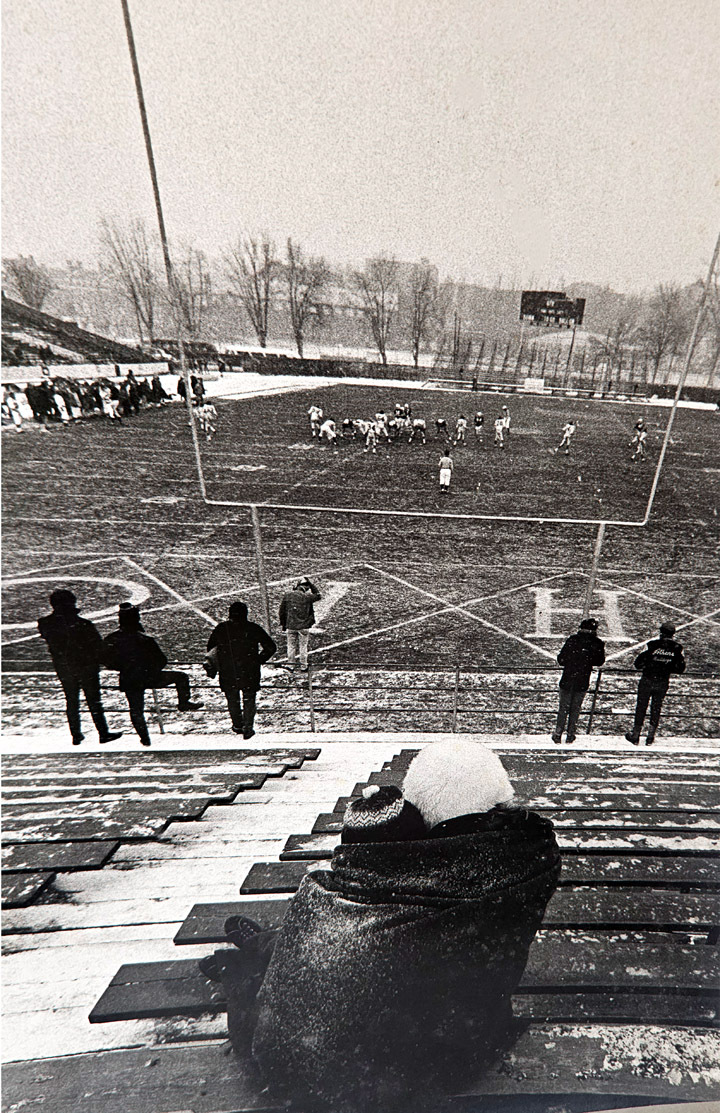
Serious snuggling
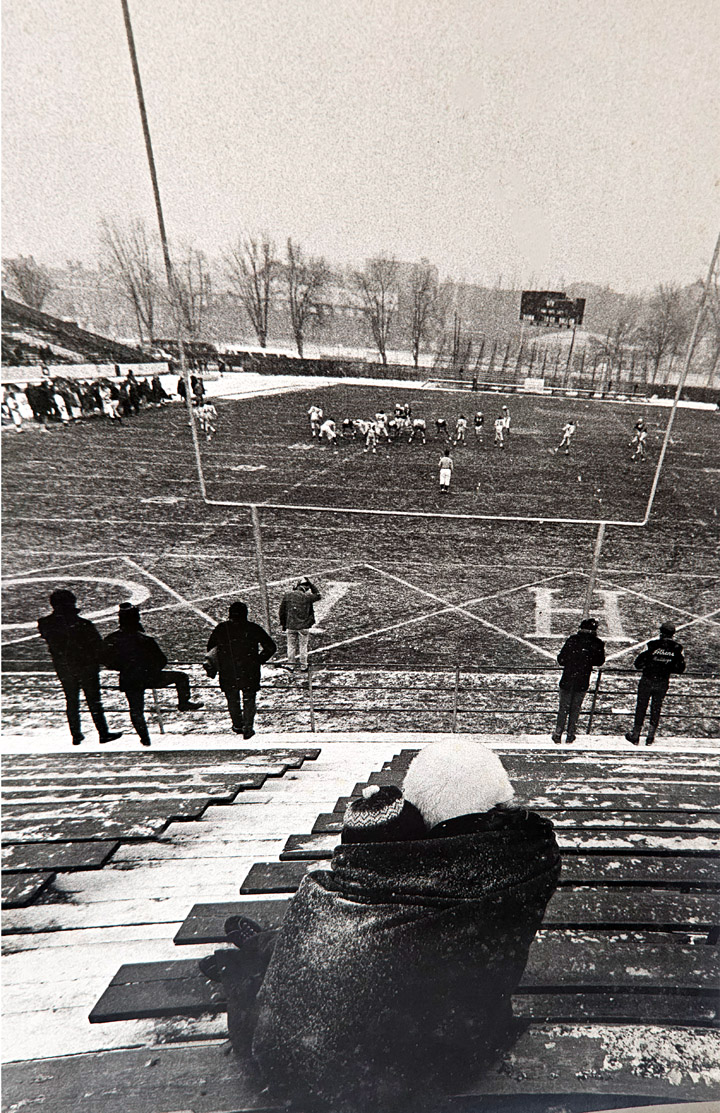
This couple had almost the whole stadium to themselves on this cold, snowy afternoon at Ohio University.
OU Football and the Capaha Park Pool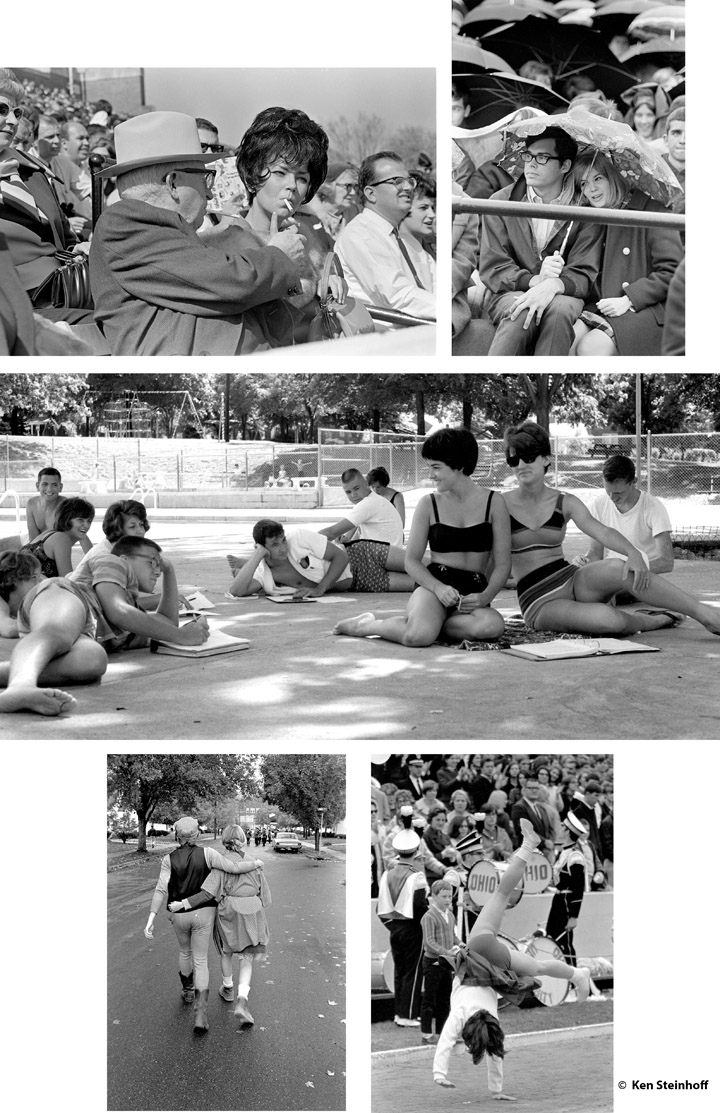
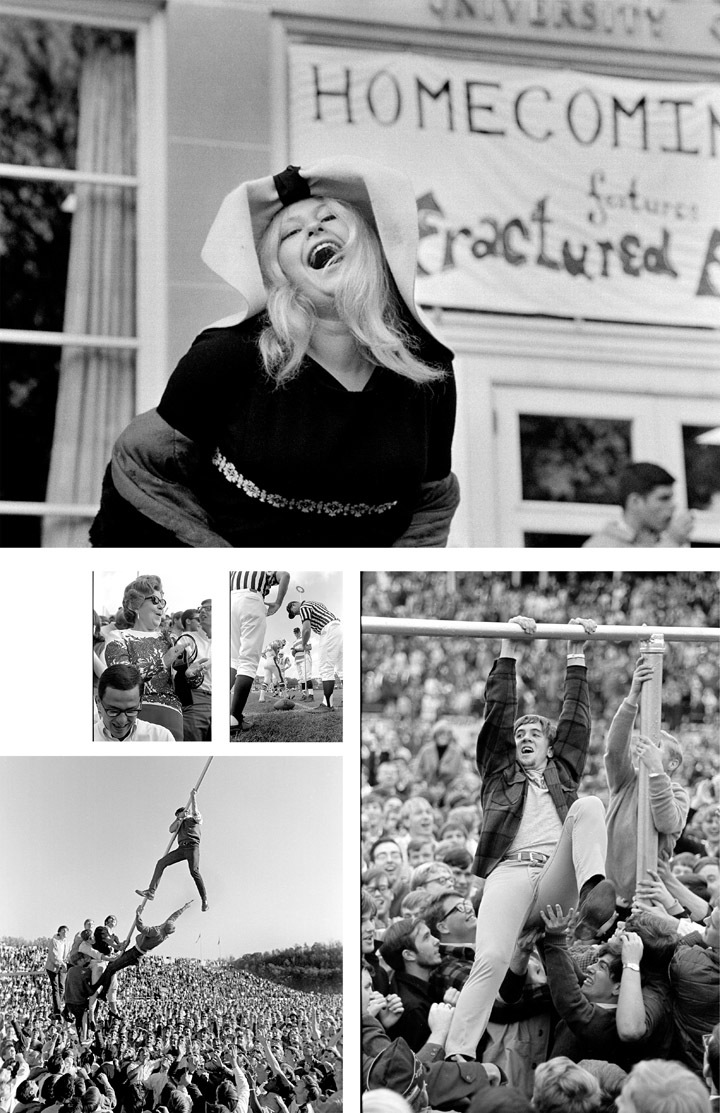
I was obligated to shoot sports action, but I really enjoyed turning the camera on people in the stands. The pictures rarely ran, but you can see them now.
The middle photos shows kids supposedly studying for a lifesaving test at the Capaha Park Pool, but it looks like the teens are studying each other more than their workbooks.
Tearing down the goalposts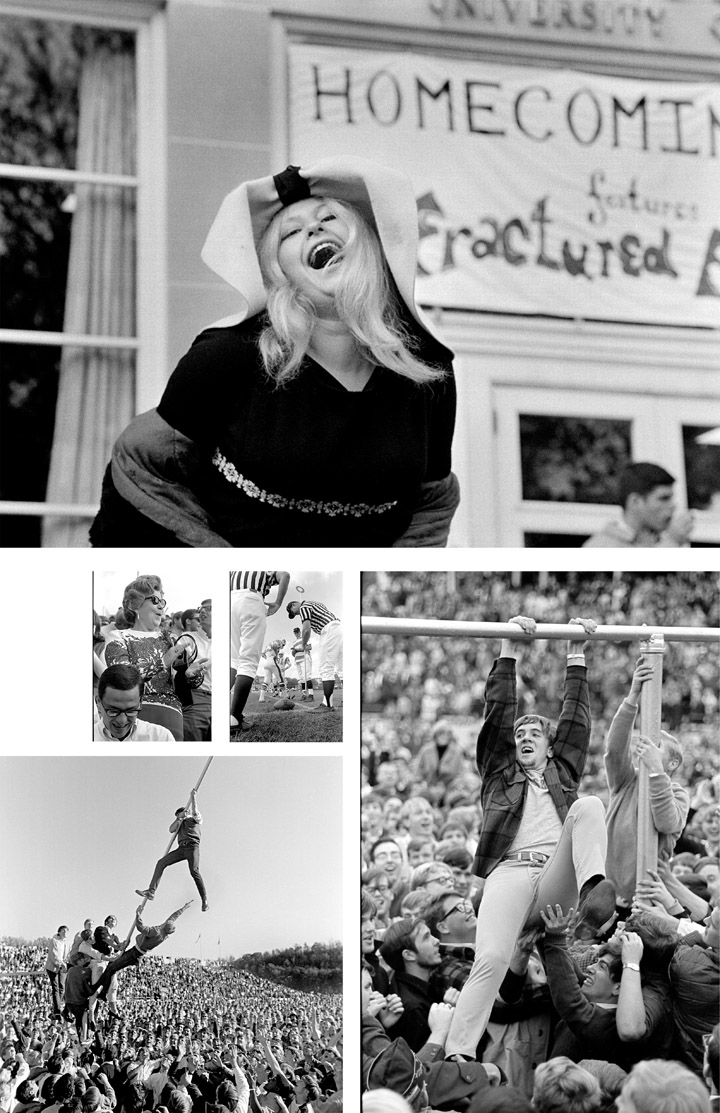
Ohio University was the only place where I photographed students tearing down their own goal posts.
The “hippy chick” at the top ran for homecoming queen as a lark. I don’t know how many votes she got, but I loved her spirit.
Miss Miller’s Wedding Day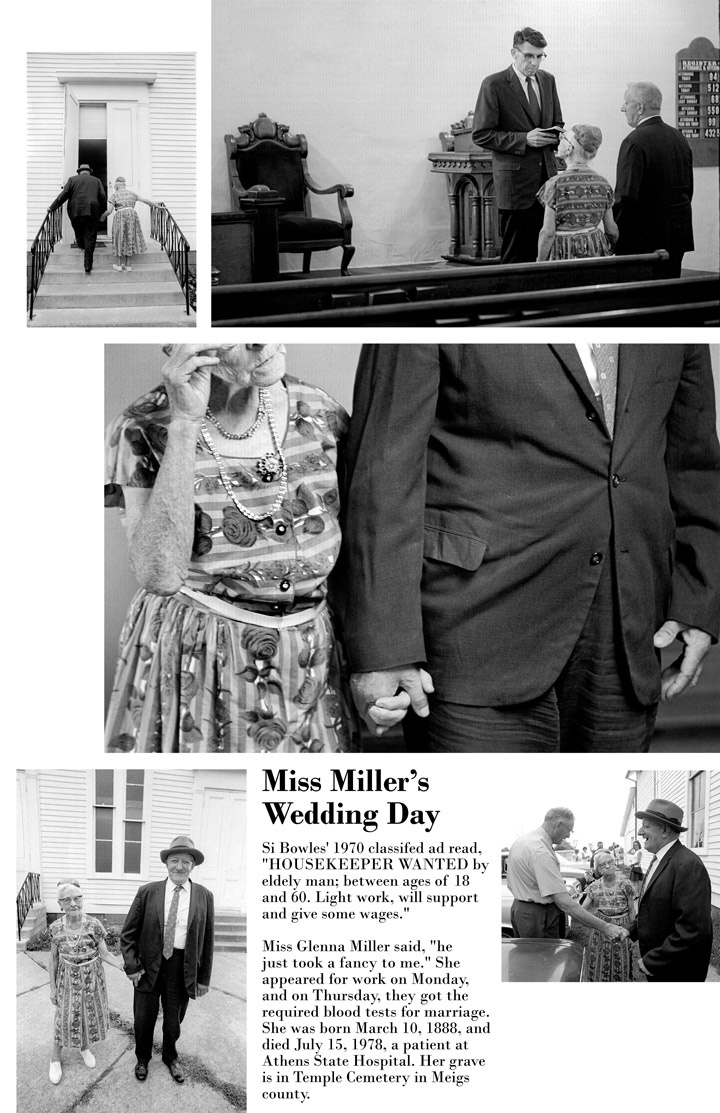
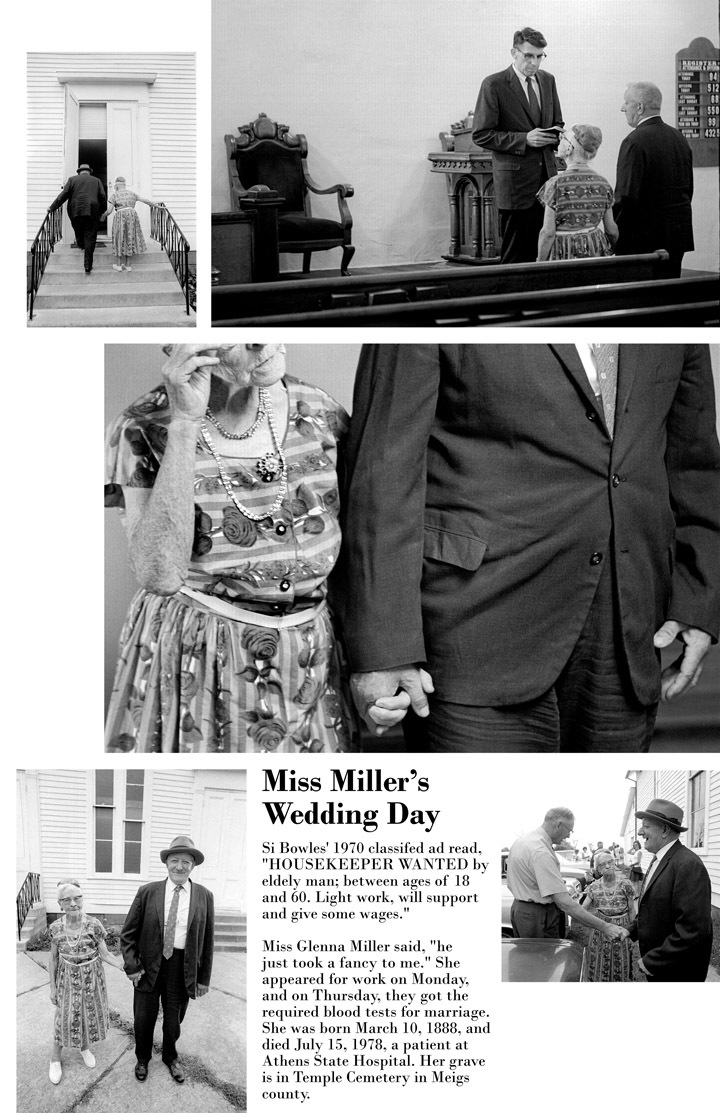
Wife Lila worked as a teller at banks in Ohio, North Carolina and Florida. One of her favorite customers in Athens was Miss Miller, a diminutive woman of uncertain age, who would show up to withdraw tiny sums of money.
One day, she announced that she was getting married. Lila and I attended the ceremony, and The Messenger did a story about the couple.
A few days after the wedding, I stopped by the old two-story frame house the man owned. I had almost stepped up onto the porch when I heard a “THUD, THUD, THUD” and I had to dodge a big tire rolling out into the yard.
Miss Miller was cleaning house.
MLK National Day of Mourning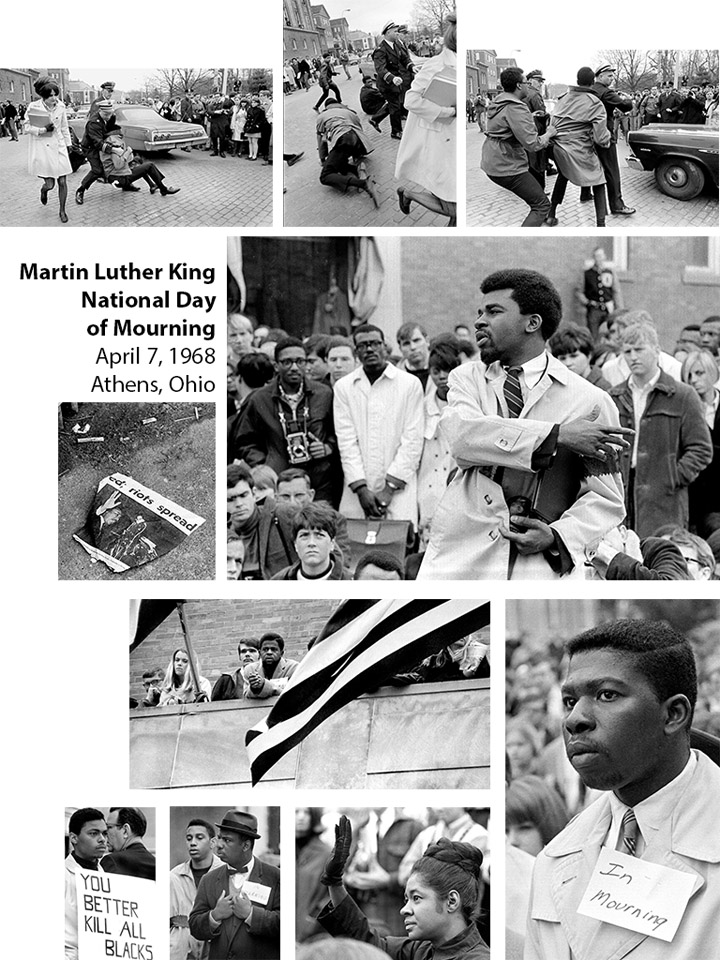
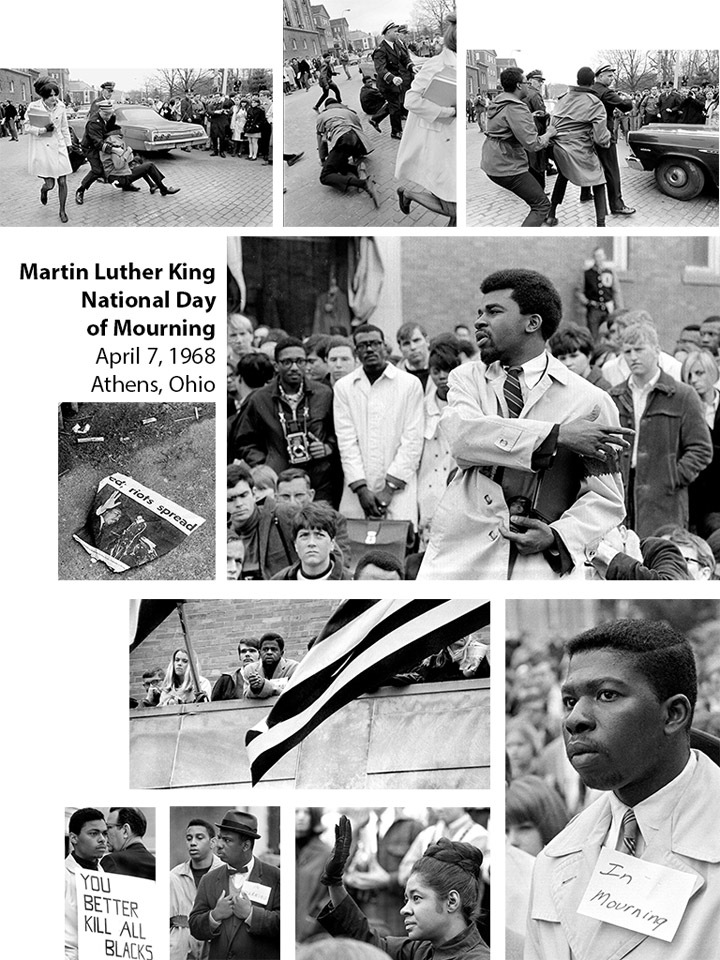
One of my most productive days as a news photographer was covering the Martin Luther King National Day of Mourning at Ohio University. It was a solemn gathering that culminated with hundreds of students conducting a sit-in at Court and Union, the main drag. Here is a more complete account of that day, including a video a man did incorporating my images.
A hot-headed police captain didn’t realize this wasn’t your normal rites of spring event when he started to throw a student off “his” street, uttering racial epithets at the time. Emotions were raw, and if cooler heads hadn’t stepped in it could have turned into a disaster.
While I was standing in the middle of the street, I came to the realization that I was fortunate enough to be part of something historical, but as an observer and recorder rather than a participant.
That was brought home to me when I met a school bus taking a bunch of students to jail after a different demonstration. Kathy, a young woman I had covered and admired because she was the real deal – someone who believed in her causes and worked with poor kids in the dying coal towns of Appalachia, stepped off the bus.
“Kathy, are you OK?” I asked. “Is there anybody you’d like for me to call?”
She gave me a withering glare and said, “Ken, one of these days you’re going to have to lay down that damned camera and take a stand.”
She was wrong.
Your whole world shrinks
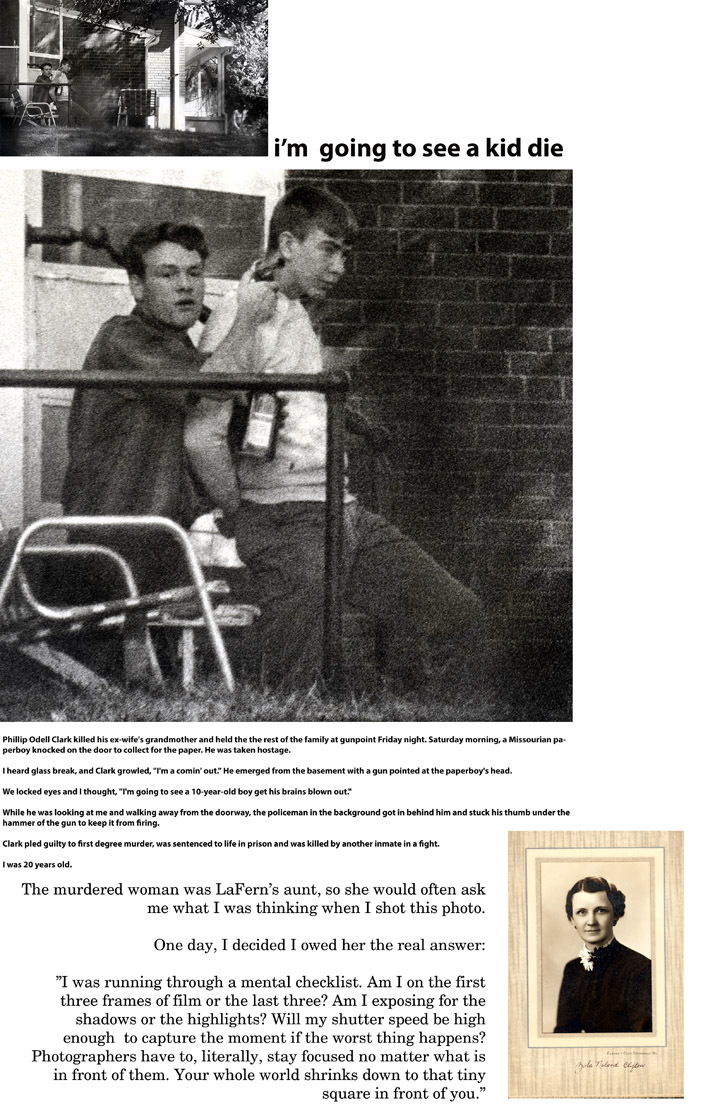
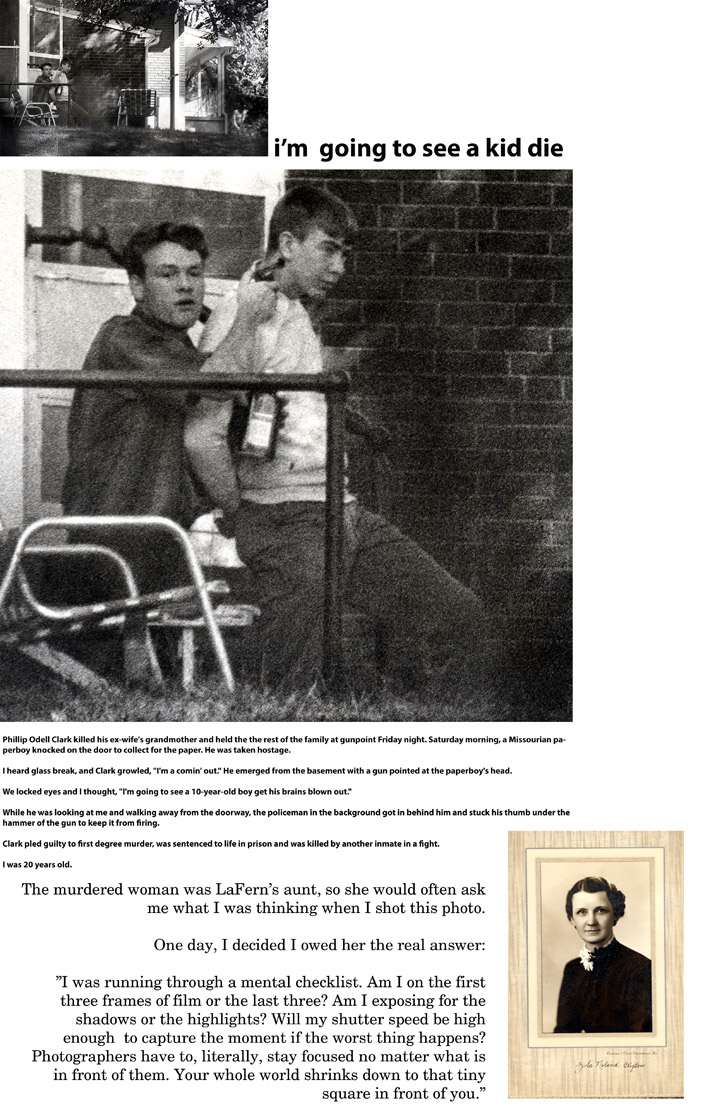 I was sitting in The Missourian office on a slow Saturday when I heard police traffic on the radio that sounded unusual. When I checked it out, I found that Phillip Odell Clark had killed his ex-grandmother-in-law and taken family members and others hostage. When a 10-year-old paperboy showed up to collect, he was added to the hostages.
After an hour or so, I heard glass break and Clark growled, “I’m a comin’ out.” He emerged with a gun at the boy’s head and a bottle of whiskey in the other hand.
I was asked many times what I was thinking, and I usually gave a flip answer “I thought I was going to see a boy get his brains blown out.”
Years later, I met LaFern Stiver, friend Shari’s mother, who quizzed me repeatedly about the experience since the murdered woman was her aunt.
One day, I thought I owed her the real answer: “I was running through a mental checklist. Am I on the first three frames or the last three? Am I exposing for the shadows or the highlights? Will my shutter speed be fast enough to capture the moment if the worst happens? Photographers have to, literally stay focused no matter what is in front of them. Your whole world shrinks down to a tiny square.”
To serve and protect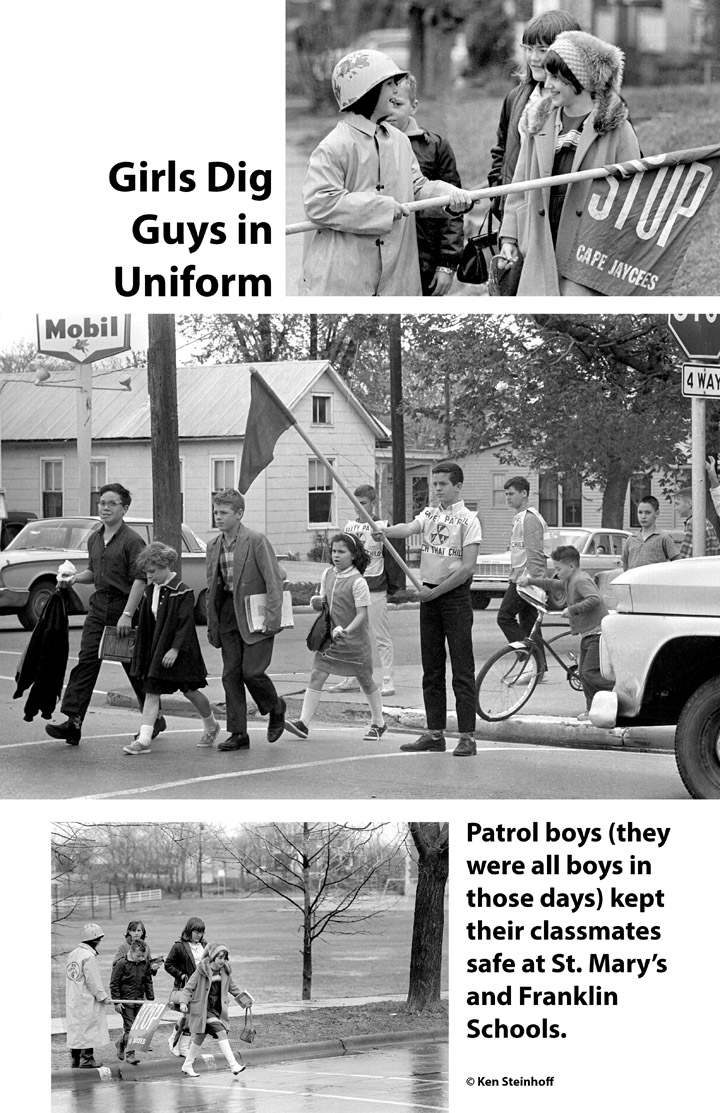
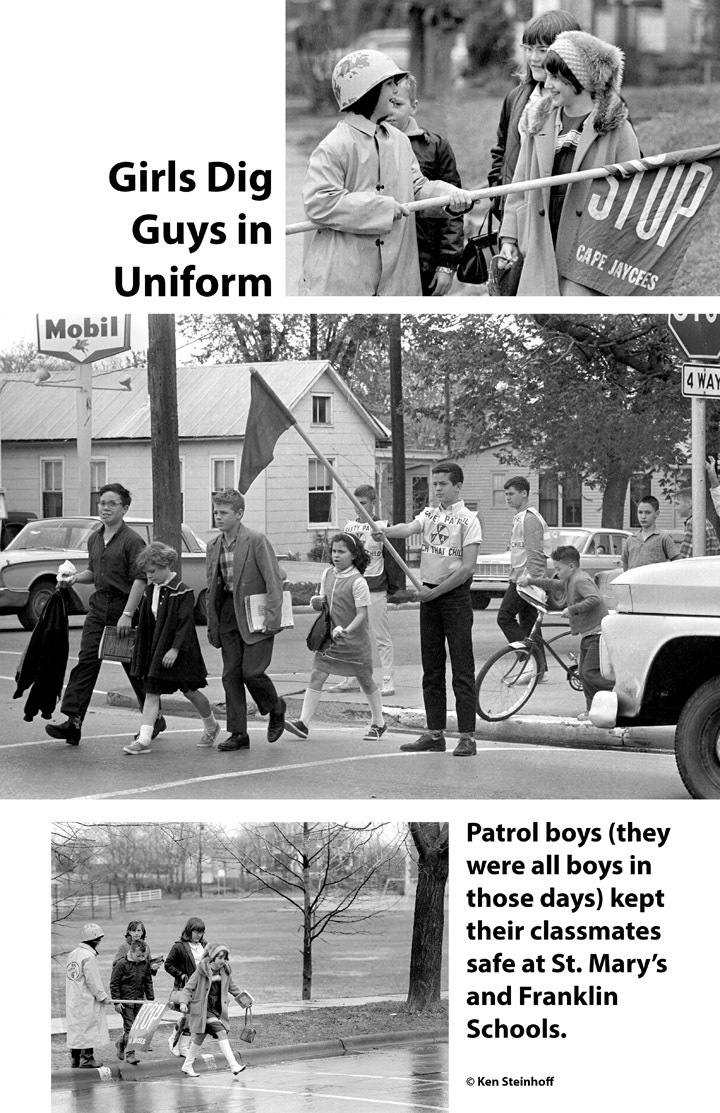
I was captain on the Trinity Lutheran School Safety Patrol, so I’ve always had a soft spot for those boys (and later, girls) who kept their classmates safe crossing the street.
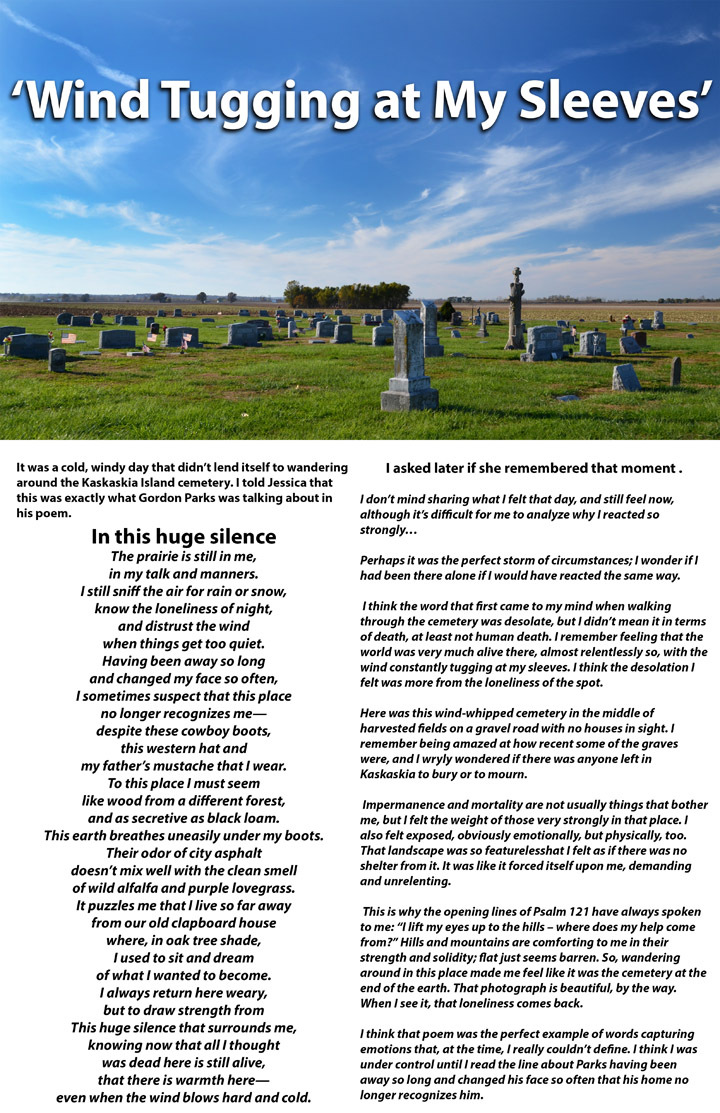
In This Huge Silence
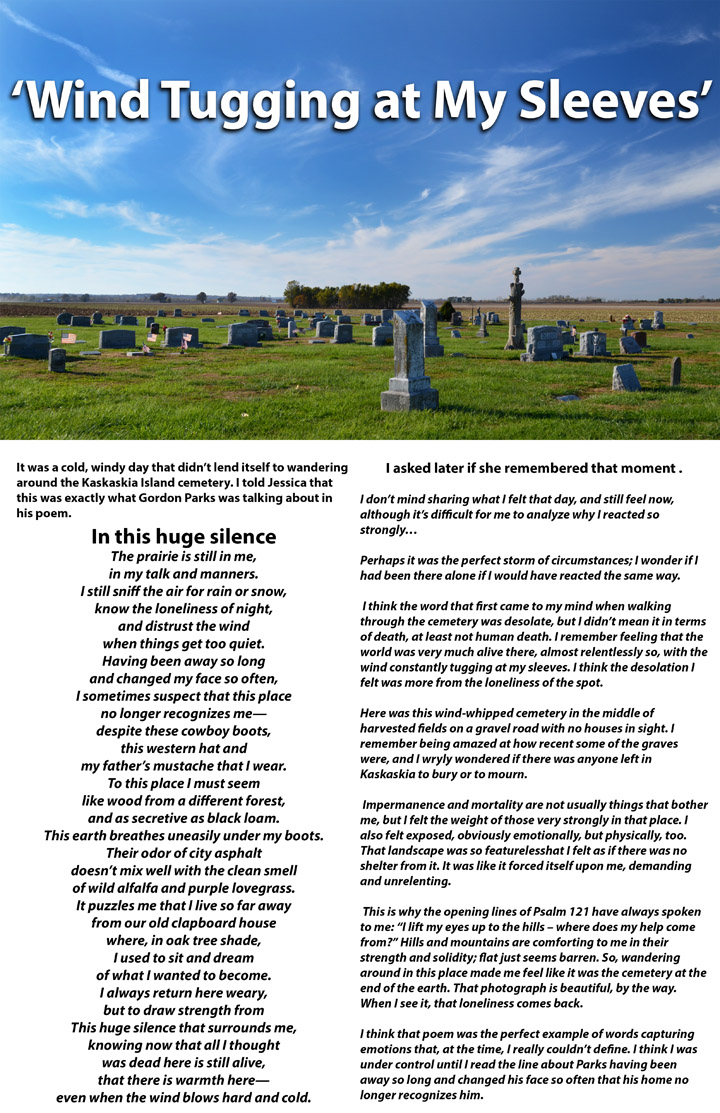 I had Gordon Parks’ poem on my office wall for years. It has always moved me to the point that I can’t read it aloud without getting a fishbone in my throat.
I introduced SE Ohio curator (now director) Jessica to the poem when we visited Kaskaskia Island. She was equally moved by the powerful words.
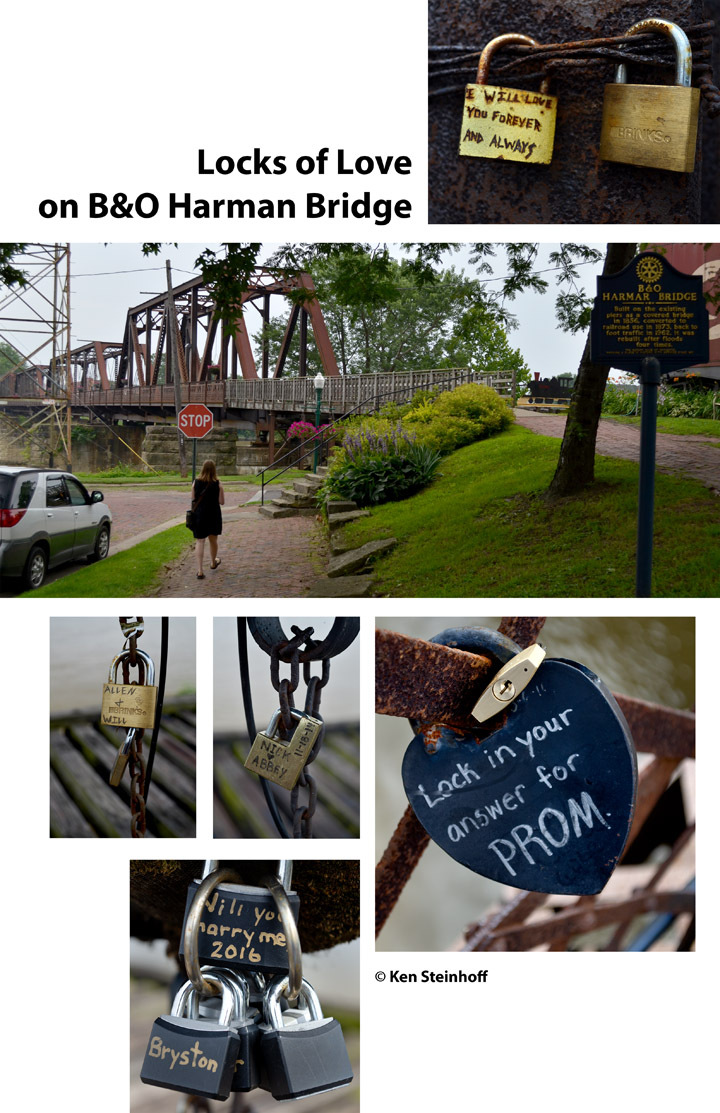
Locks of Love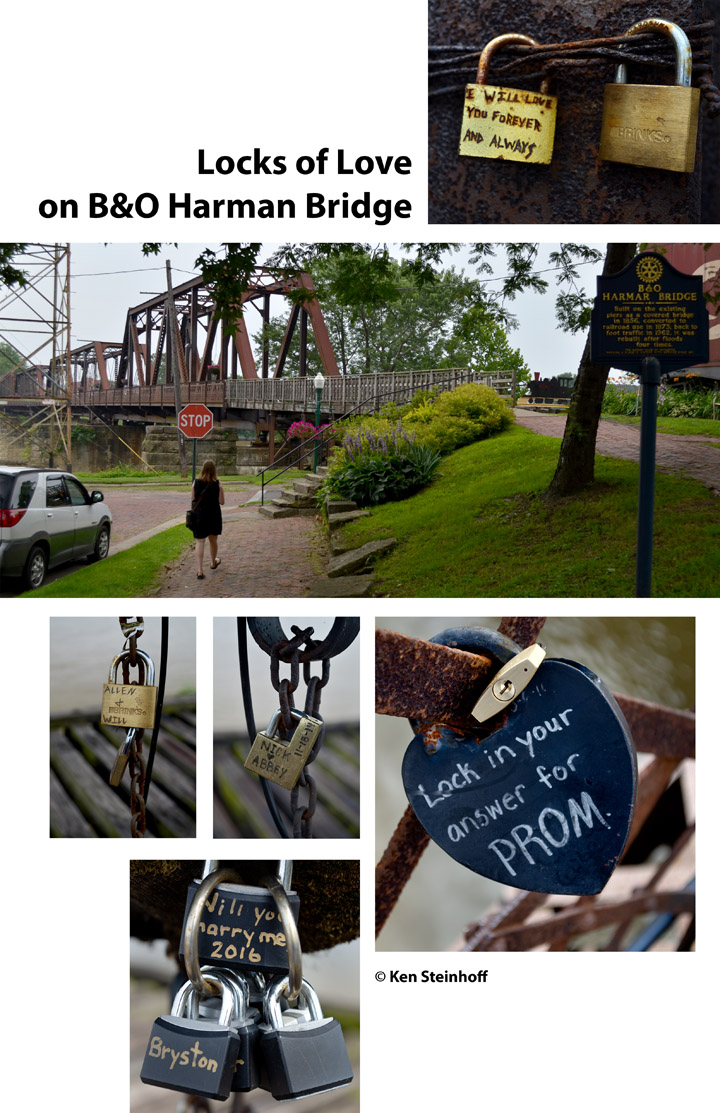
Speaking of Jessica, we found these locks of love on a bridge in Marietta, Ohio.
Ordinary people doing ordinary things
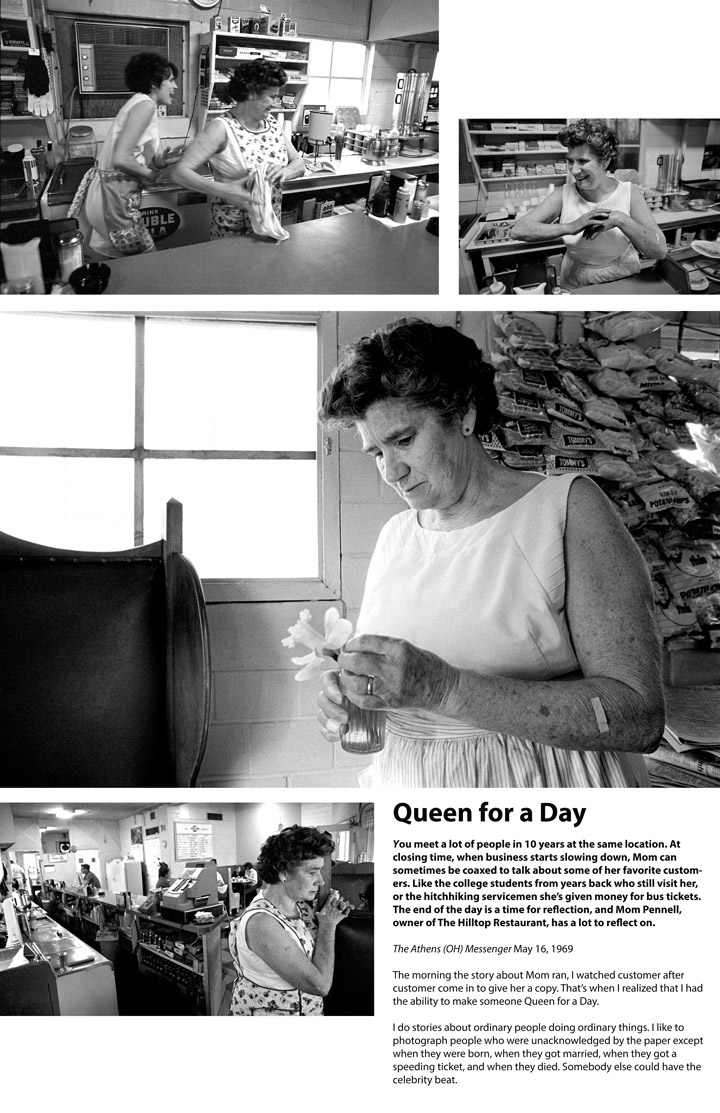 If you’ve been around me much at all, you’ve probably heard me quote Chicago columnist Bob Greene, who said his job as a journalist boiled down to getting someone to love him for 28 minutes while he stole their soul.
I like to think with age comes maturity, so I tell folks that I didn’t steal the souls, I only borrowed them, and now I’m trusting you to to carry them with you.
I covered presidents, wannabe presidents, the Pope and the Queen of England, but my greatest pleasure was shooting photos of ordinary people doing ordinary things. I wanted to find people whose names would appear in the paper only when they were born, died, got married or got a speeding ticket.
Mom of the Hilltop was one of those subjects that caused me to realize that I had the ability to make one of those ordinary people Queen for the Day.
Coffee can film
Since I was a freelancer in Cape, I had a darkroom set up in the basement. When I was through processing and printing the money shots, I’d take the random frames I shot to burn up film and put them in a plastic garbage can under my desk. The family knew not to put anything in it.
After I had been gone about ten years, I saw the scraps of film were still there, unmolested (unlike my comic book collection destroyed by my destructive younger brothers). I rolled up the film, wrapped rubber bands around it, and stuffed it in coffee cans, not to be looked at until after I retired in 2008.
It turned out that many of those “useless” pictures turned out to be more precious than the ones I had been paid to take.
An assignment to shoot a cleanup campaign in Smelterville turned out to be in that group. Since I only needed a few pictures for the paper, I spent a couple hours roaming around shooting people and places that were never published.
After I digitized the film, I wondered if I could track down my subjects. Smelterville had been flooded in 1973 and 1993, and the area, like Red Star at the north end of Cape had been bought out.
After many false starts, I finally ran across a man who not only could identify most of the people, he could tell me the names of their dogs and what was the matter with the cars scattered around.
I started interviewing folks and turned the project into a book. You can read details here.
I won the lottery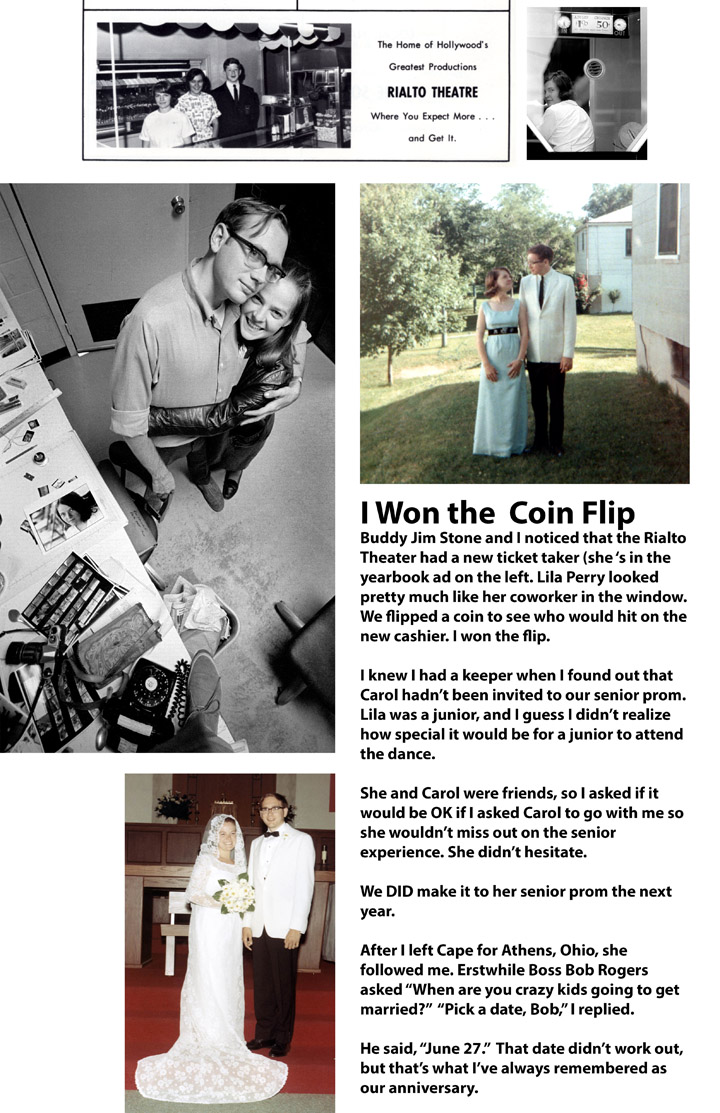
Buddy Jim Stone had an on-and-off girlfriend named Carol whose mother owned the Rialto theater in Cape. Jim loved making popcorn, and I was fascinated by watching the projectionist swapping reels of film in the projection booth. We spent a fair amount of time there.
When we pulled up to the place one night, we noticed a new cashier in the ticket booth. We flipped a coin to see who would hit on the new gal.
I won the flip. It was one of only two winning lotteries in my life. The second was when my birthday came up as Number 258 in the draft lottery, and I was spared an all-expense-paid vacation in SE Asia.
Future Wife Lila and Carol were friends, so when I found out that Jim wasn’t going to ask Carol to the senior prom, I asked Lila if she would mind if I asked Carol, also a senior, to go so she wouldn’t miss out on the event.
Being fairly clueless, I didn’t recognize the significance of what I was asking – it was a big deal for a junior girl to be invited by a senior to his prom. To her credit, she understood what I was doing and immediately gave her consent.
And, that was who she was. Someone who would over look my many faults and foibles.
Cute then, cute now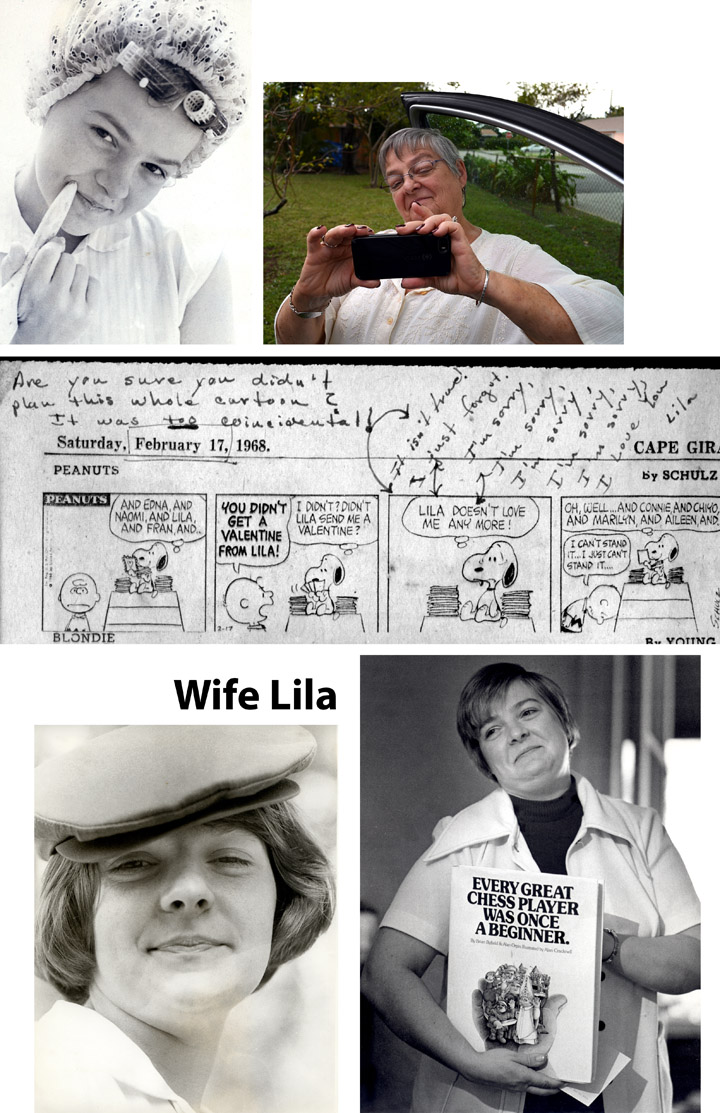
On one of our first dates, I pulled out my ever-present camera and started to take her picture. She let me know that wasn’t on the list of acceptable behaviors.
When she let me take the photo of her with a paintbrush and curlers in her hair – and live – I thought there may be some hope for me.
I swear that my Wife Wife, Bike Wife and Office Wife must have coordinated that eye-roll look of amusement when dealing with me. I couldn’t have been luckier.
Gallery of layouts
Here’s a gallery of all the layouts in one place. Click on any image to make it larger, then use your arrow keys to move around. I hope you’ve enjoyed my time machine.