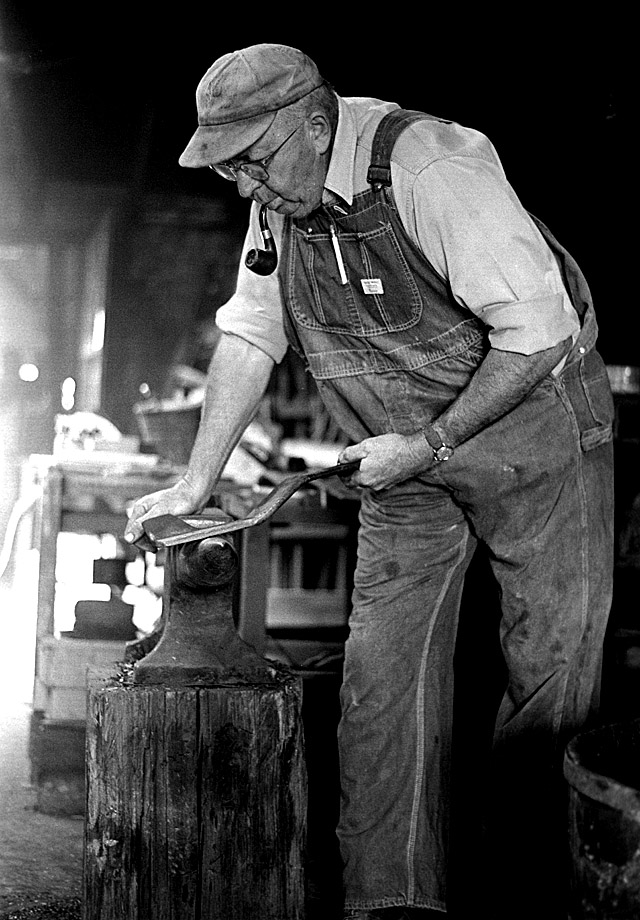
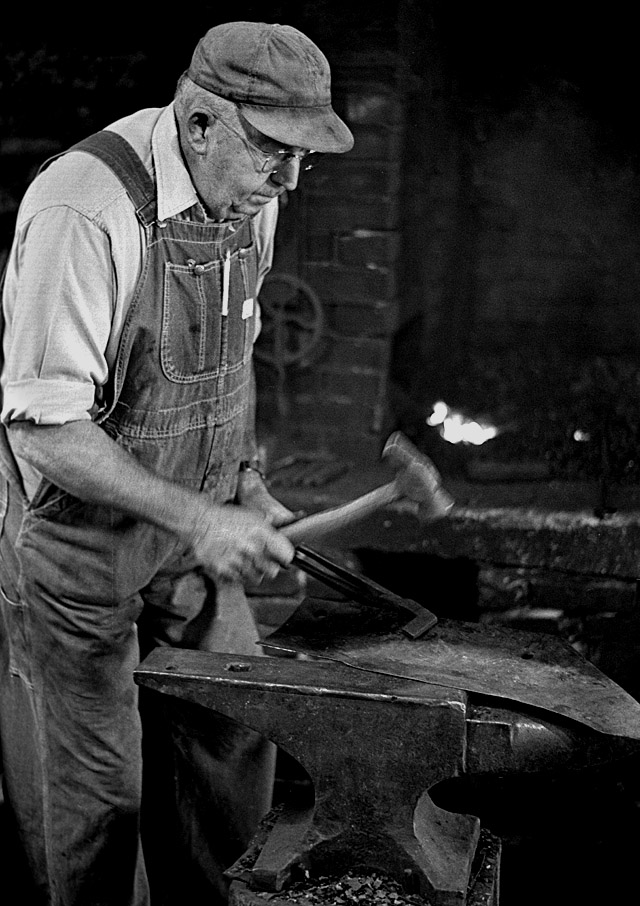
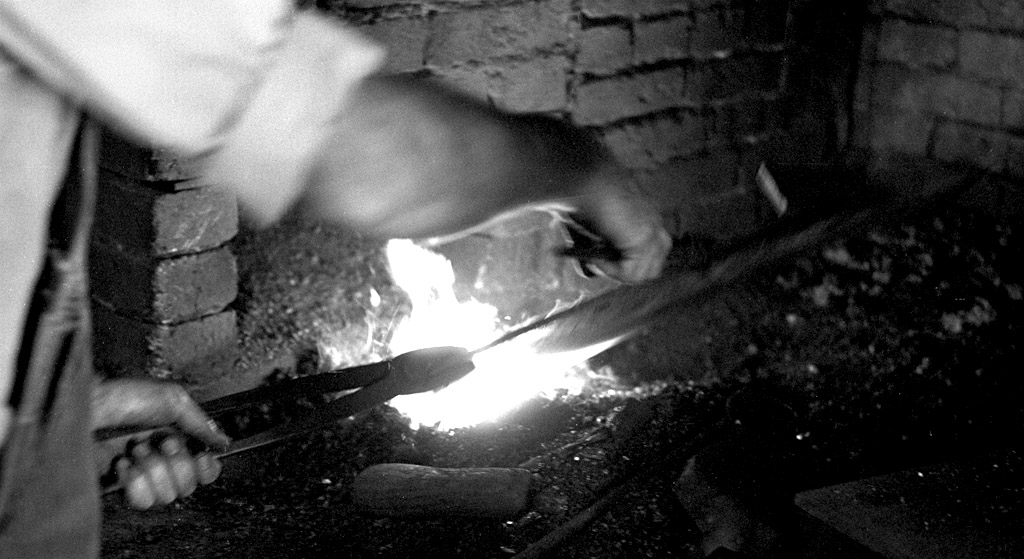
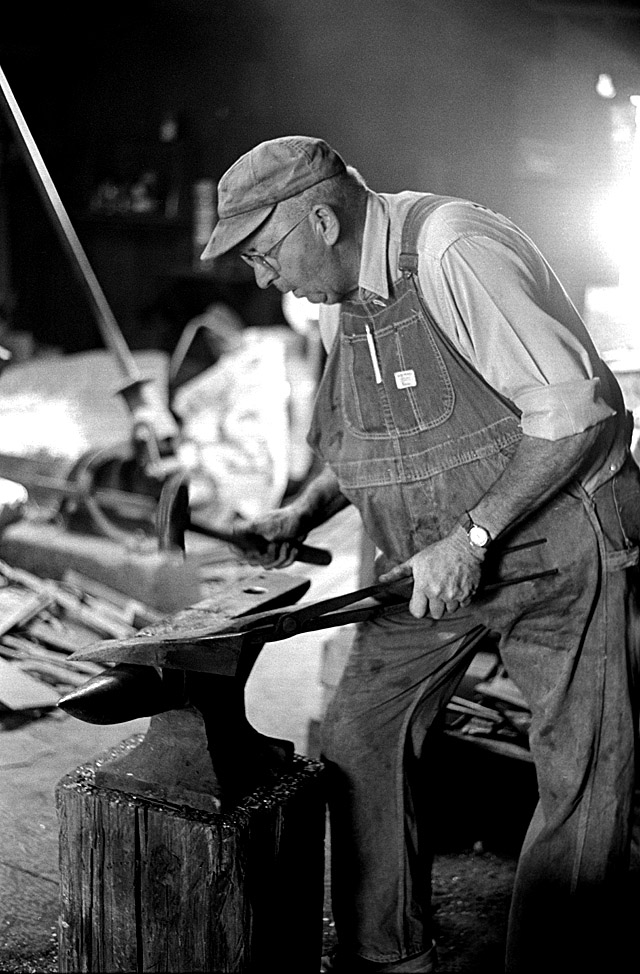
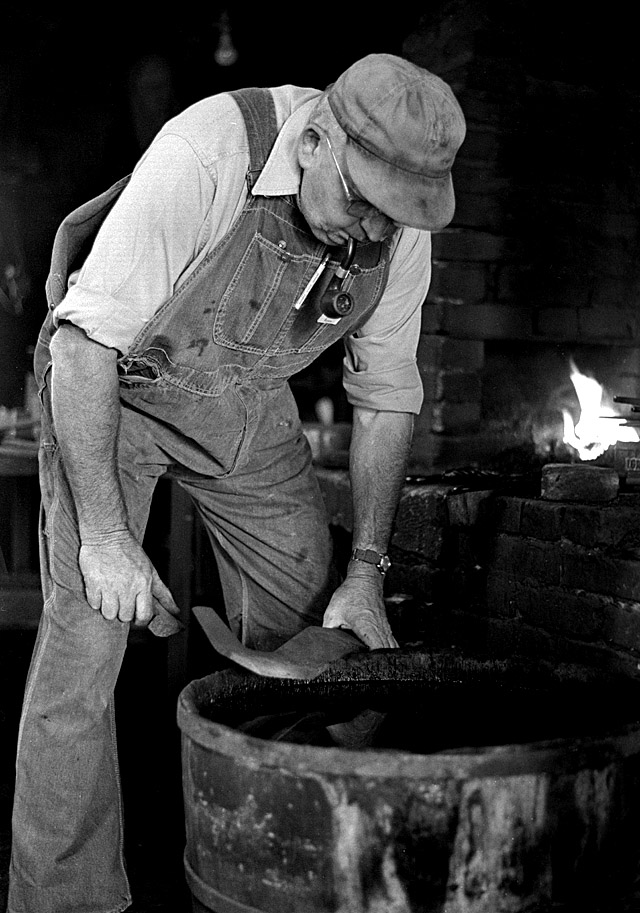
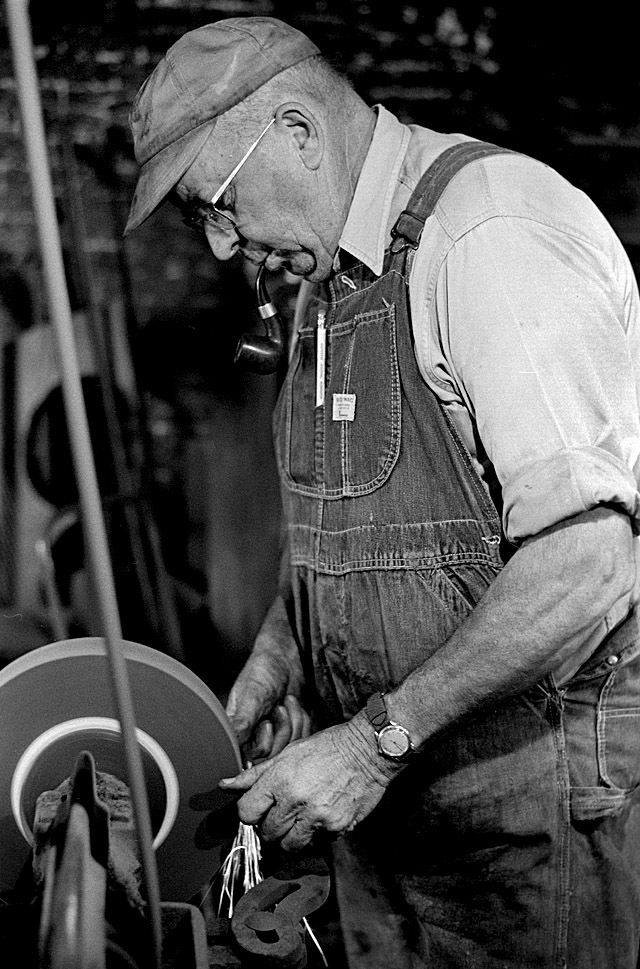
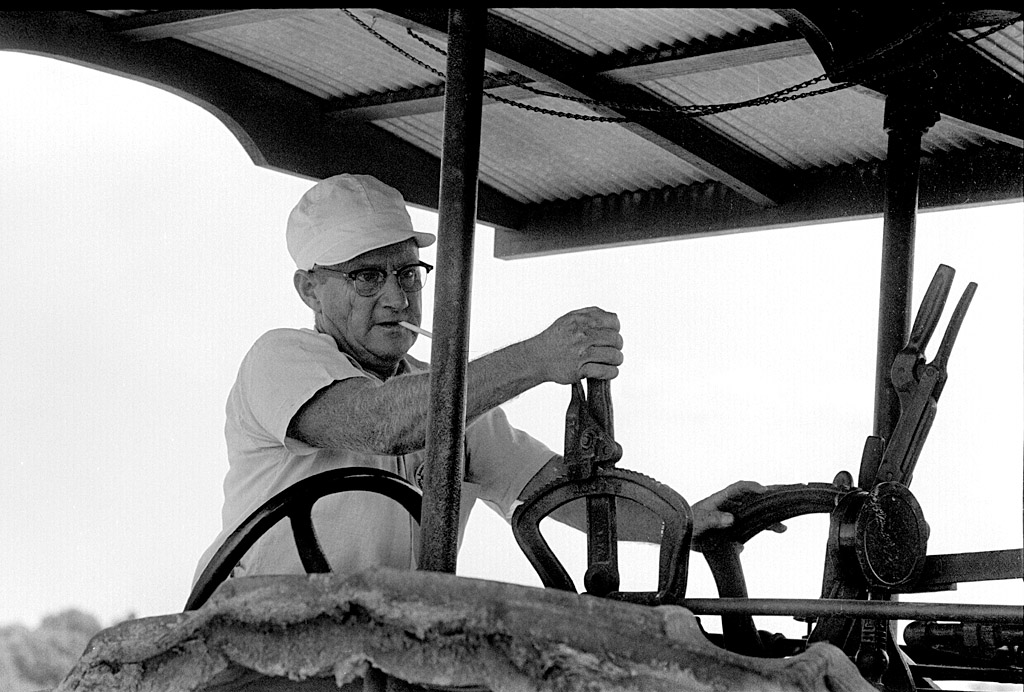
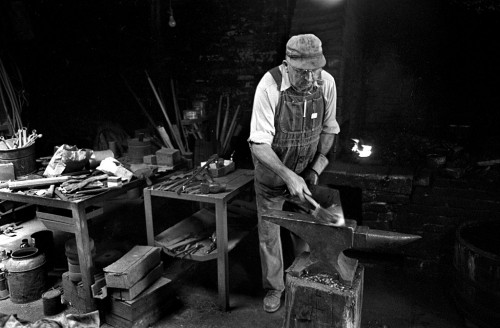
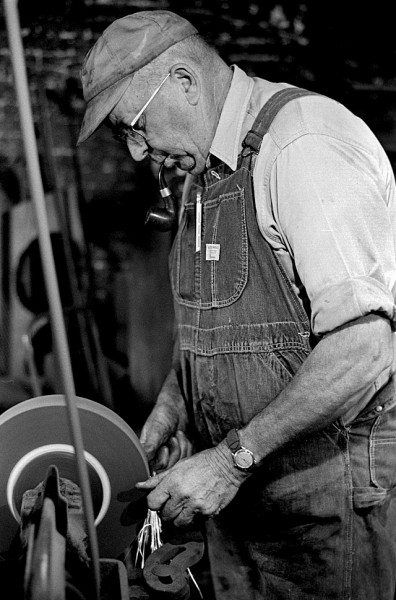
 “For 42 years, Frank Brockmeyer has lifted, heated, pounded, molded and tempered hot steel,” I wrote in a rare bylined story on The Missourian’s front page August 23, 1967. (The paper doled out bylines about as often as it gave raises.) Unfortunately, the page was microfilmed at a 90-degree angle, so you can’t search on that date. You have to search for August 22, then lay on your side to read it.) Click on any photo to make it larger.
One of the last blacksmiths
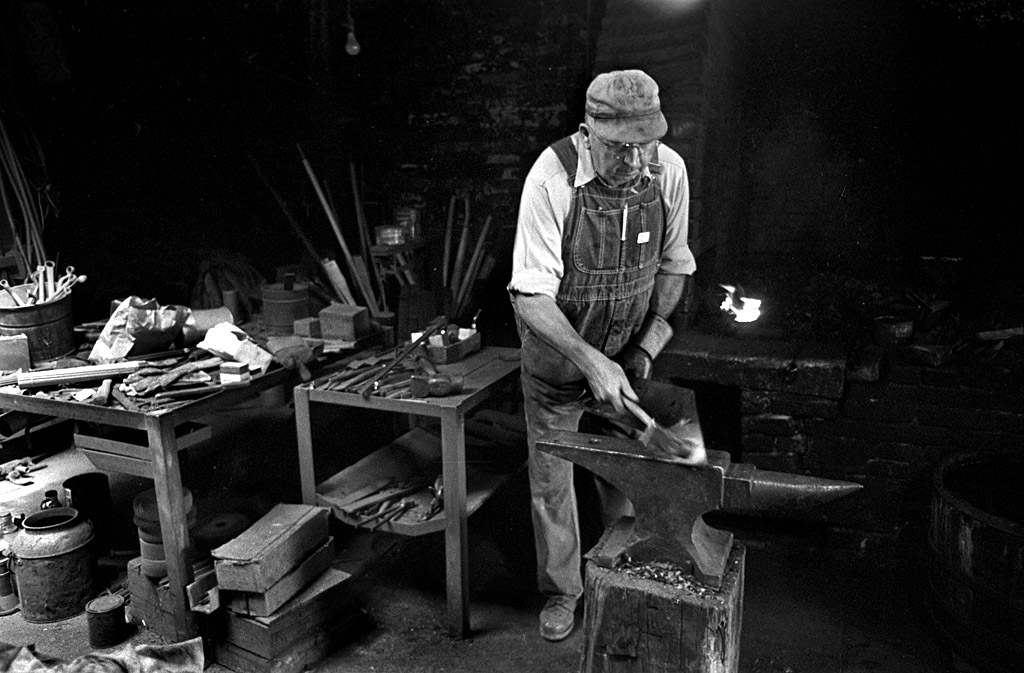
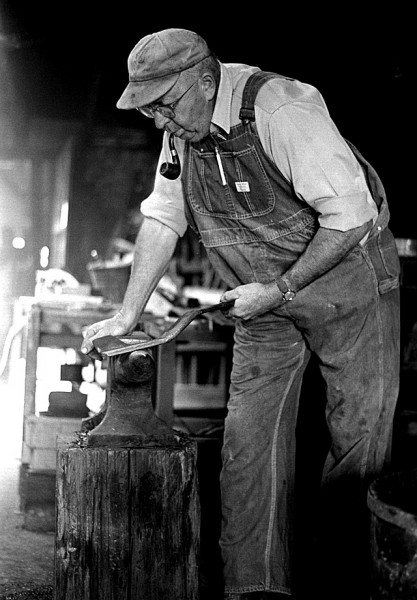 Mr. Brockmeyer, who was going to turn 66 on September 17, was one of the city’s last blacksmiths. His shop – a small, sagging brick and wooden structure with a weatherbeaten door – was located at 35 South Spanish.
Massive anvils
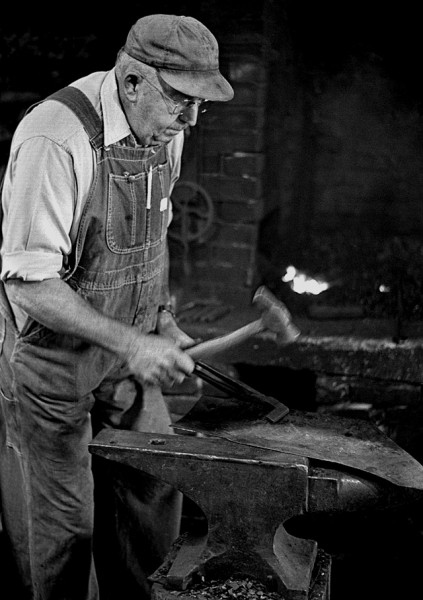 Behind the door were the tools of the smithy’s trade: the massive anvils securely anchored to equally massive blocks of wood; the huge wooden tub filled with water; the forge, and the tongs and sledge hammers and grinders and other paraphernalia.
The forge
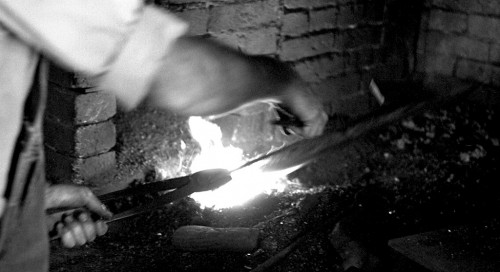 The work is getting harder, “but any kind of work gets harder when you get older,” he quickly added, with a smile breaking out around the curved pipe usually carried in his mouth. “Lot of people think this is easy, but you try to hold this hot steel with tongs and swing at it with a hammer. Here – feel this hammer. That’s eight pounds,” he said.
Hired as apprentice in 1925
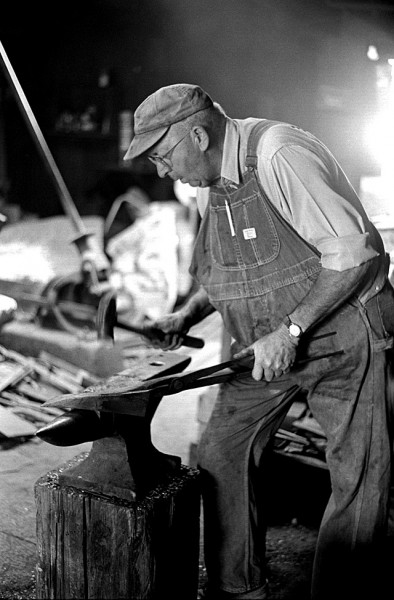 Back in 1925, when Mr. Brockmeyer was apprenticed to Joe G. Schonhoff, owners brought their horses into the building to be shod. After the shop acquired so much equipment that there wasn’t enough room for the operation, they went to the farms to do the job. The original owners started the business in a different location in 1890.
The worst thing you can do
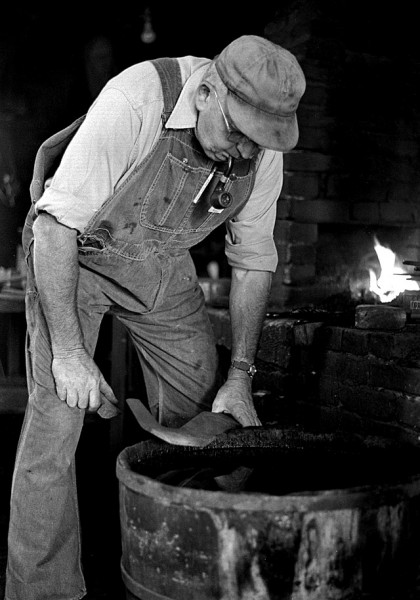 Those days were past. Mr. Brockmeyer said it had been 27 years since he had last shod a horse, and he didn’t appear to have missed the task. “Do you know the worst thing you can do?” he asked. “It’s shoeing a horse laying down.” Noting a perplexed look on his listener [another rare thing: Missourian reporters were not to insert themselves into the story] he continued, “That’s where you have to rope him, throw him, hogtie him and then shoe him.”
You can’t trust newspapers
 I was curious to see if the paper had run any other stories about Mr. Brockmeyer. I found his obituary in the May 15, 1983, paper, the day he died at 81. He was born Sept. 17, 1901, at Apple Creek, the son of Theodore and Mary Schumer Brockmeyer. On Sept. 24, 1924, he married the former Mary Eftink of Oran, who survived him. The couple had nine children. His only son tried blacksmithing, but didn’t like it, Mr. Brockmeyer said.
The obit said he was a self-employed blacksmith, operating a shop on South Spanish from 1925 until his retirement in 1963. He couldn’t have retired in 1963, because I shot him working in 1967, back when he shared his philosophy of work: “When things get too rough, I just quit and go fishing.”
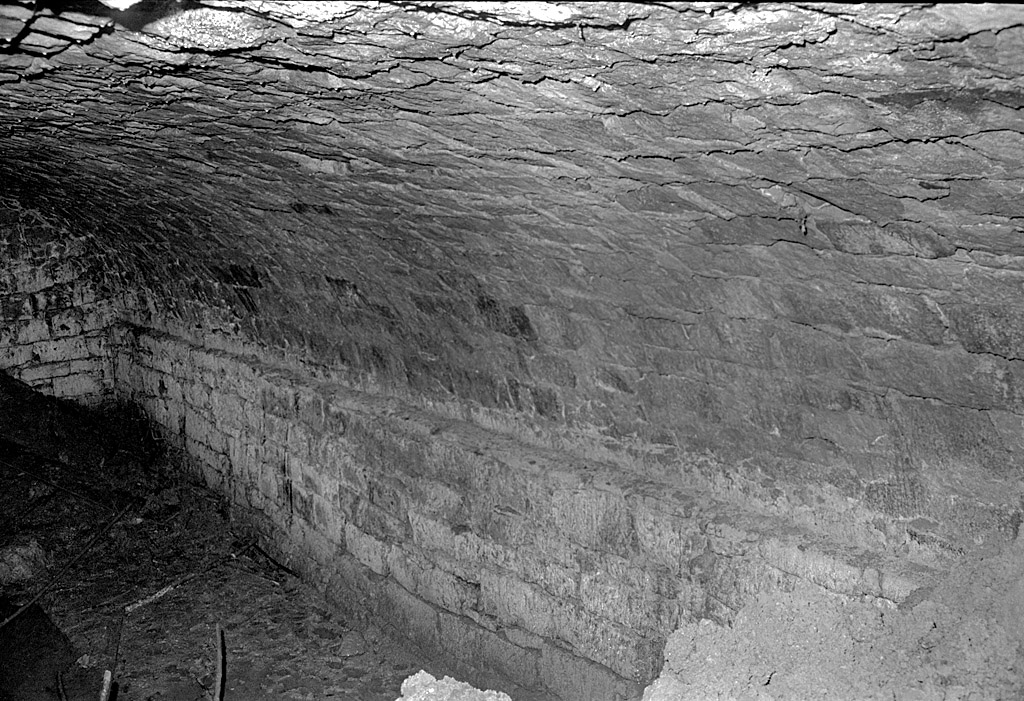
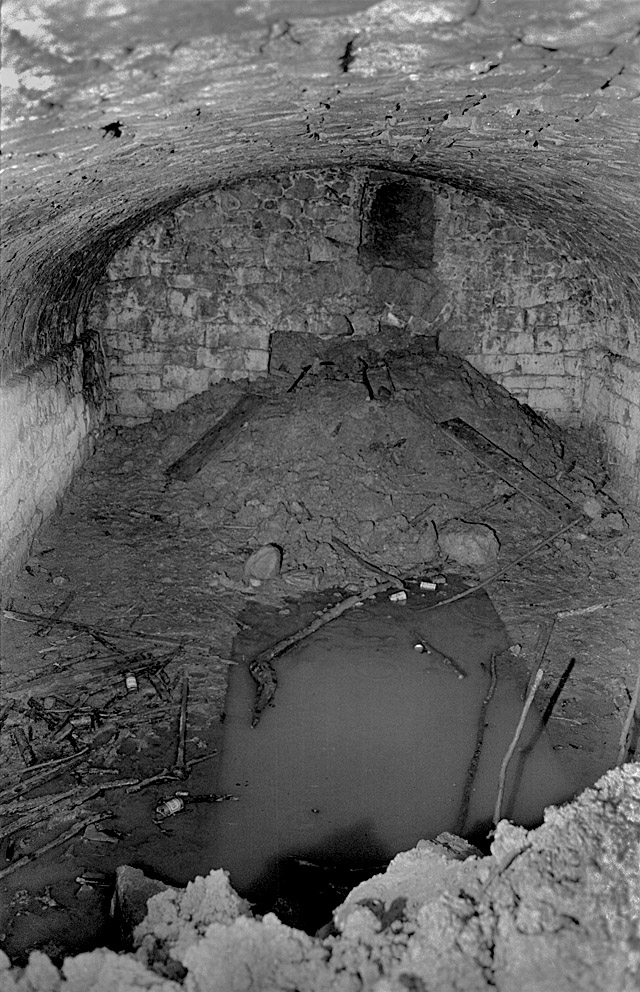
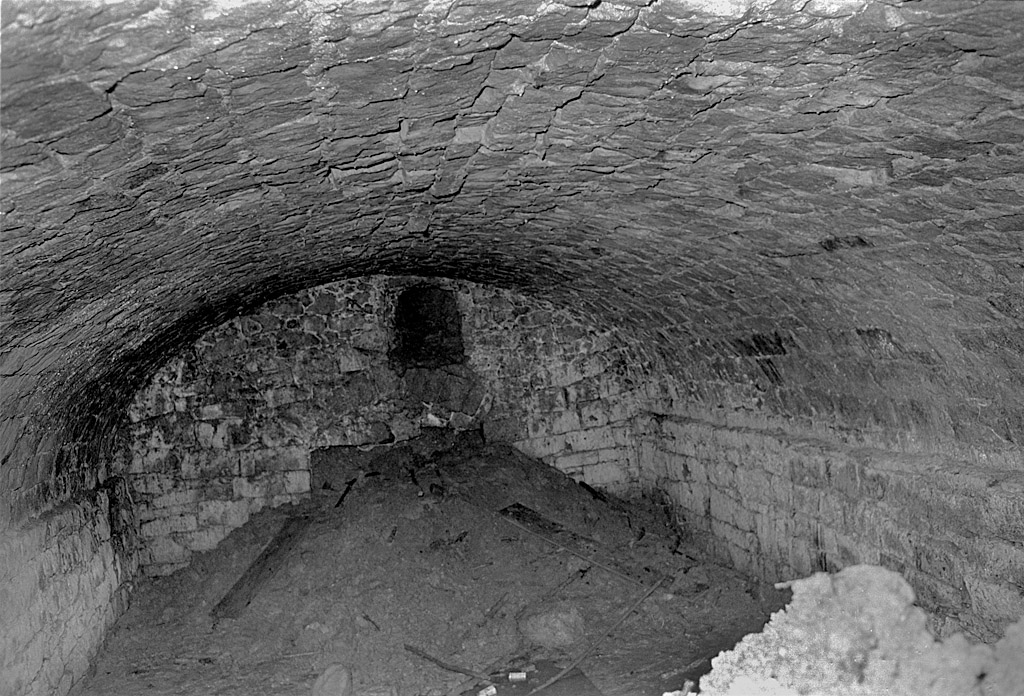
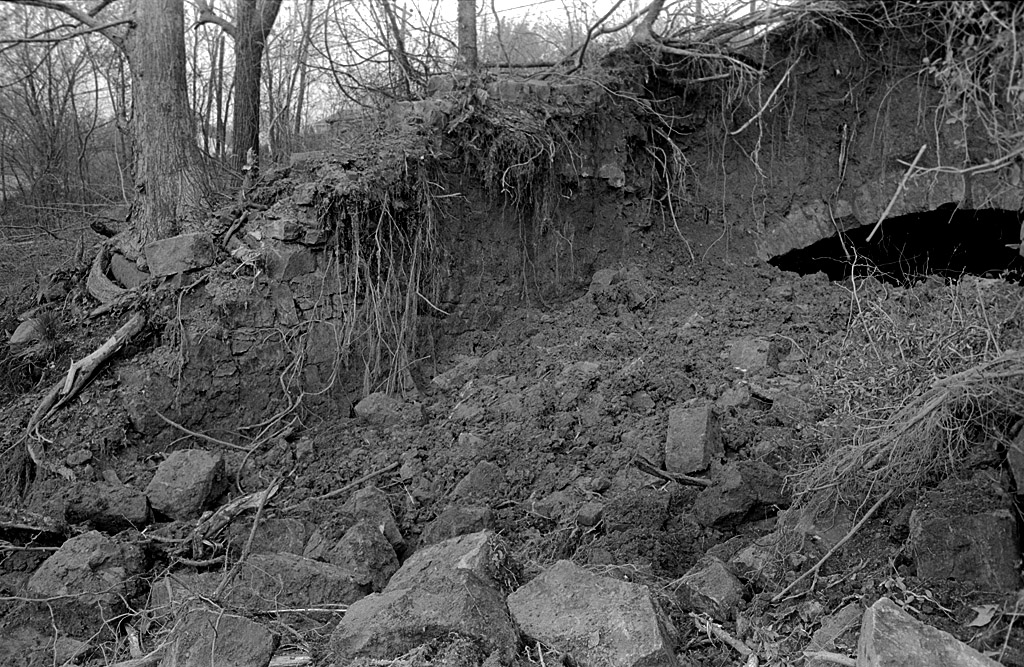
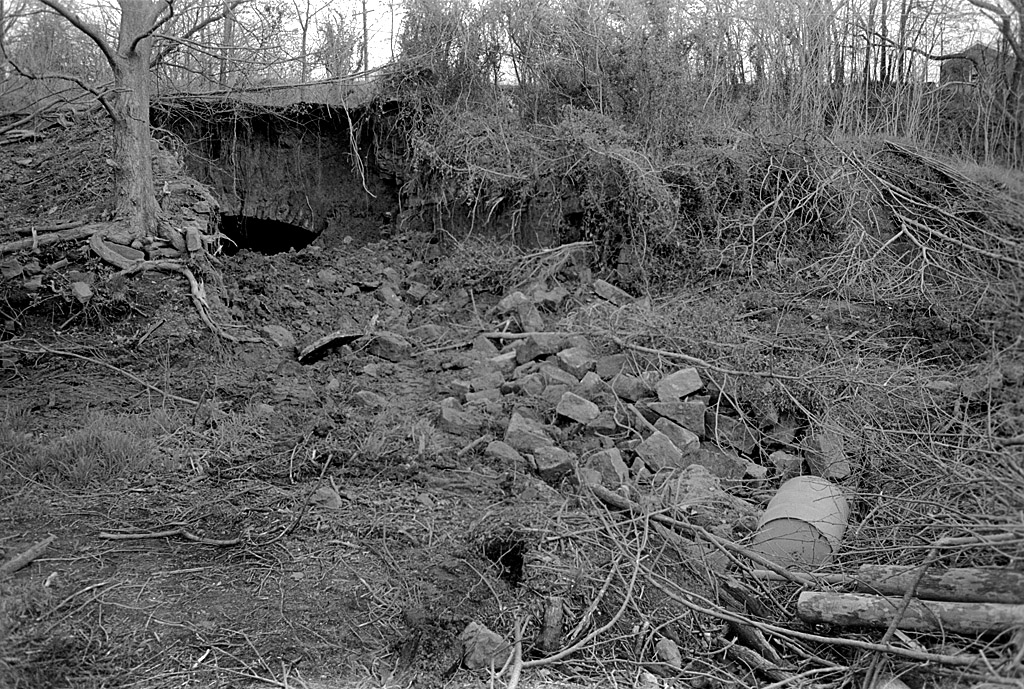
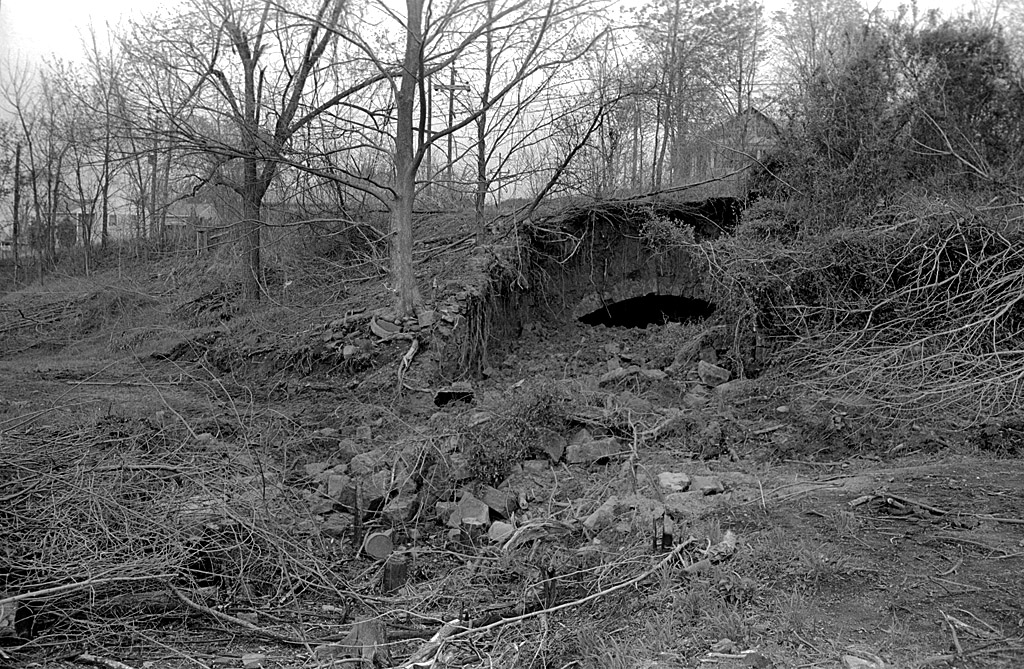 Here’s a mystery that’s been bugging me for months. In April of 1966, construction workers working along North Sprigg Street uncovered a large cellar that was thought to have housed beer or wine. I don’t remember if it was part of the dormitory construction or if Sprigg was being widened.
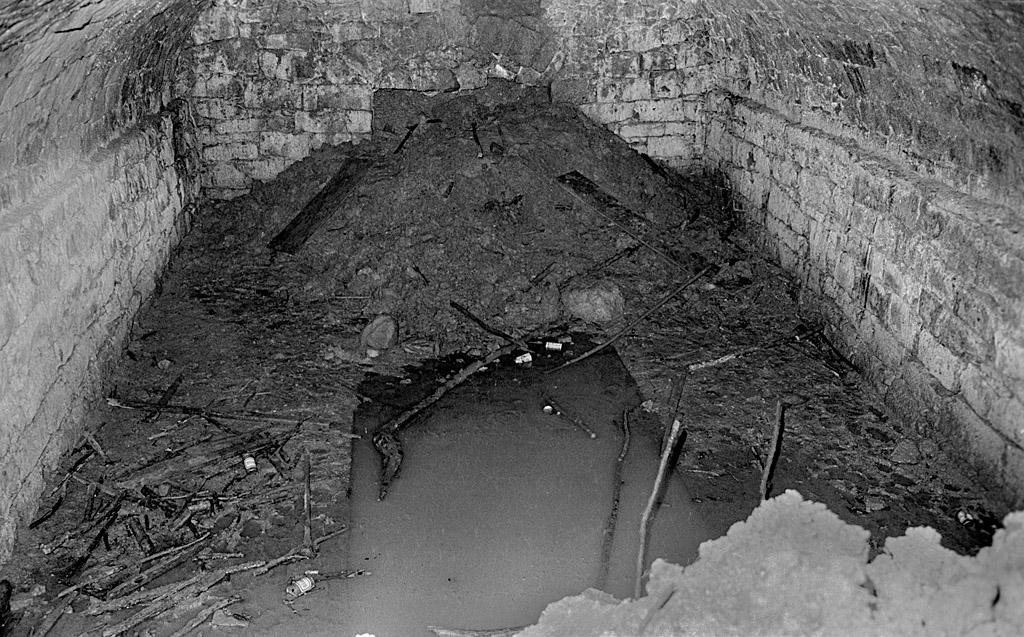 I didn’t prowl inside the cellar, but I could see a few Stag beer cans floating around. I think there were of more recent origin. There was a flat floor, but there was a square section in the middle that was cut out. I don’t know if that might have been a sump area where water could collect to be pumped out.