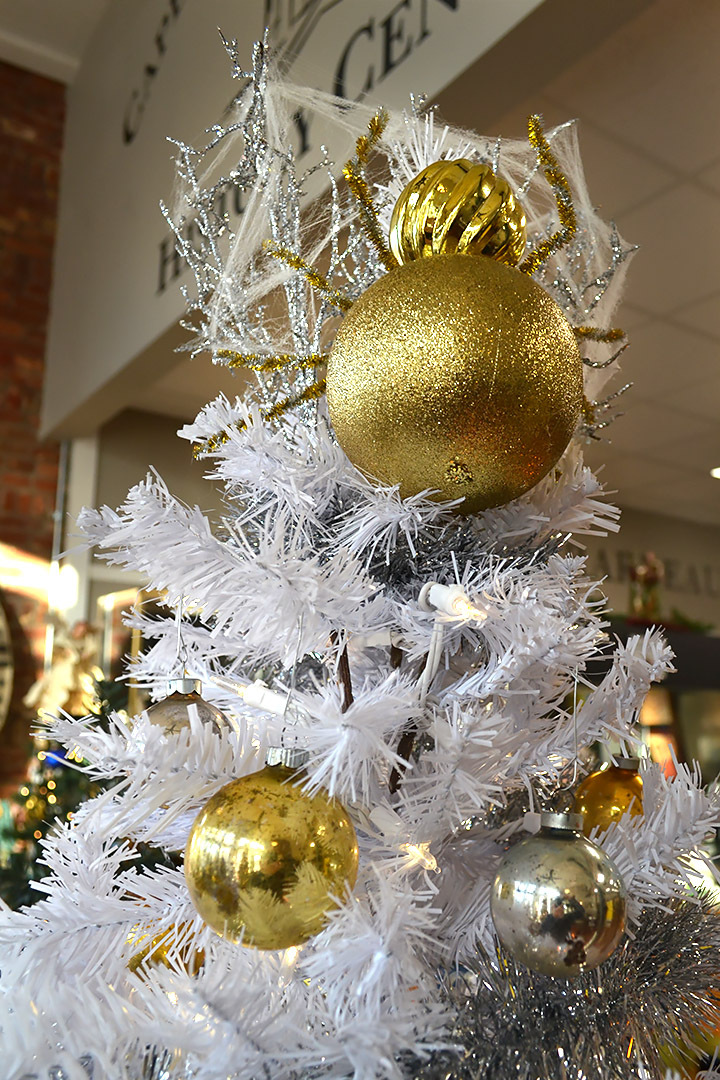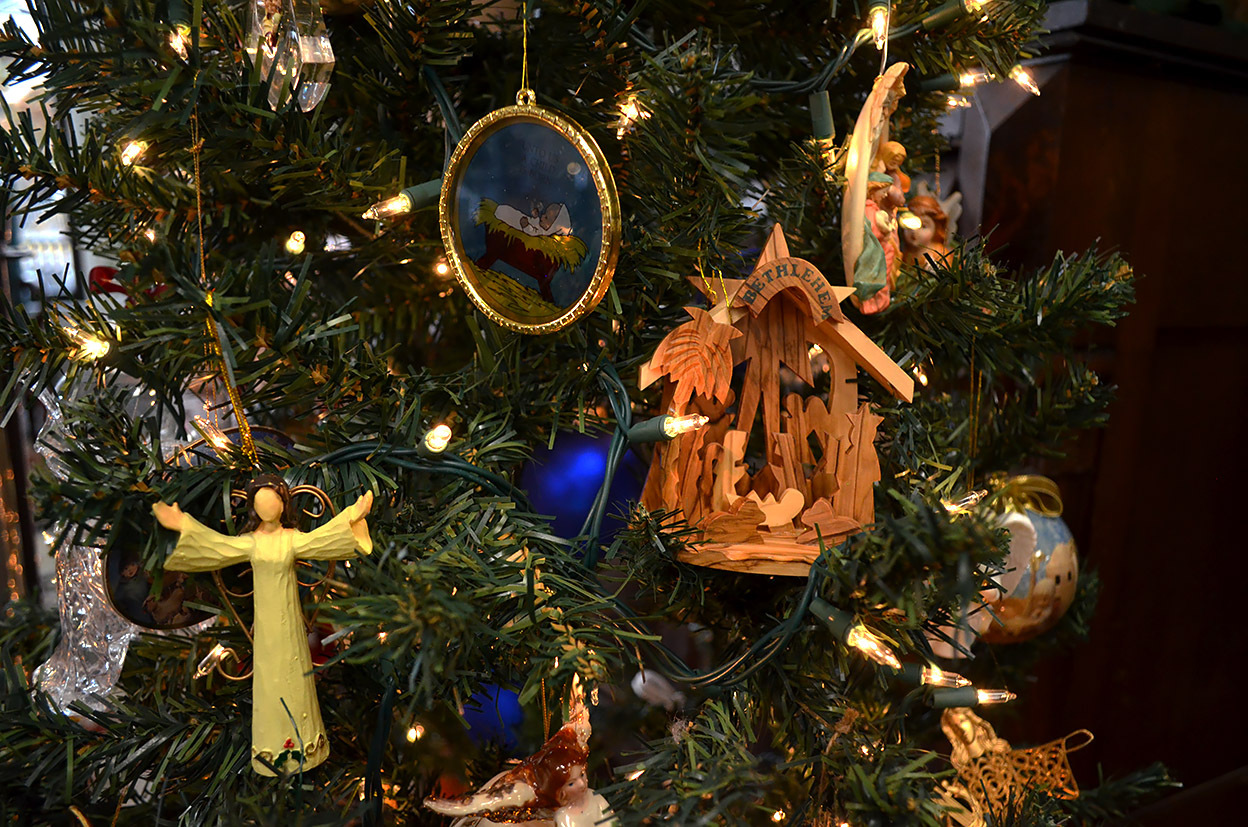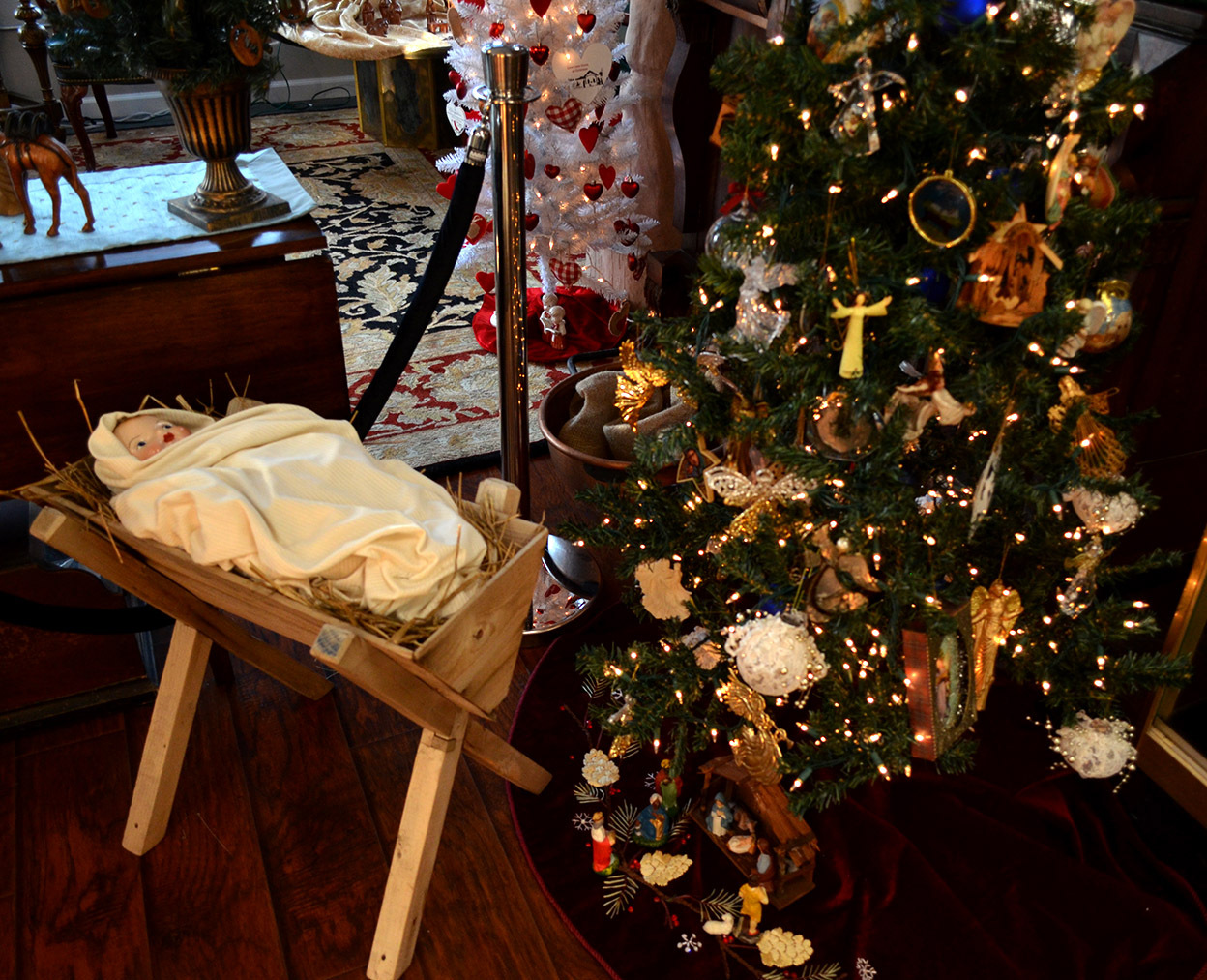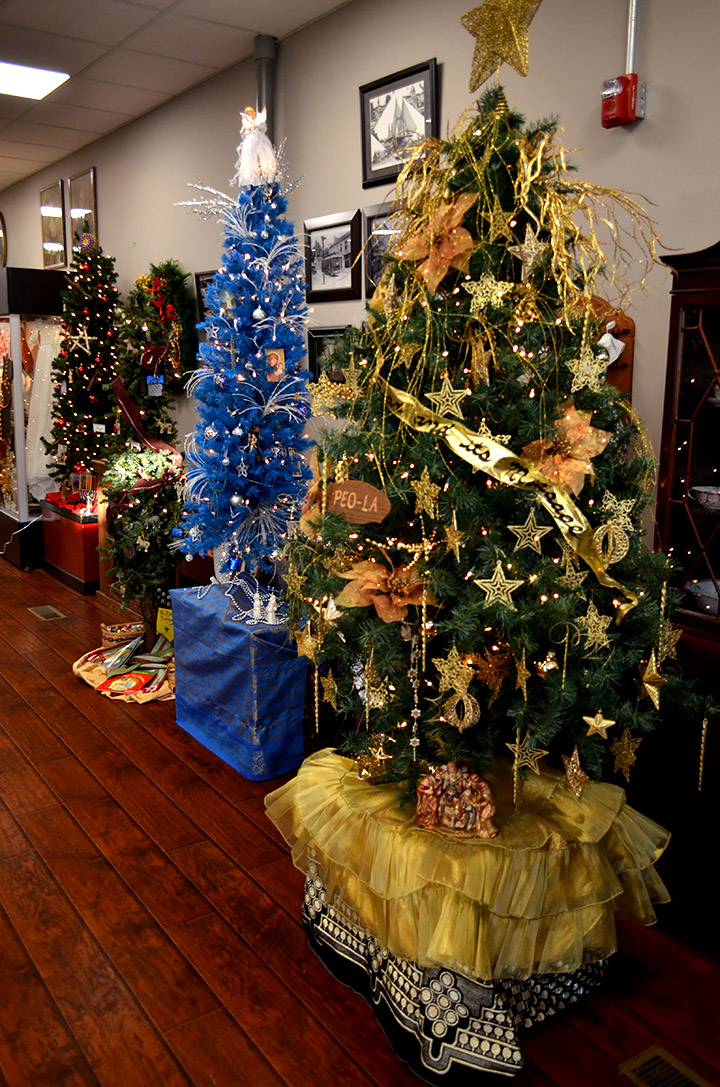
I went to the Cape Girardeau County History Center on the square in Jackson on Monday to shoot the annual display of Christmas trees. That night, I realized that I had missed the point in thinking of the trees as just trees.
The display is themed, and each tree carries out a part of that theme. The details are what make them work. I went back later in the week to concentrate on parts, instead of the whole tree.
See for yourself until the trees come down on January 15. The History Center will be open during the Southern Country Church Tour until 8 p.m. on Dec. 10, and on the Original Country Church Tour on Dec. 15 and 16.
Director Carla Jordan wrote a description of The Nativity Story: History, Tradition, and Beauty, that I will borrow.
Food Pantry Tree
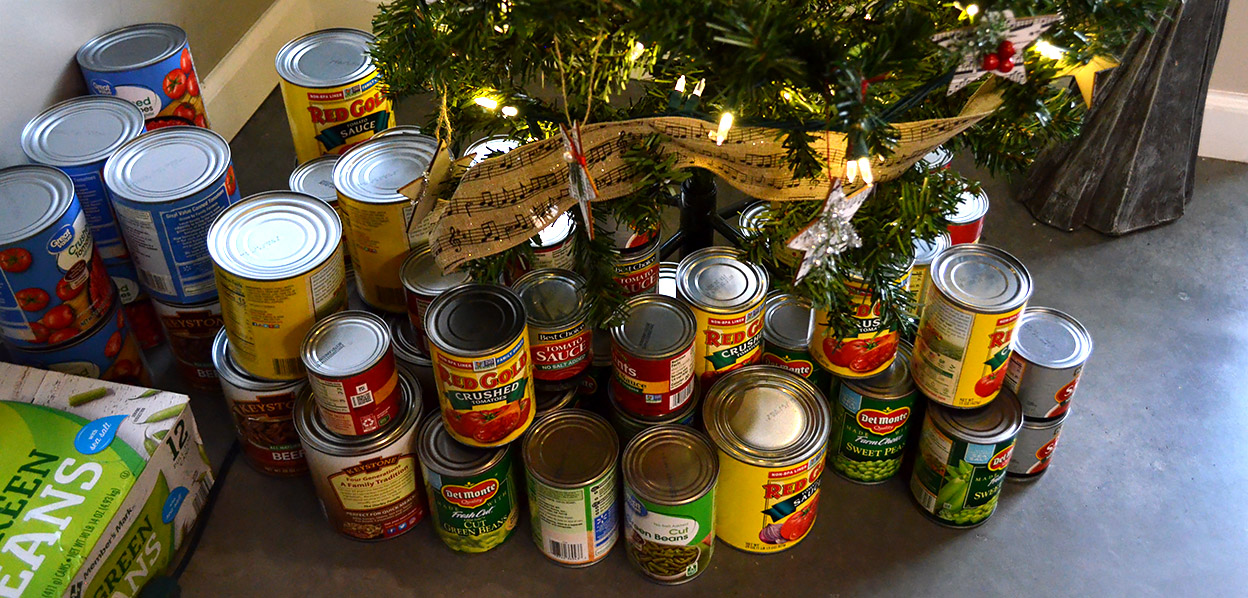 This tree is our annual Food Pantry tree. It is covered with musical stars and angels created by our docent team. You may choose an ornament for a $5 donation that will be given to the Jackson Ministerial Alliance Food Pantry.
The Drummer Boy
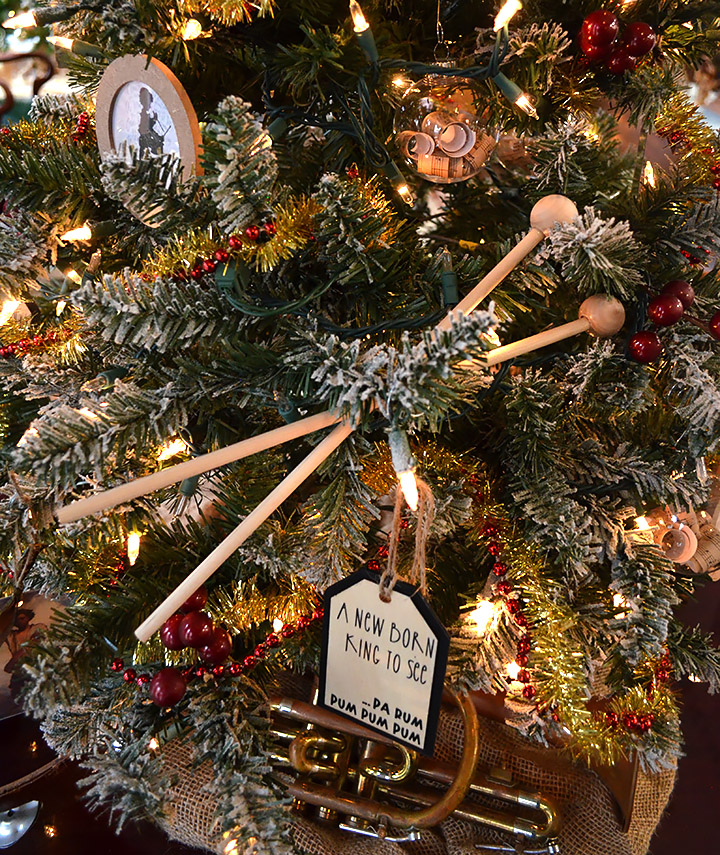
Designer Jo Nell Cougill brought this popular Nativity story into the modern-era with Civil War drummers, and instruments that make a joyful noise like the early story of the Little Drummer Boy.
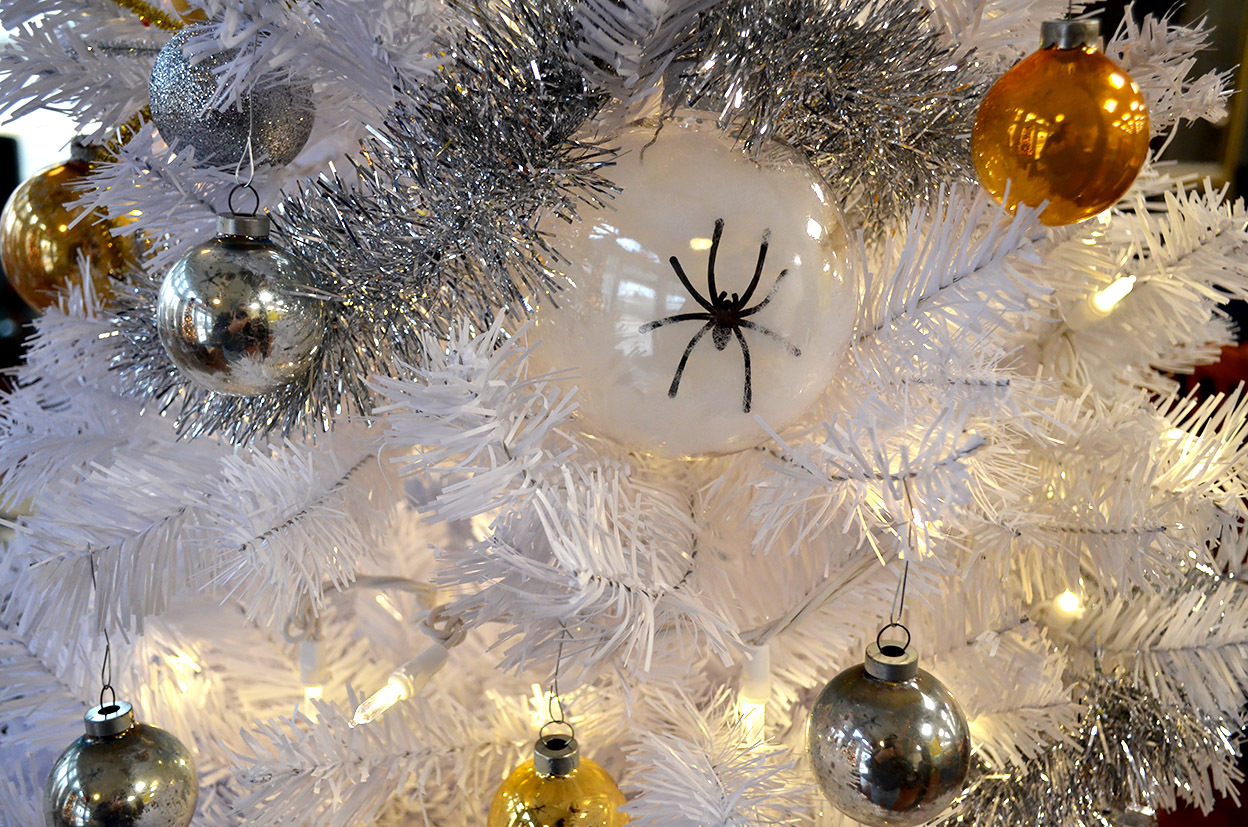
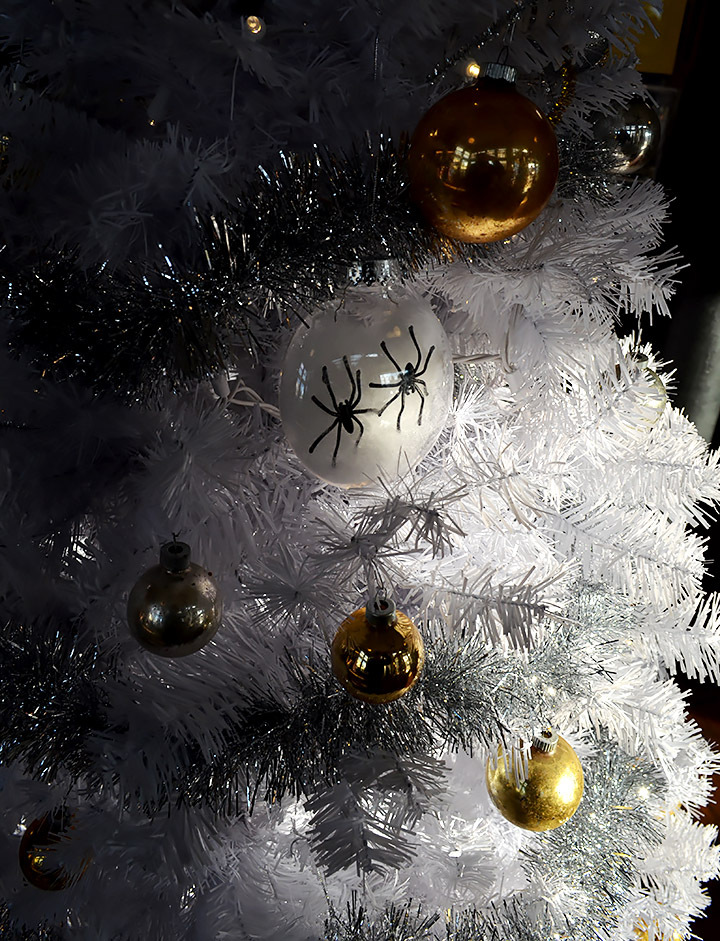
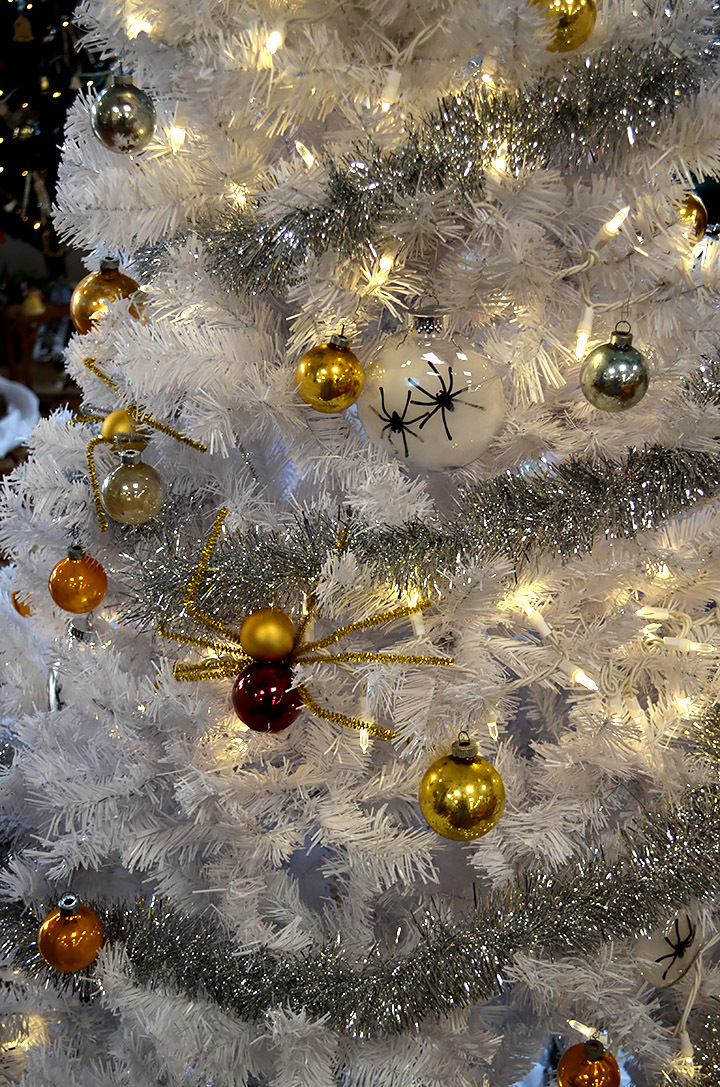
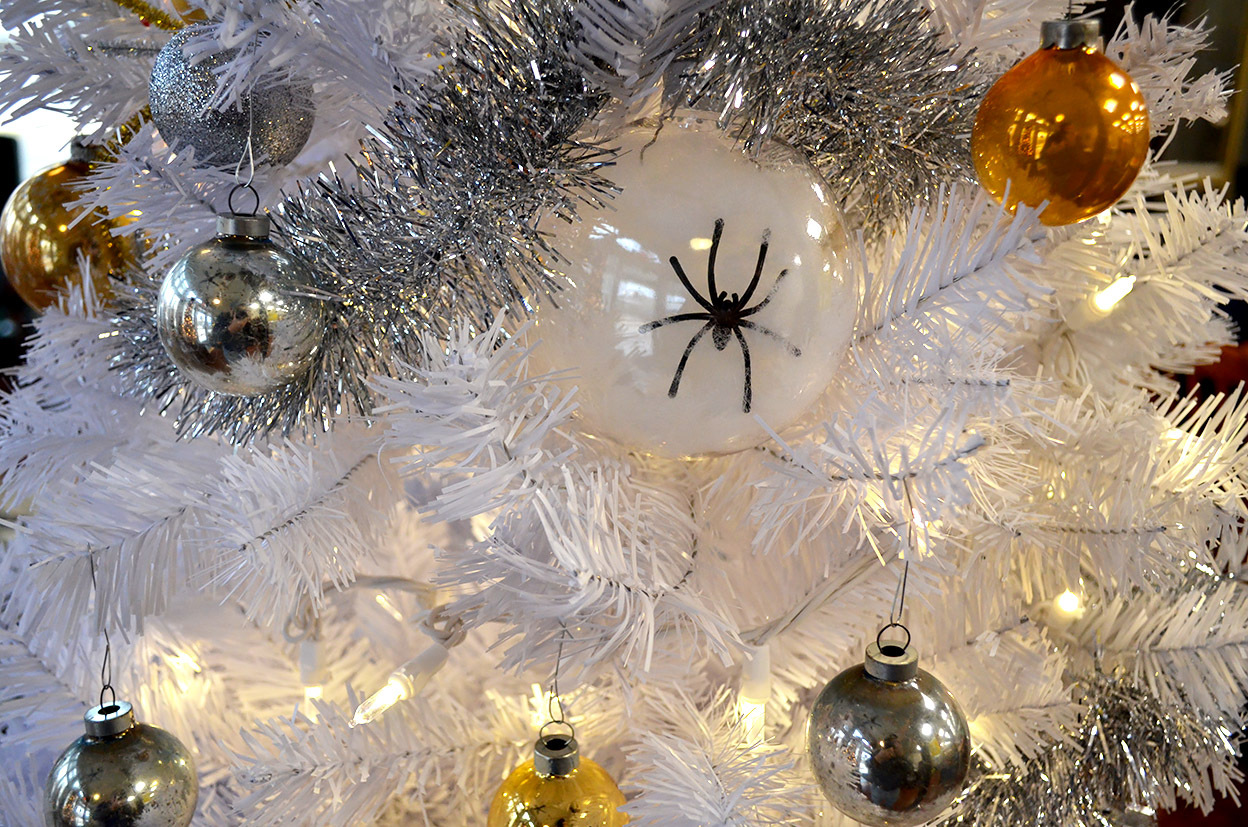
The Legend of the Spider Tree
I have to confess that this is one of my favorites because it tells a story I’d never heard before. (Click on the photos in this gallery to make them larger, then use your arrow keys to move through them.)
The Legend of the Spider Tree is designed by mother/son team, Lisa and Brody Goodman. The legend has different variations in Germany and the Ukraine, but the version we chose tells of the Christ-Child’s Christmas Eve visit to the family home to leave blessings. The family had thoroughly cleaned in order to prepare for the visit. The spiders also wished to see the Christ-Child and scampered up the family’s tree to get a good view, leaving their webs behind. The Christ-Child was delighted with the spiders, but did not want the family to find their cleaning efforts disregarded, and He touched the webs, turning them to silver and gold.
The Legend of the Candy Cane
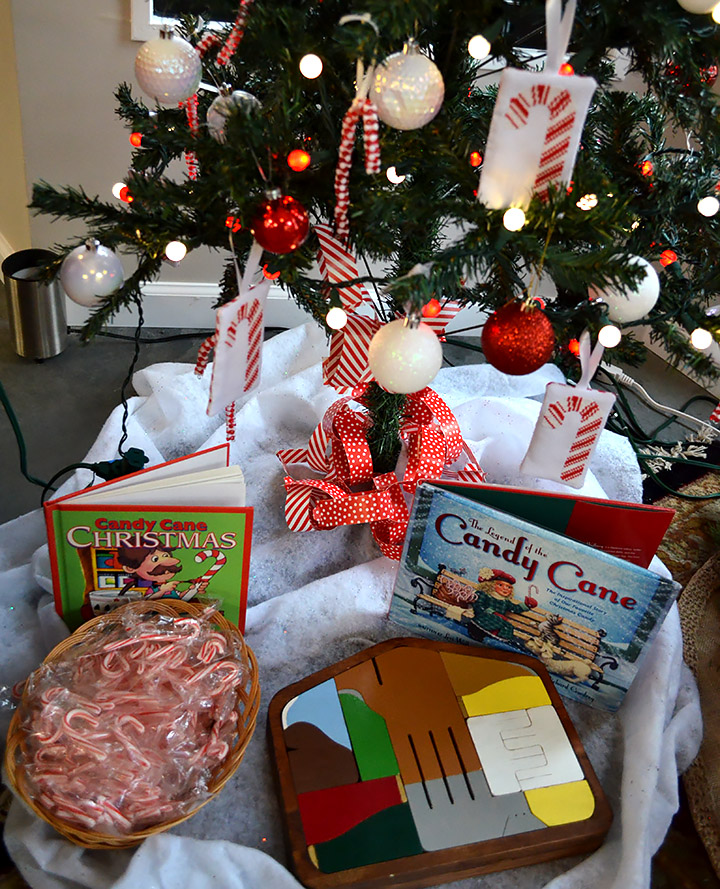
The Legend of the Candy Cane is illustrated in the tree created by 8-year-old, Ben, with his Grandmother Sandy Loesel. One legend says that the candy cane dates back to 1670, and the sweet sticks of candy were used by the choirmaster to keep choir boys hushed during the Living Creche ceremony at Cologne Cathedral in Germany.
I Heard the Bells on Christmas Day
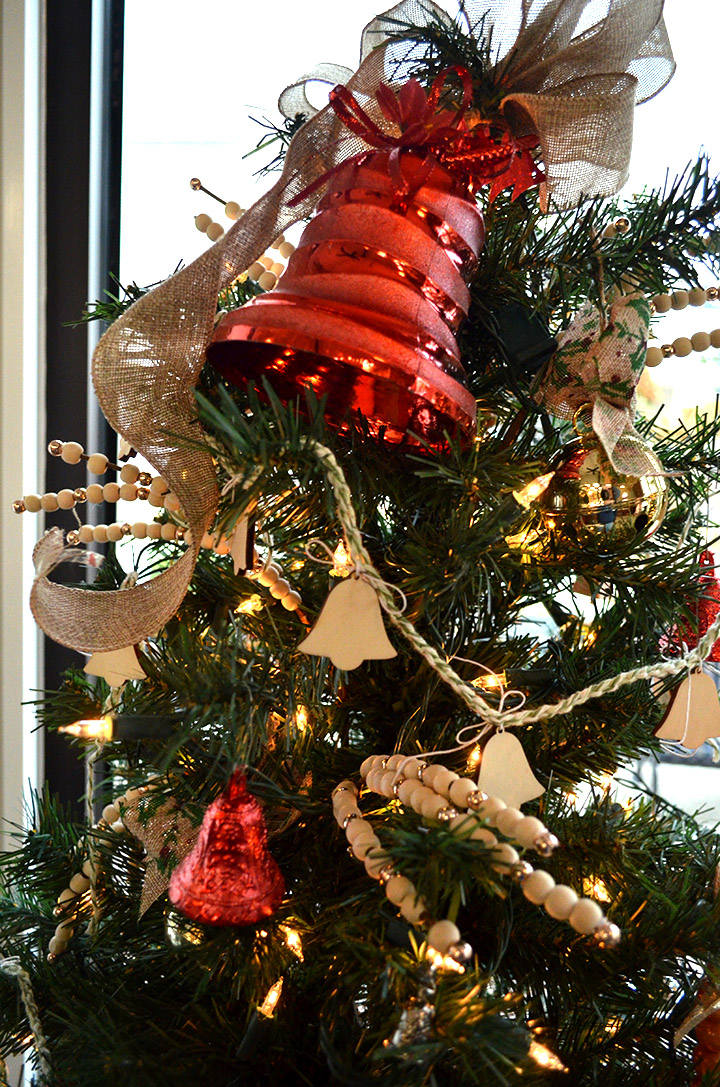
I Heard the Bells on Christmas Day designed and created by Karen Friese. The story is based on an 1863 poem by Henry Wadsworth Longfellow. He was distraught by the loss of his wife in a tragic fire, and his son joined the Union Army during the Civil War and was severely injured. Upon hearing the Christmas bells ringing on Christmas morning during this dark period, Longfellow found comfort in the church bells, and wrote the famous poem, “God is not dead, nor doth He sleep…peace on earth, and good will to men.” The poem was first published in Our Young Folks, a juvenile magazine in 1865, and is now a beloved Christmas carol.
Feathered Friends
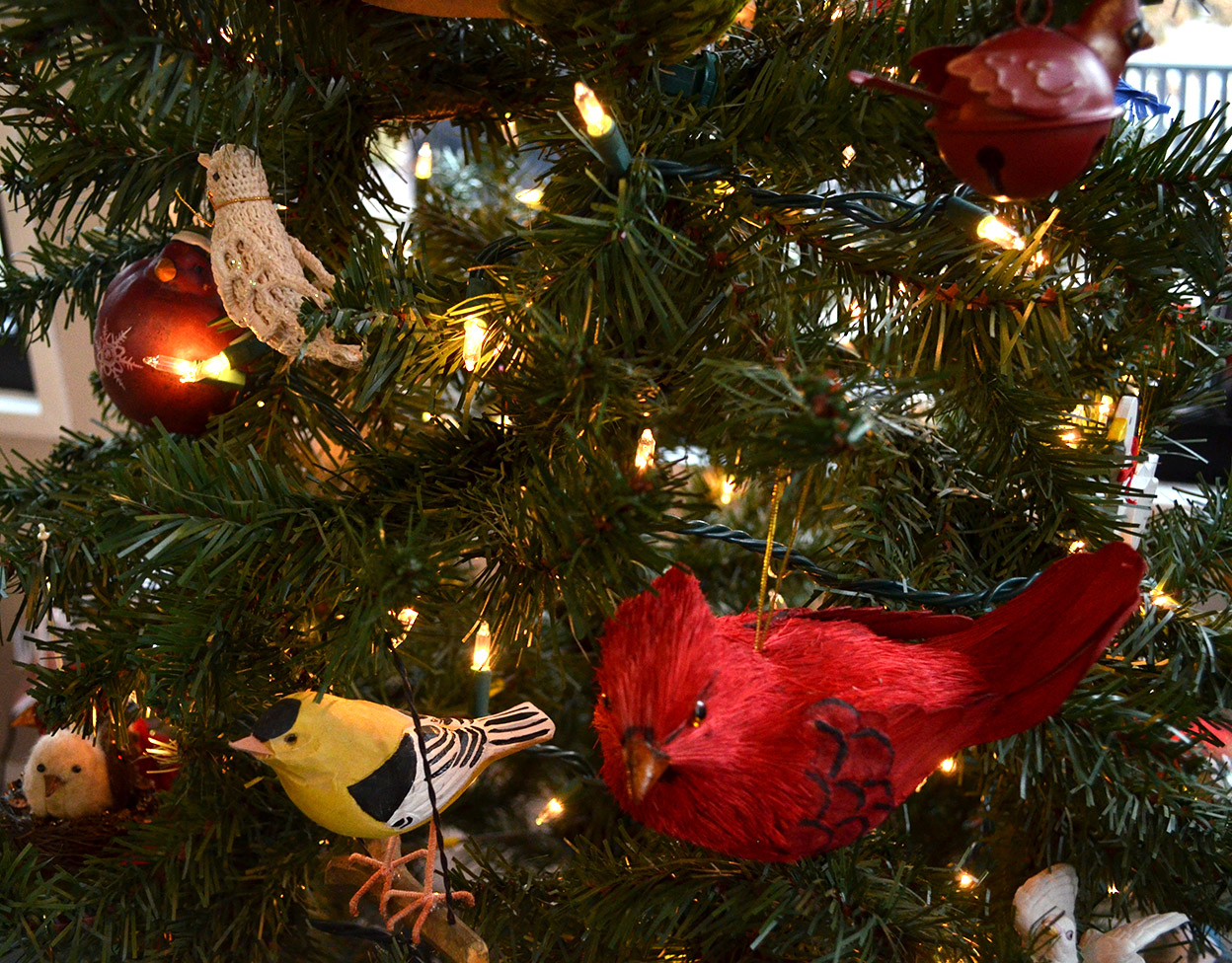
In the history of Christian art, animal forms have been important symbols. Birds have been used to represent the Holy Spirit, the Passion of Christ and immortality. Doves are a common bird illustrated in the rafters of the Nativity story. At the Nativity there might have been sparrows, swallows, and possibly roosters and hens. This tree celebrates all of the feathered friends and their celebration of this Christmas legend.
Chrismon Tree
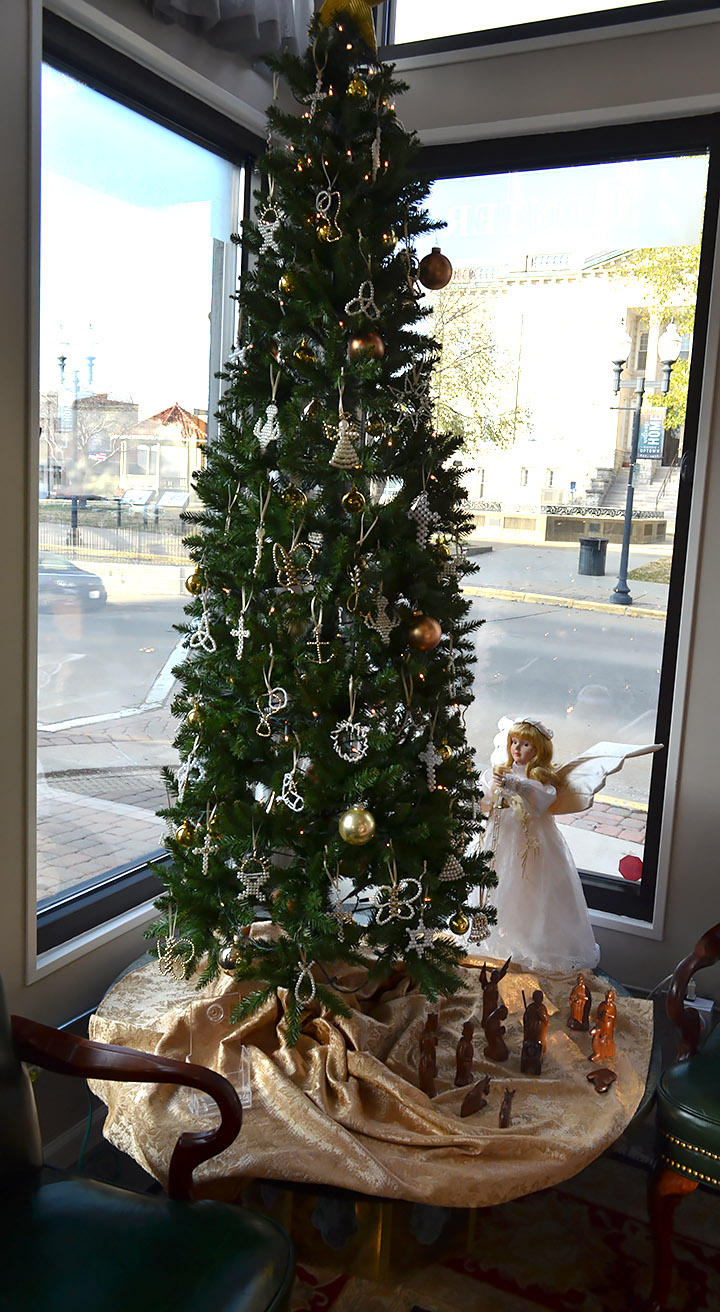
Chrismon Tree (symbols of Christ): A group of participants met next door at the Research Annex each month for 11 months, creating Chrismon’s with their instructor, Jo Nell Cougill. The class created this tree with the symbols they learned to make. Some of these symbols are ancient, and some are more modern. The Chrismon tradition was renewed and preserved by Frances Spencer and the women of the Ascension Lutheran Church in Danville, Virginia in 1957.
Love Came Down at Christmas
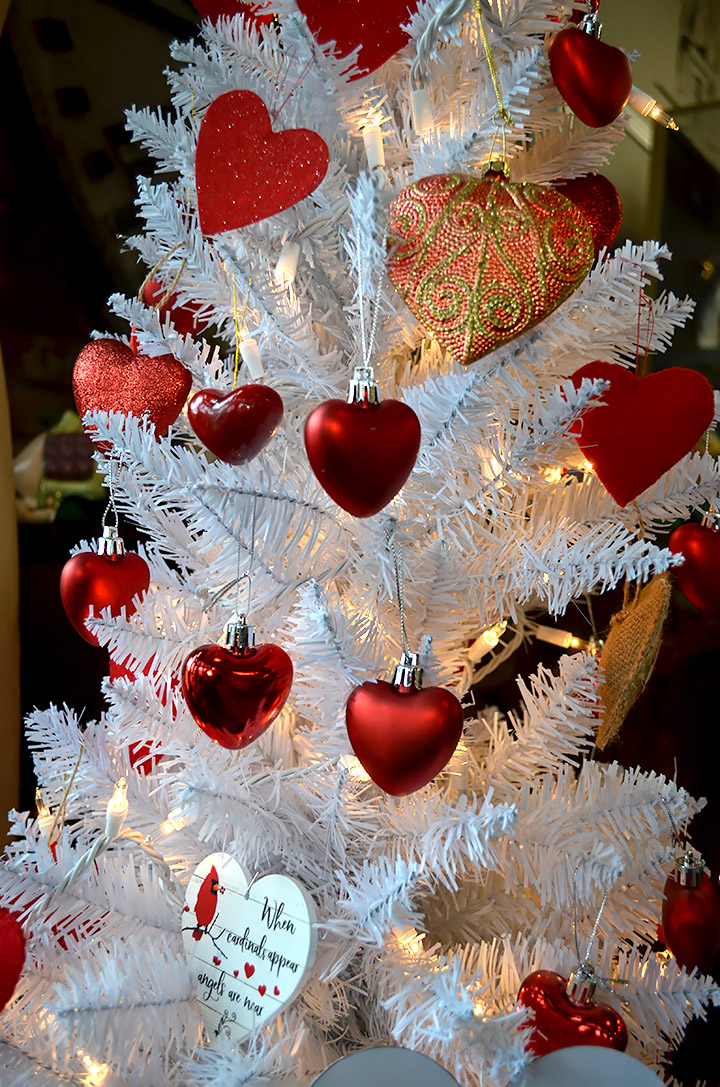
Love Came Down at Christmas. This tree was designed and created by Jan Vogel, and represents the Christmas season of love.
Olive Wood Nativity
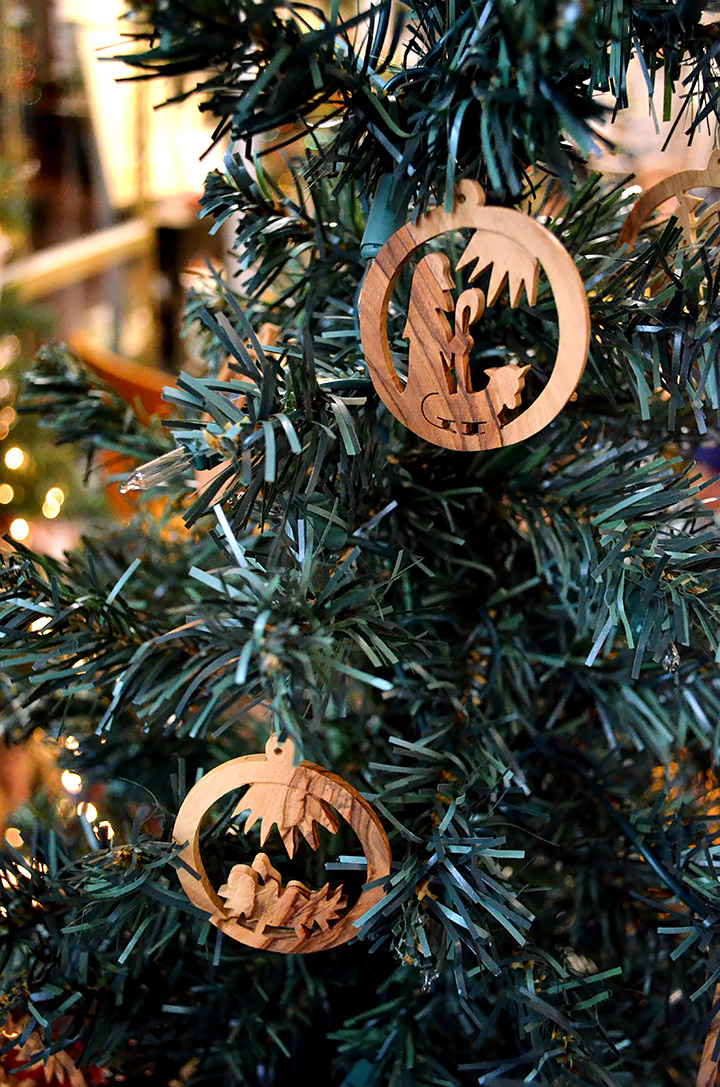
The long narrow pecan table has two topiary trees with a central olive wood Nativity. All of the olive wood ornaments and the Nativity are from the Holy Land, a gift from the Kenneth White Collection. The beautiful ceramic Nativity set on the buffet was created by Kenneth White’s mother in her private ceramics studio.
PEO-LA Star Tree
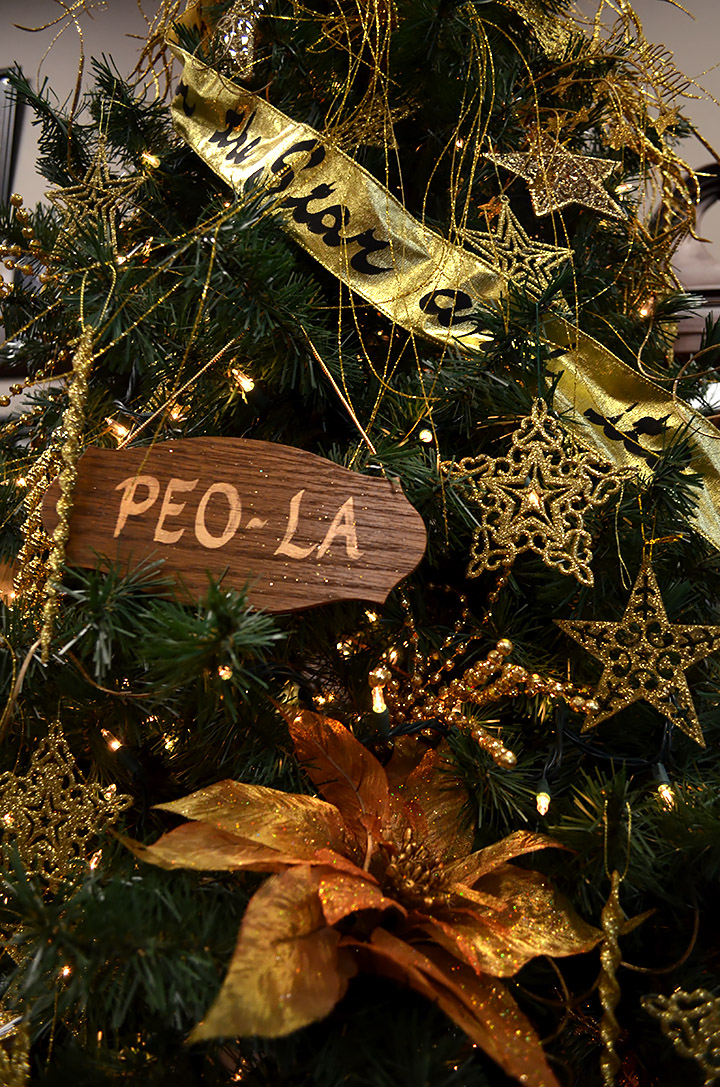
The Star: This tree has been a part of our Christmas tradition for 7 years. It is designed and created each year by the PEO-LA organization and chapter.
Marian Blue Tree
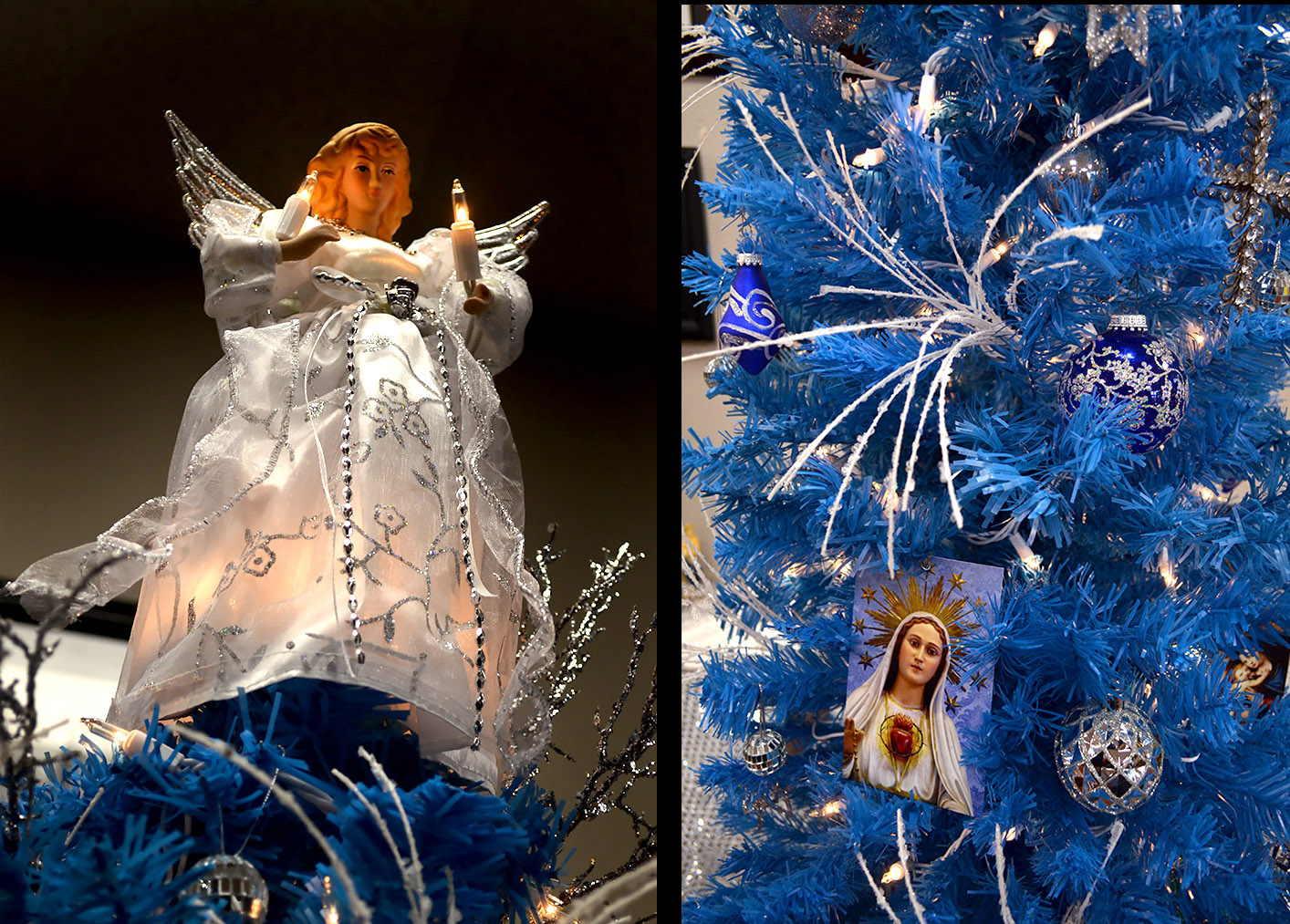
This Marian Blue tree is another tree that has been a part of our exhibitions for years, but the new tree adds a special focus on the special blue color. Early Egyptians loved bold cobalt blue and pulverized lapis lazuli stones to obtain the pigment for embellishments and art works. For millennia, blue has been a costly, sacred hue—at times more prized than gold. Marian blue is a color creating Mary’s elevation in the interpretation of historic art since the 5th century. During the first few centuries after Christ, Mary was often depicted in a red gown or wrapped in a pink mantle. Slowly, blue replaced the artist’s preferred color for Mary.
The Donkey Tree
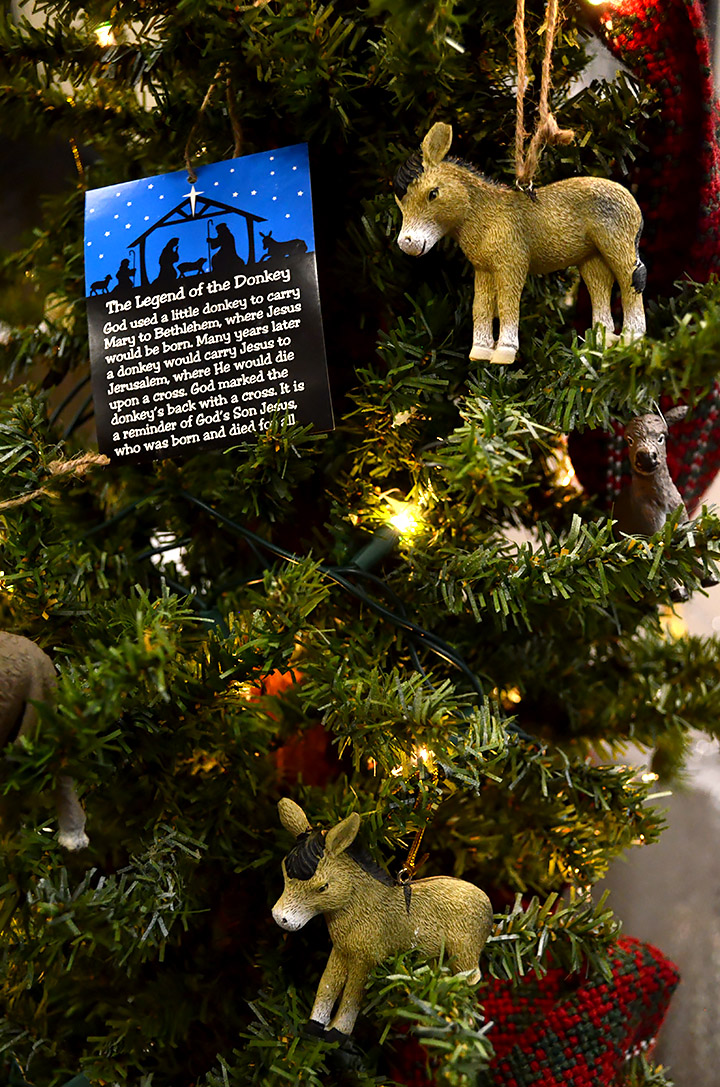
Donkey Tree: nearly always depicted as Mary’s mode of transport to Bethlehem. We chose to place this dear animal near Mary.
The Joseph Tree
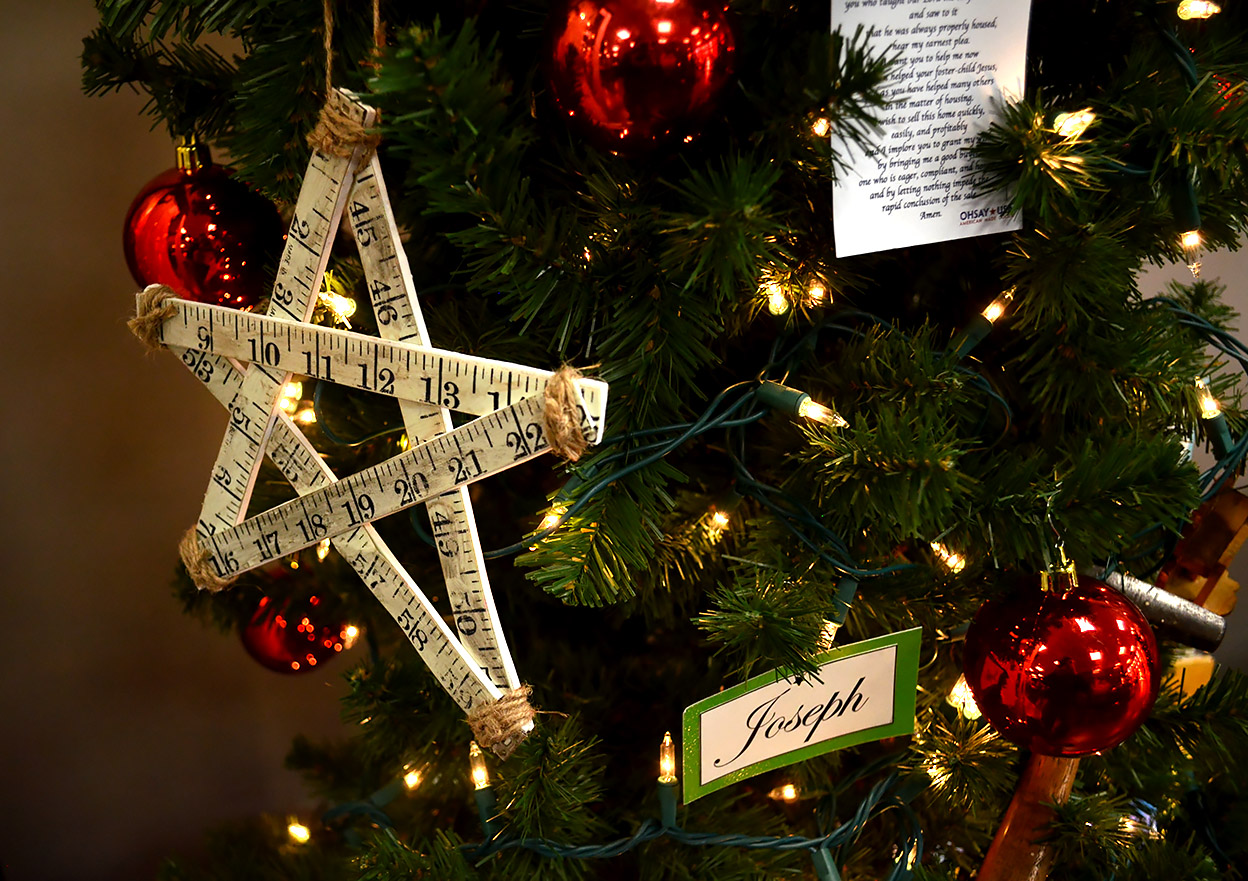
Joseph Tree: You will see the symbols of Joseph’s carpentry tools, the symbol of the lily, a menorah and a yarmulke tree topper. You often see the lily flower depicted in art with Joseph. An ancient legend says that Joseph was chosen from among other men by the blossoming of his staff like a lily. “The just man shall blossom like a lily.”
The Three Wisemen
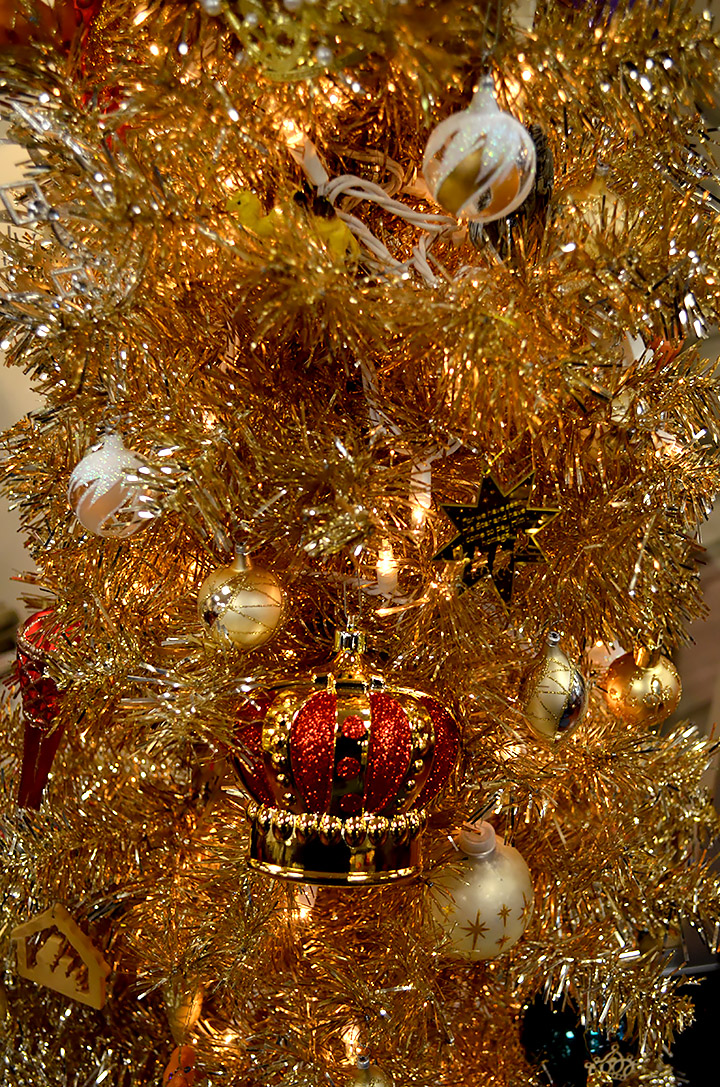
The Three Wisemen: This story tree tells of the visitors to the Nativity who came to Bethlehem bearing gifts that are symbolized under the tree. This tree represents that the Nativity story is for all people.
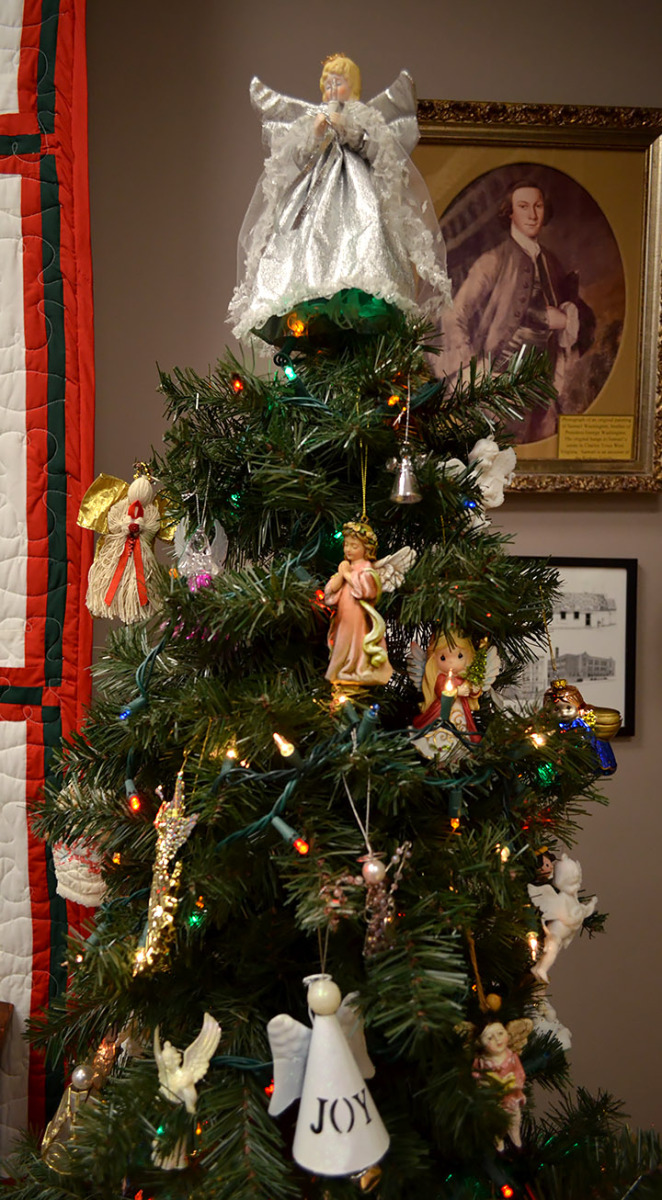
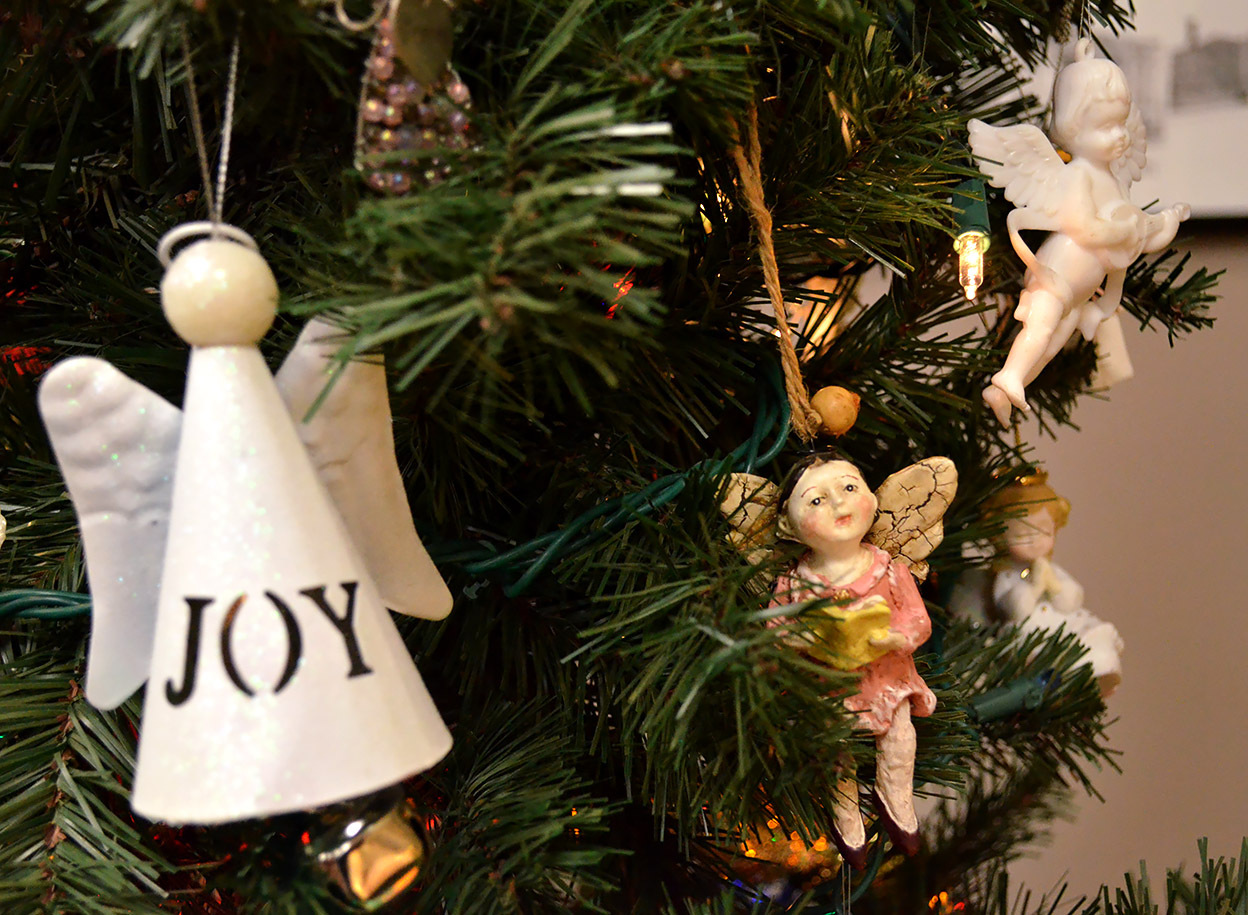
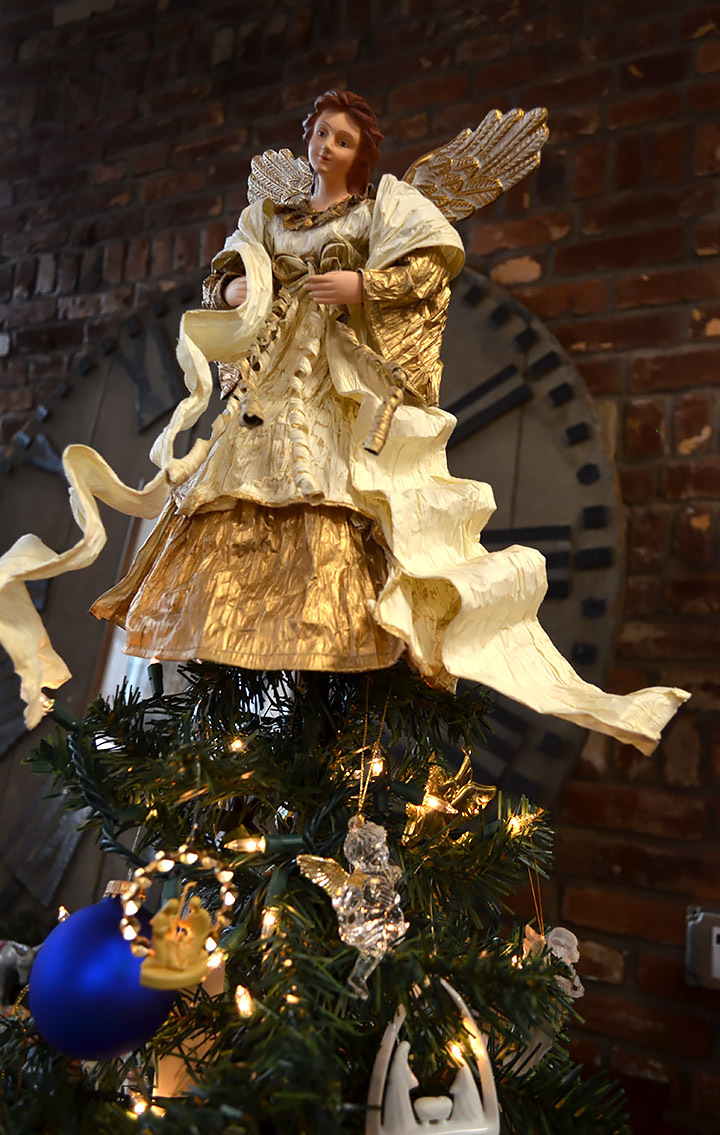
A Multitude of Angels
A Multitude of Angels: created and designed by
LaVerne Wachter and
Mary Kiehne, from Mary’s personal angel collection.
Click on any image to make it larger, then use your arrow keys to move around.
White Feather Tree
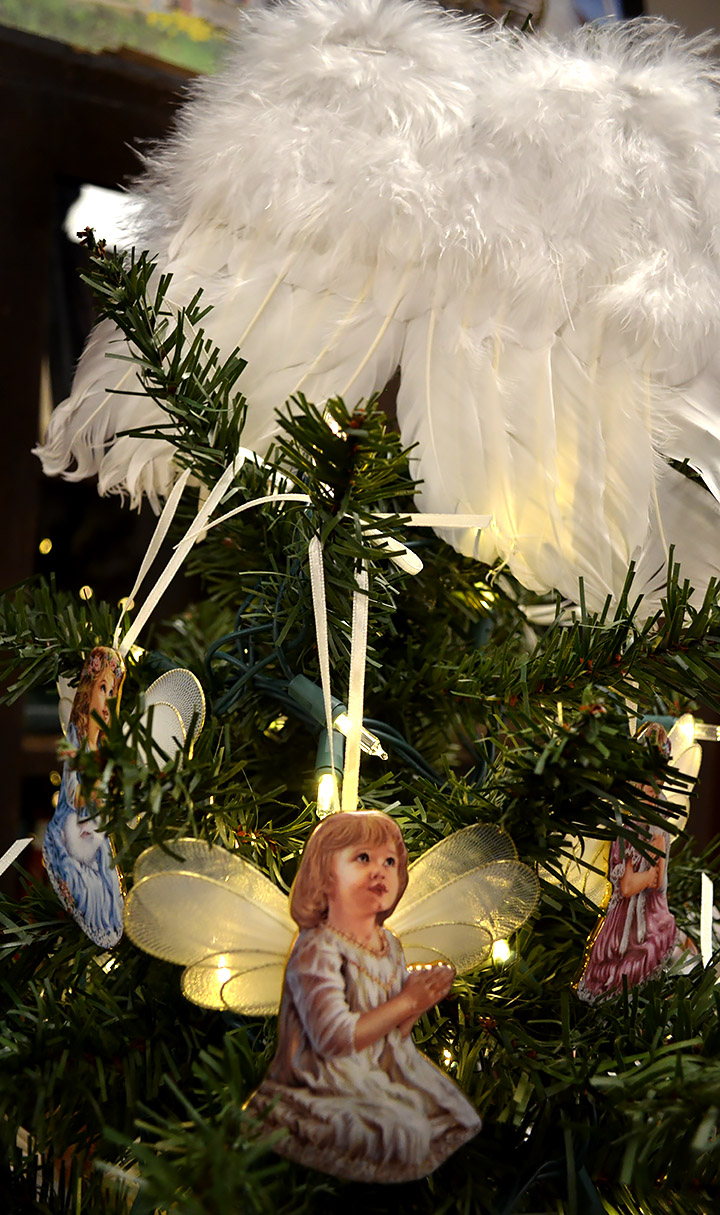
The next angel tree is full of winged child-like angels from the Bradford Collection. The angels were a gift from the Dr. Deborah Price and Kenneth White Collection.
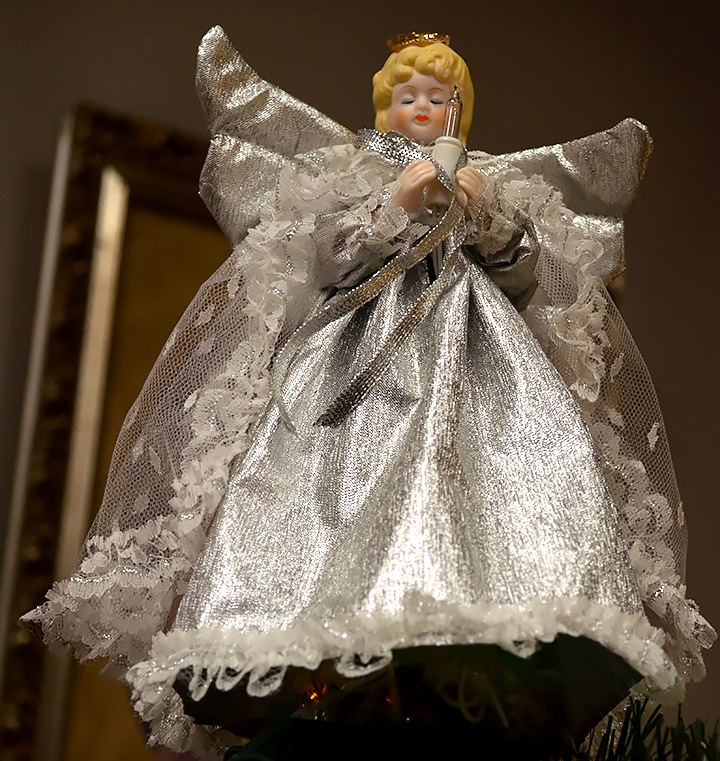
Lace Angels
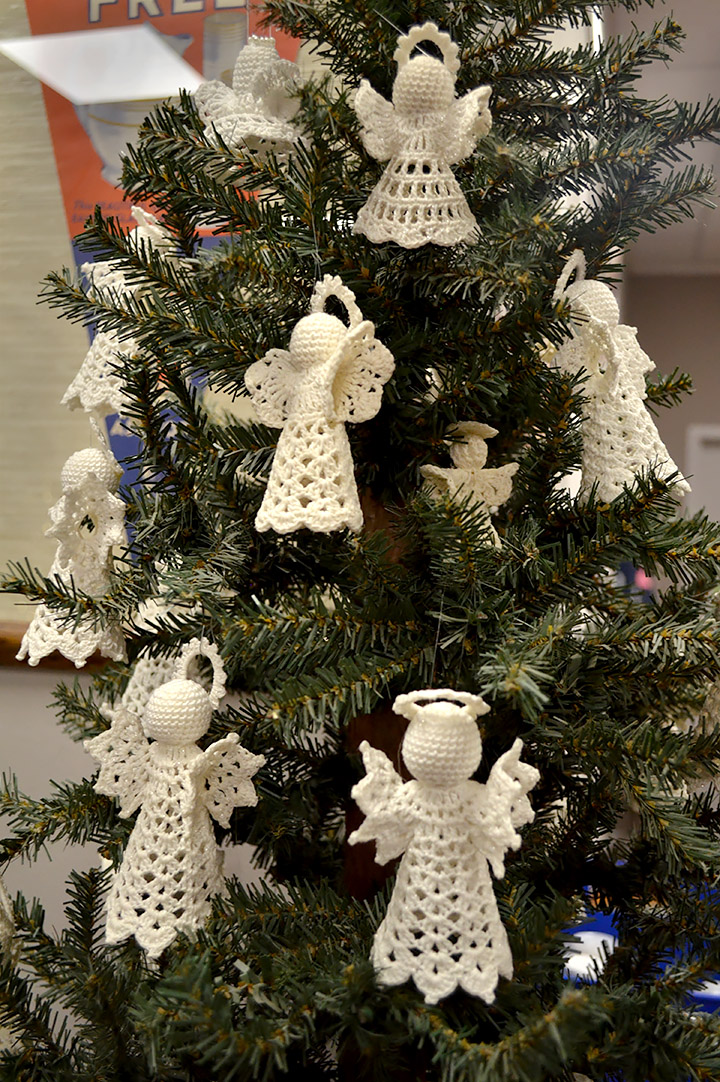
A small tree on the coffee bar has lace angels created by Juanita M. Criddle Niswonger. A beautiful host of angels fly above an artist, Lori Mitchell Nativity.
The Shepherd and Lamb Tree
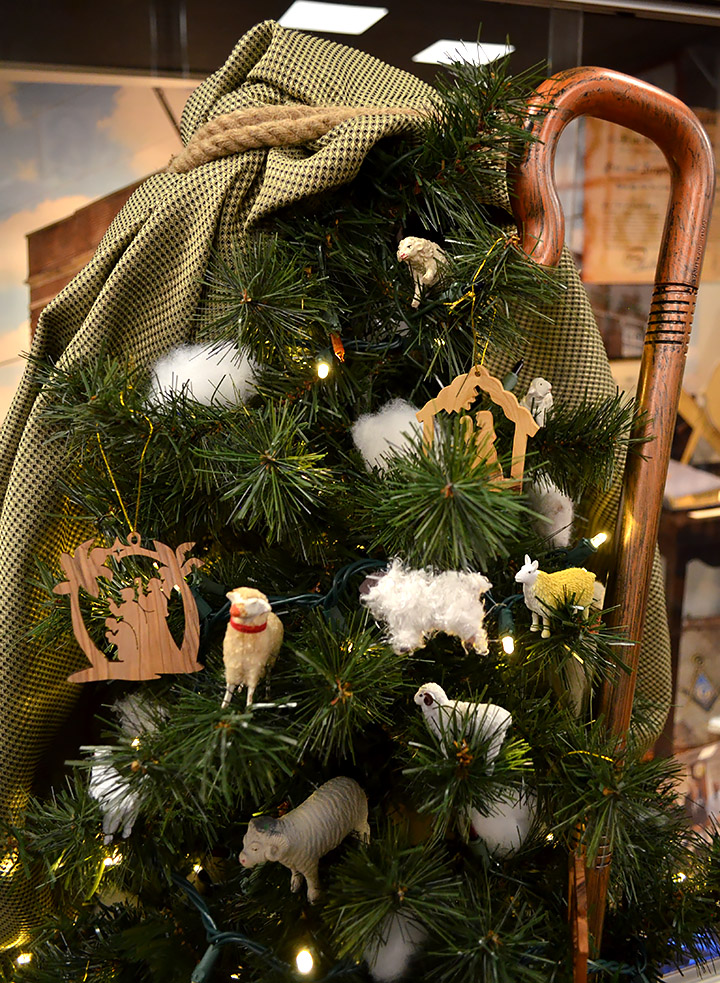
The Shepherd and Lamb Tree: created from a group effort of love.
Oxen Tree
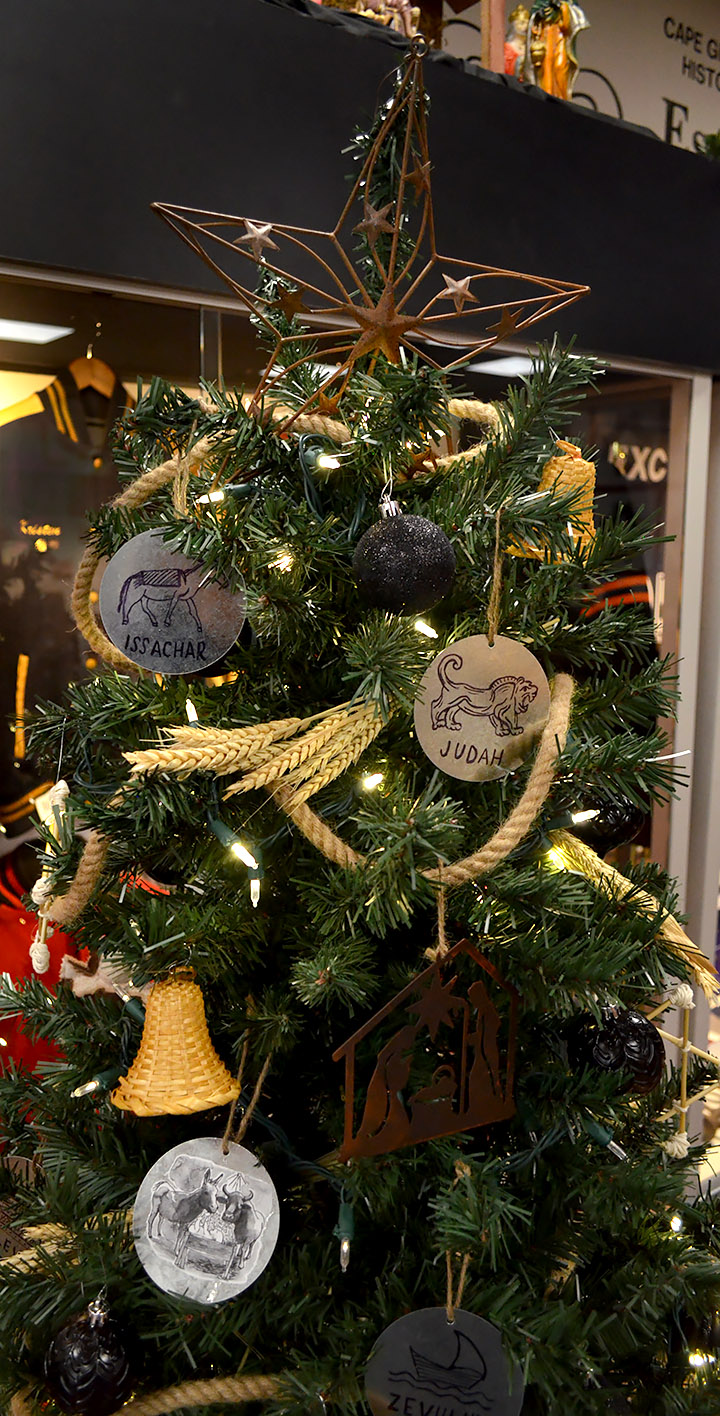
Oxen Tree: this unique tree designed and created by Jo Nell Cougill, acknowledges the oxen that is always present near Jesus in traditional Nativity scenes. Oxen are symbols of the 12 tribes of Israel, representing strength and power. Note the other symbols represented on the tree. The oxen yoke is a gift from the Robert and Yvonne Keathley Collection.
Happy Birthday, Jesus
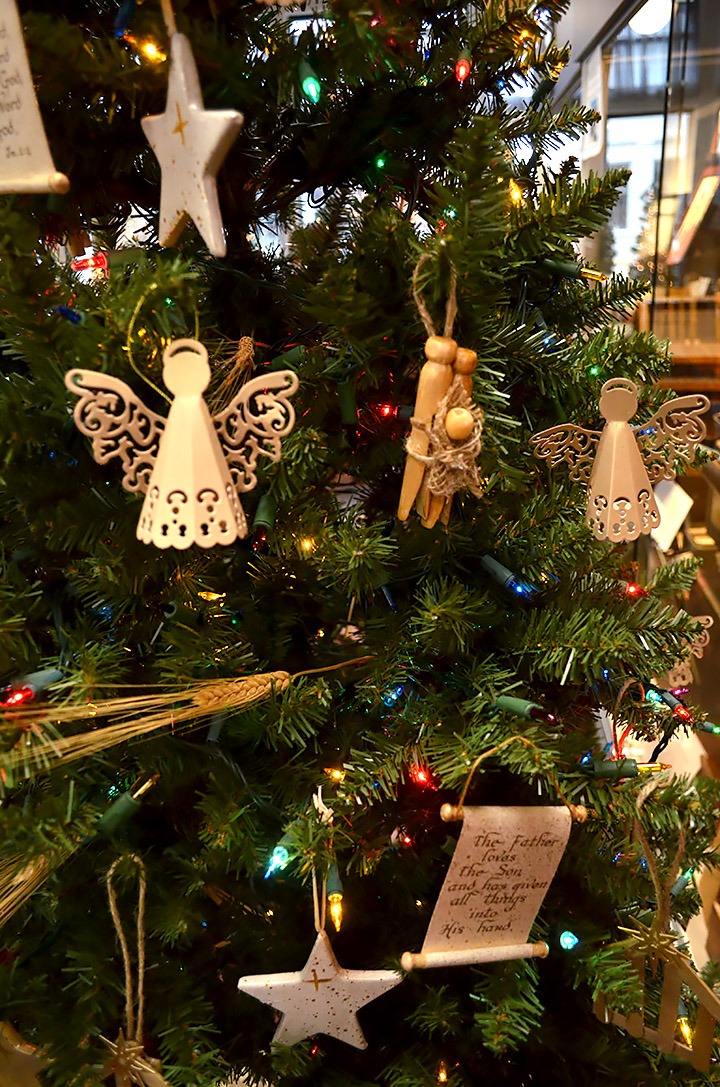
The Happy Birthday, Jesus tree by the PEO organization, Chapter DJ. Note that the items on this tree are handmade by the members. This tree has grown each year and has become a traditional feature in the exhibit.
Oh, Holy Night
Oh, Holy Night tree. The Nativity ornaments on this tree are a part of the 50+ year collection of docent,
Carolyn Taylor.
A special thanks to Abbey Road Christian Church for the use of their Creche for the Oh, Holy Night exhibit.
The Giving Tree
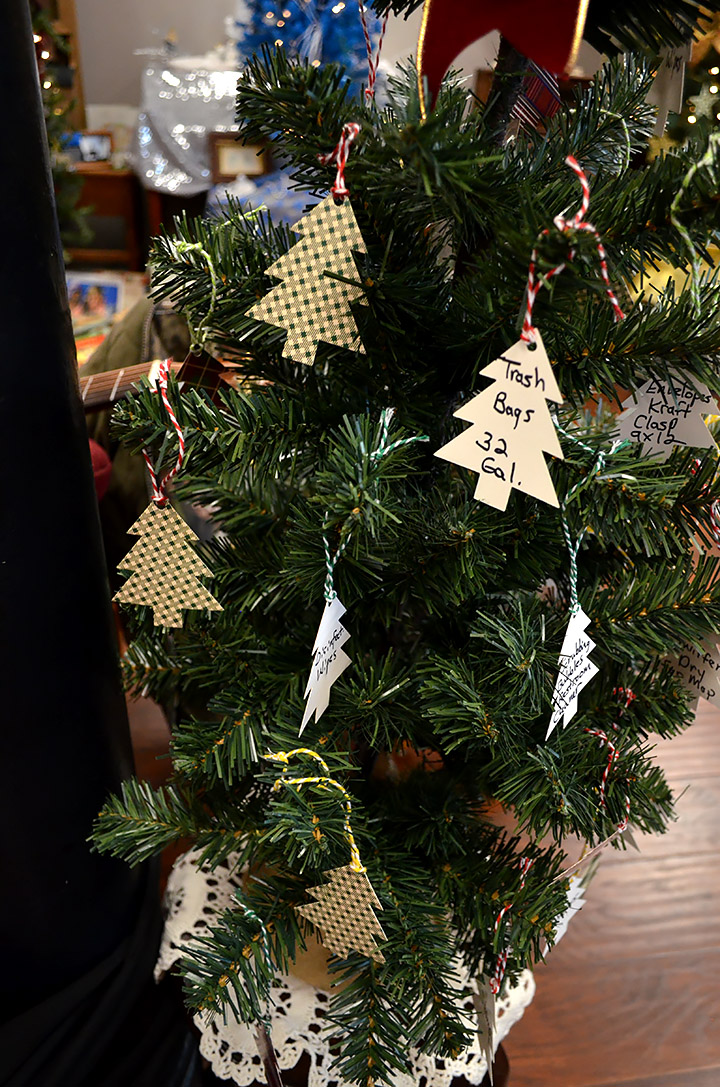
This little tree has tags on it to be taken home to remind you to contribute things that we need to run the History Center and Research Center, copy paper, cleaning supplies and office materials.